
12/03/1999 • 7 views
NASA Confirms Loss of Mars Climate Orbiter After Dec. 3, 1999, Maneuver
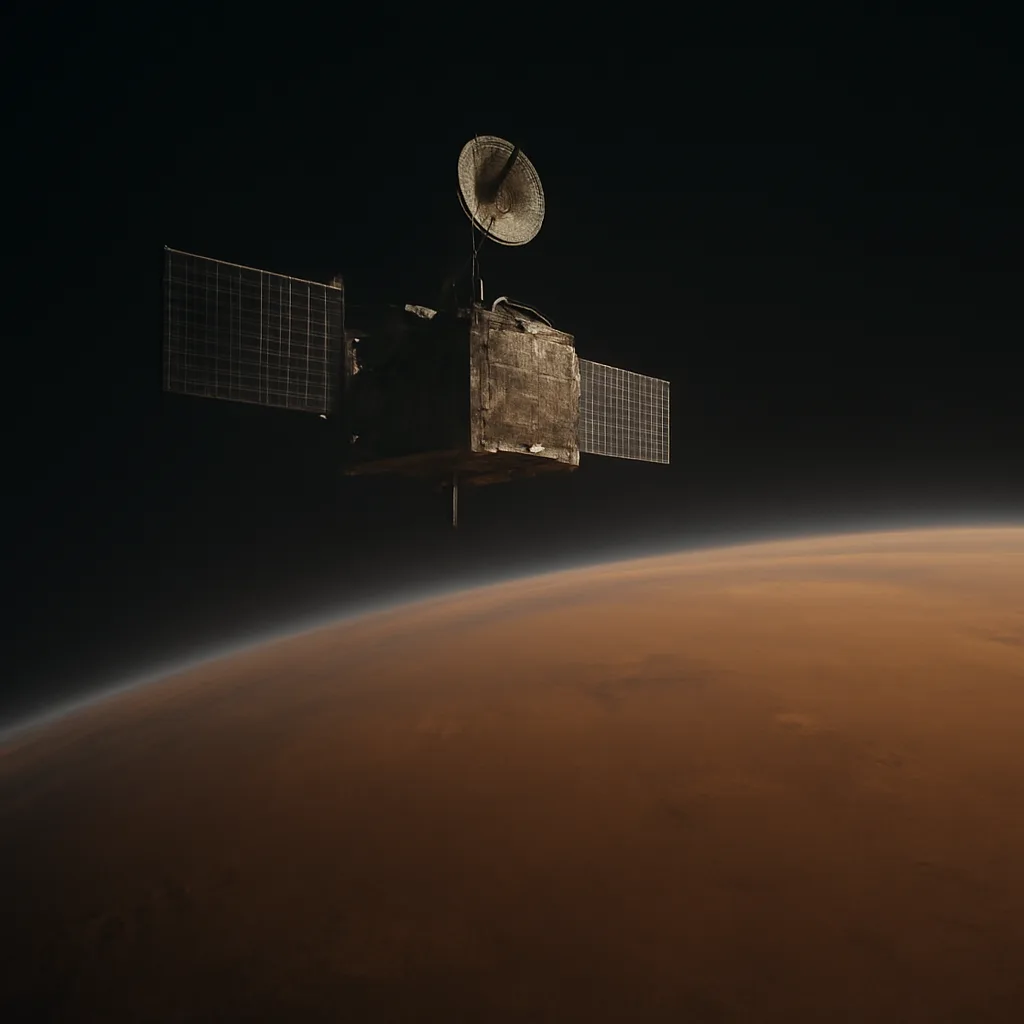
On Dec. 3, 1999, NASA announced that the Mars Climate Orbiter was lost during orbital insertion around Mars after a course-correction maneuver; subsequent investigations pointed to a navigation error stemming from a metric–imperial units mismatch.
Mission profile and final approach
Mars Climate Orbiter arrived at Mars for orbital insertion in late September 1999, with a series of course-correction maneuvers intended to place it into a science orbit. On approach, mission teams executed planned burns to adjust trajectory and enter orbit. Shortly after the insertion window, contact with the spacecraft was lost and telemetry ceased. Ground teams were unable to reestablish communications, and later analysis concluded the spacecraft most likely entered the Martian atmosphere at a lower altitude than intended and was destroyed.
Investigation and primary cause
A joint investigation board convened by NASA examined telemetry, engineering data and flight software. The board determined that the primary cause was a failure to convert units between two collaborating teams’ software systems: one system provided forces in pound-force seconds (imperial units) while another system expected newton-seconds (SI units). Because of this mismatch, the navigation software computed incorrect thrust effects, producing trajectory errors that were not properly corrected during final approach.
The investigation highlighted how this seemingly small systems-integration error propagated through automated navigation calculations and was not caught by available verification checks. The board also identified lapses in systems engineering practices, inadequately rigorous interfaces between teams, and insufficient end-to-end testing that would have exposed the unit inconsistency before launch or during cruise-phase rehearsals.
Consequences and lessons
The loss of MCO—estimated by NASA to have cost around $327.6 million including spacecraft and launch—led to changes in NASA project management and engineering oversight. NASA revised its verification and validation protocols, reinforced standards for units and interfaces in software systems, and emphasized independent cross-checks and reviews for critical mission functions. The agency also restructured aspects of its Mars program management to improve accountability and systems integration across contractors and NASA centers.
Scientific and programmatic impact
Mars Climate Orbiter had been designed to study Martian weather, atmosphere structure and climate variability, and to act as a relay for future landers. Its loss delayed some planned atmospheric science and communications capabilities for subsequent missions, increasing reliance on other assets and requiring adjustments to mission timelines. However, the lessons learned from MCO’s failure contributed to improvements that benefited later Mars missions, including more stringent systems engineering practices and enhanced testing procedures.
Historical context
The MCO failure occurred in a period when spacecraft systems were increasingly complex and reliant on multinational and multi-contractor software and hardware interfaces. The incident became a widely cited case study in aerospace engineering and project management, illustrating how human and procedural factors—such as unit standardization, interface definitions and verification rigor—can have mission-ending consequences.
Uncertainties and clear facts
The central technical finding—the units conversion error between teams’ software—was supported by the investigation board’s published conclusions and is broadly accepted in historical accounts. Some programmatic and managerial details, including precise internal communications and the extent of specific contractors’ responsibilities, have nuances that were debated during reviews, but the core sequence of events and lessons are well documented.