
← Back
11/13/2009 • 5 views

NASA Confirms Water Ice Deposits on the Moon
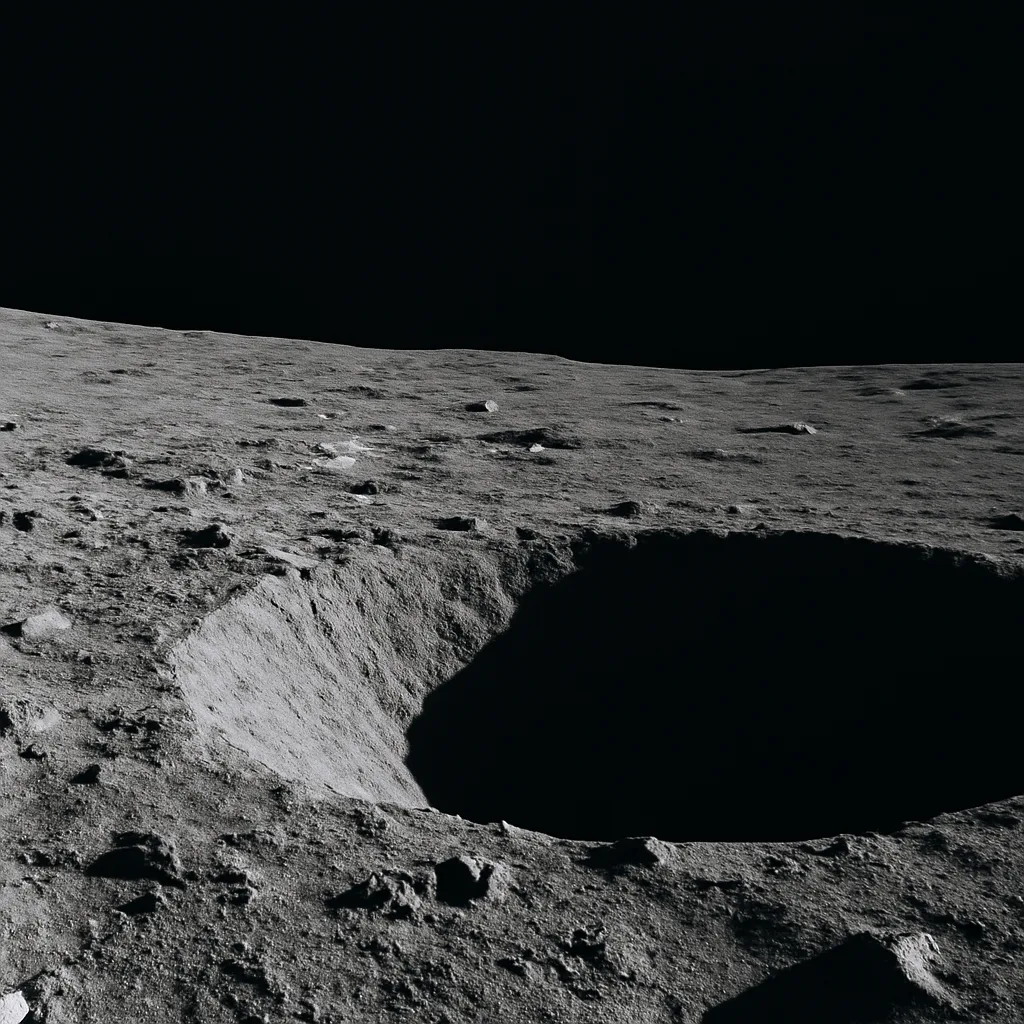
View of the Moon’s south polar region showing a steep, shadowed crater rim and sunlit lunar terrain nearby, illustrating permanently shadowed areas where water ice was detected.

On November 13, 2009, NASA announced that data from multiple missions confirmed the presence of water ice in permanently shadowed lunar craters, strengthening evidence that the Moon holds accessible water resources in its polar regions.


On November 13, 2009, NASA publicly confirmed that multiple spacecraft had detected water ice in permanently shadowed regions near the Moon’s poles. The announcement synthesized results from several missions and instruments, notably data from NASA’s Lunar Reconnaissance Orbiter (LRO) and Lunar Crater Observation and Sensing Satellite (LCROSS), along with earlier remote-sensing observations. While the LCROSS impact and LRO observations came slightly later (LCROSS impacted in 2009 and LRO arrived the same year), the 2009 statement reflected a growing consensus that water exists in cold-trap regions on the lunar surface.

What was found
- Permanently shadowed craters near the lunar poles were identified as cold traps where temperatures remain extremely low, allowing water molecules to accumulate and persist as ice. Remote-sensing instruments detected signatures consistent with hydrogen and water-bearing materials in these regions.
- LCROSS, which intentionally impacted the Cabeus crater in October 2009, produced a plume whose spectroscopic analysis detected water vapor and ice grains among other volatiles. LRO’s instruments, including its neutron detector and imaging systems, provided complementary evidence of hydrogen-rich deposits and the geological context for cold traps.

Why it mattered
- The presence of water ice on the Moon had major implications for science and exploration. For scientists, lunar ice offered insights into volatile delivery and retention in the inner solar system and the Moon’s geologic and climatic history. For exploration planners, ice in polar shadowed regions suggested potential in-situ resources for future human and robotic missions—water for life support, radiation shielding, and conversion into oxygen and rocket propellant.

Scientific context and limitations
- Findings were based on remote sensing and impact plume analysis rather than large-scale ground surveys. Instruments inferred water and hydrogen presence through spectral signatures, neutron flux suppression, and analysis of ejected materials; such methods indicate likely ice but do not quantify exact volumes or distribution at high spatial resolution.
- The ice appears concentrated in permanently shadowed areas where sunlight never reaches, making direct access and use technologically challenging. The physical state of the water—whether as clean slabs of ice, mixed with regolith, or as thin coatings—varied by location and remained an active area of study.

Broader timeline and follow-up
- The 2009 confirmation built on earlier hints from missions such as Clementine (1994) and Lunar Prospector (1998), which detected signals suggestive of hydrogen at the poles. The combined LCROSS and LRO-era findings provided more direct and higher-resolution evidence.
- After 2009, subsequent missions and observations have continued to refine understanding of lunar volatiles, mapping distribution and estimating concentrations. Ongoing and future missions have aimed to characterize accessibility, geometry, and purity of ice deposits to assess their usability for exploration.

Uncertainties and contested points
- While the presence of water ice in polar cold traps became widely accepted after 2009, there remained scientific debate over the total inventory, precise physical state, and ease of extraction. Estimates of quantity and purity varied between studies, and large-scale in situ verification remained necessary to resolve these questions.

In summary, the November 13, 2009, NASA announcement marked a turning point in lunar science by consolidating evidence that water ice exists in the Moon’s permanently shadowed polar craters. The finding reshaped scientific models of lunar volatiles and influenced planning for future robotic and human exploration, while leaving important questions about distribution and accessibility for further missions to answer.

Share this

Email Share on X Facebook Reddit

Did this surprise you?