
← Back
11/21/1993 • 5 views

NASA Loses Contact with Mars Observer Spacecraft
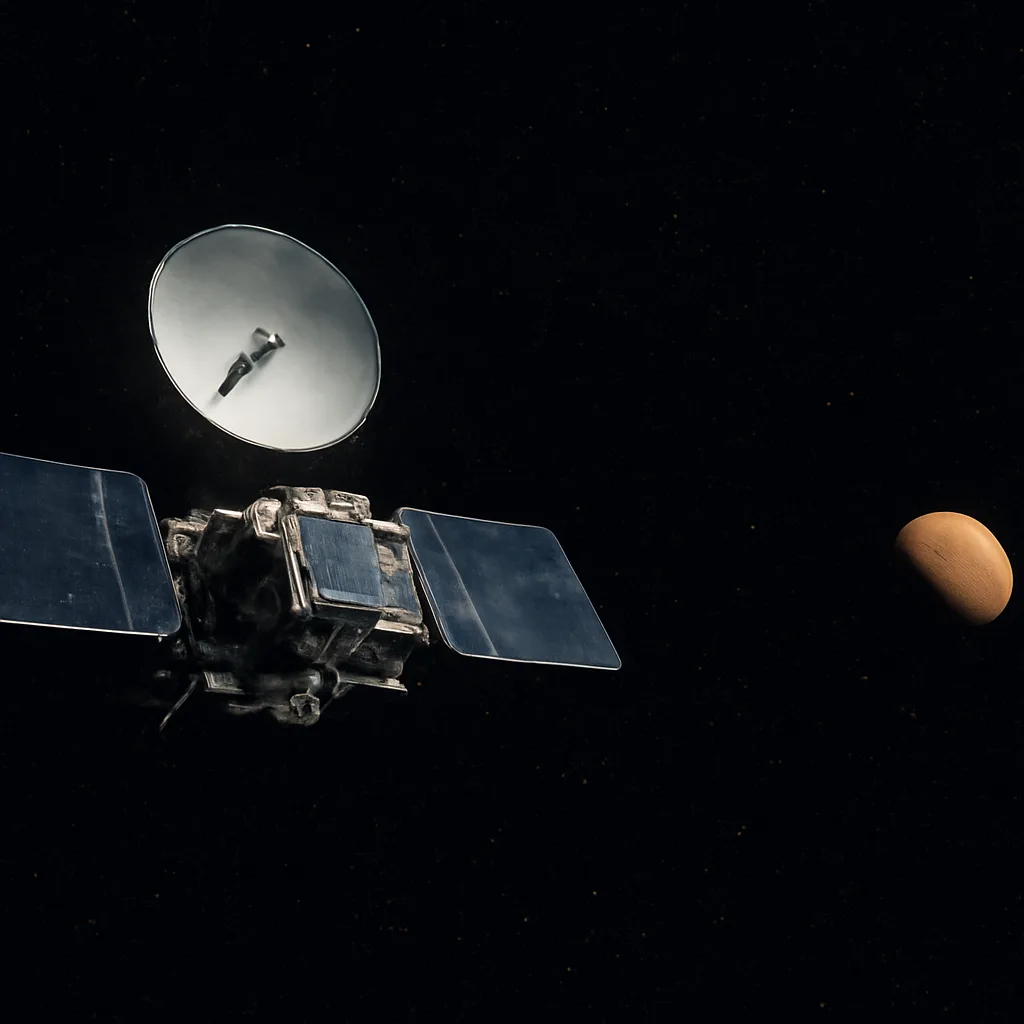
Artist-style depiction of the Mars Observer spacecraft in deep space against a star field with a distant view of Mars; spacecraft components such as a large dish antenna and solar arrays are visible.

On November 21, 1993, NASA lost communications with the Mars Observer spacecraft just days before its scheduled orbit insertion at Mars. Attempts to reestablish contact continued for months but the spacecraft was never recovered.


Background
The Mars Observer was launched by NASA on September 25, 1992, as the United States' first post-Viking mission to Mars. It carried instruments to study the planet's surface, atmosphere and magnetic field, and was intended to enter a polar orbit in late August 1993 (later rescheduled to late November) to begin a planned one-year science mission.

Loss of contact
On November 21, 1993, while the spacecraft was about 2.5 million kilometers from Earth and preparing for a planned Mars orbital insertion (MOI) more than a month later, NASA's Jet Propulsion Laboratory (JPL) recorded the loss of telemetry from Mars Observer. The last telemetry indicated nominal spacecraft operations. Initial attempts to reestablish communications by sending commands and listening for a response produced no contact.

Immediate response and search effort
NASA and JPL conducted an intensive search and recovery effort. Ground stations were tasked with repeated attempts to downlink telemetry and uplink commands, and engineers examined all available pre-loss data and the spacecraft's flight history to identify possible causes. The search included trying different transmission frequencies, sending reset commands, and programming receivers to scan for any weak signals.

Investigations and likely causes
Because the spacecraft was never recovered, investigators relied on telemetry recorded before loss and on analysis of the spacecraft's design and recent activities to assess probable causes. Early hypotheses considered a computer reset, a power system failure, or a propulsion system leak. A leading scenario proposed that a rupture in a hydrazine fuel line or an errant propulsion system event during a routine maneuver could have resulted in a catastrophic breakup or damage to the spacecraft's communications systems. Another possibility was an electrical short, perhaps related to thermal stresses during cruise.

Official outcomes
No definitive cause was established because contact could not be reestablished and no telemetry was available after the outage. NASA formally concluded the spacecraft was lost and closed the recovery effort in the months that followed. The loss prompted internal reviews and influenced design and operational practices on subsequent Mars missions, including increased attention to propulsion system isolation, fault protection, and communications redundancy.

Impact and legacy
The failure of Mars Observer marked a significant setback for NASA's Mars exploration program at the time, delaying planned science and data returns. It also contributed to organizational and technical lessons that informed later missions, such as Mars Global Surveyor (launched in 1996) and the Mars Pathfinder program. Those missions incorporated improved systems engineering, testing protocols, and mission assurance practices aimed at reducing the risk of similar losses.

Contextual note
Some operational details and diagnostic assessments remain technical and partially speculative because the primary evidence—post-loss telemetry—was never obtained. Where exact mechanisms could not be established, investigators presented probable scenarios based on available data and engineering analysis.

Conclusion
The loss of Mars Observer on November 21, 1993, remains an unresolved chapter in planetary exploration: a mission that reached interplanetary space and communicated nominally until sudden loss of contact, after which it could not be recovered. Its legacy is reflected in procedural and design changes implemented on later Mars missions to improve resilience and fault tolerance.

Share this

Email Share on X Facebook Reddit

Did this surprise you?