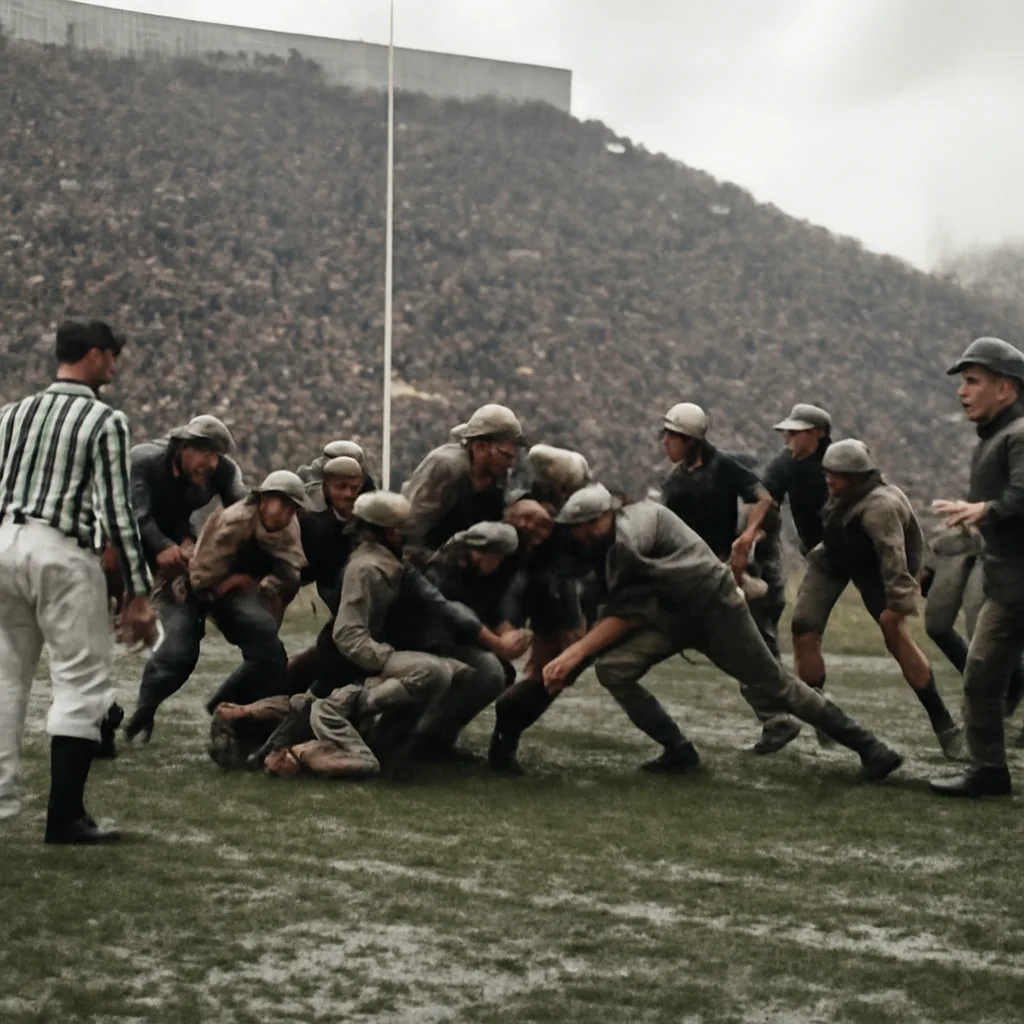
Player Scores Unintended Touchdown for Opponents in 1965 Championship
In a rare and confusing moment during the January 3, 1965 championship game, a player inadvertently carried the ball into his own team's end zone, resulting in a touchdown awarded to the opposing side. The incident became an infamous play in that season’s title match.
On January 3, 1965, a championship football game was marked by an unusual and decisive play: a player running the ball into his own team’s end zone, producing a score for the opponents. Contemporary reports and later accounts describe the moment as a mix of traffic, miscommunication and the chaotic flow typical of high-stakes football, though specific details vary among sources.
The play occurred in the second half with both teams contending for field position in wet, heavy conditions that made footing and ball handling more difficult than usual. After a broken or misexecuted play—accounts differ on whether it began as a designed run, a botched handoff, or a scramble following a quarterback pressure—the ball carrier found himself boxed in near his own goal line. In attempting to evade tacklers and find open space, he turned and ran toward the area he believed offered the best chance to advance. Instead, he crossed into his own end zone.
Officials ruled the result a touchdown for the opposing team rather than a safety or a play nullified by a penalty. This ruling reflected the rules and situational interpretation applied in that game: once the ball carrier, in possession and driving the ball, entered his own end zone and the opposing team had gained control of the play’s momentum in that zone, the referee awarded the score accordingly. Some contemporary newspaper accounts questioned the interpretation, and later summaries note that officiating standards and replay capabilities of the era limited postgame clarification.
Eyewitness reports at the time emphasized the confusion on the field—teammates and coaches briefly protested, and radio broadcasters attempted to parse the ruling for listeners in real time. Photographic and film evidence from the game is limited and sometimes ambiguous, contributing to varying retellings of the moment. Authors and historians who have covered the season cite the play as an example of how quickly possession and scoring opportunities can reverse in goal-line situations, and as a reminder of the narrower margins for error before the introduction of modern review technologies.
In the aftermath, the play influenced discussions about situational awareness and coaching emphasis on clearing the ball away from danger near one’s own end zone. It also featured in season summaries and retrospective pieces about that championship game as one of the more memorable and instructive incidents. While not every contemporary source framed the moment identically—some called it a blunder, others a hard-luck miscue—the consensus accepts that the scoring event stood as called and had an impact on the final outcome or momentum of the match.
Because records, film and detailed play-by-play from the era are not as comprehensive as modern archives, some specifics remain disputed: the exact sequence of player movements, the identities attributed in some reports, and the rationale cited by individual officials immediately after the ruling. Historians and reporters who revisit the game caution against definitive reconstruction of intent or motive, instead presenting the play as an illustrative, if imperfectly documented, episode from mid-1960s championship football.
The incident remains part of the lore surrounding that season’s title game: an uncommon scoring play, debated in detail by those who saw or studied it, and a historical footnote underscoring how interpretation, conditions and the limits of contemporary coverage shaped how moments on the field were recorded and remembered.