
← Back
07/24/2013 • 5 views

Deadly Train Derailment Near Santiago de Compostela Kills Dozens
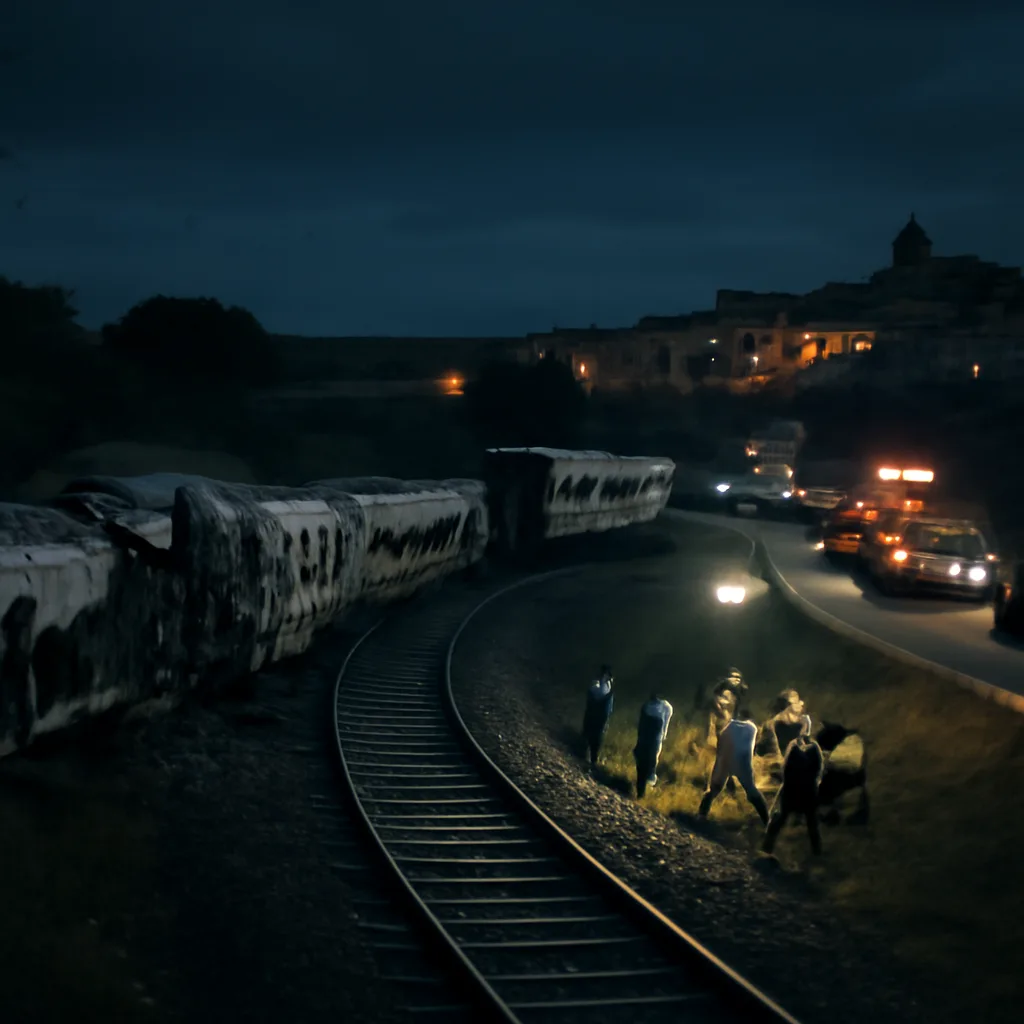
Derailment site near Angrois, Santiago de Compostela: twisted passenger train carriages on a curved section of track beside a rural embankment, emergency vehicles and responders at the scene during night operations.

On July 24, 2013, a high-speed passenger train derailed near Santiago de Compostela in Galicia, Spain, killing 79 people and injuring over 140. The accident prompted national mourning and an investigation into speed and signaling practices on the line.


On the evening of July 24, 2013, a high-speed Alvia passenger train traveling from Madrid to Ferrol derailed on a curve near the station of Angrois, close to Santiago de Compostela in Galicia, northwestern Spain. The train was carrying pilgrims and holiday travelers. Seventy-nine people were killed and more than 140 were injured, making it one of the deadliest railway accidents in Spain’s recent history.

The train involved was a RENFE Alvia service that had traveled on high-speed tracks for part of its journey before switching to conventional lines approaching Santiago. The derailment occurred on a sharp curve with a permanent speed limit significantly lower than the train’s operating speed on straight high-speed sections. The official investigation by Spain’s Civil Ministry and subsequent judicial inquiries focused on the train’s speed as a primary factor. Data recovered from the train’s event recorder showed the train was traveling far above the curve’s speed limit at the moment of derailment.

Investigators examined multiple potential contributing factors, including human error, signaling systems, track geometry, and the adequacy of warning systems for speed reduction. Media and public scrutiny centered on whether the train driver had sufficient warning and time to slow the train and whether automatic speed control systems could have prevented the crash. Spain’s rail system included the European Train Control System (ETCS) on some high-speed lines, but not uniformly across all conventional stretches; questions were raised about the transition between systems and the presence of automatic braking systems on the route.

The derailment prompted immediate rescue operations involving local emergency services, national police, and volunteers. Survivors and rescuers described chaotic scenes as twisted carriages trapped passengers, and emergency responders worked through the night to free victims. Hospitals in Santiago de Compostela and the surrounding region treated the injured, and the Spanish government declared a period of national mourning.

In the months and years after the accident, technical reports and judicial processes produced detailed analyses and contested interpretations. Official technical reports emphasized excessive speed on the curve as the immediate cause. Judicial investigations led to charges and legal proceedings examining responsibility, including scrutiny of infrastructure managers and train operators. In 2019, a Spanish court acquitted some defendants while convicting the driver of manslaughter; that conviction was later overturned on appeal in 2020, underscoring ongoing legal complexity and debate over culpability and systemic failures.

Beyond legal outcomes, the derailment spurred policy discussions about safety upgrades, the deployment of automatic braking and speed supervision systems, and improvements in the management of transitions between high-speed and conventional lines. Rail safety advocates and some investigators argued for faster and broader implementation of automatic train protection systems to reduce reliance on human response in speed-critical situations.

The 2013 Santiago de Compostela derailment left a lasting impact on Spain’s public memory. Annual commemorations and memorials have honored the victims, while survivors, families, and advocacy groups have sought clearer answers and stronger safety measures. The accident remains a focal point in debates over rail safety technology, infrastructure investment, and accountability in modern rail networks.

Sources: reporting and official investigative summaries from Spanish authorities, contemporary news coverage, and subsequent court rulings. Where interpretations differ among technical reports, judicial findings, and commentary, this account notes the primary facts (date, location, casualties, and excessive speed at the curve) and the existence of contested legal outcomes.

Share this

Email Share on X Facebook Reddit

Did this surprise you?