
← Back
07/24/1969 • 5 views

Apollo 11 Crew Splash Down Safely in Pacific, Ending Historic Moon Mission
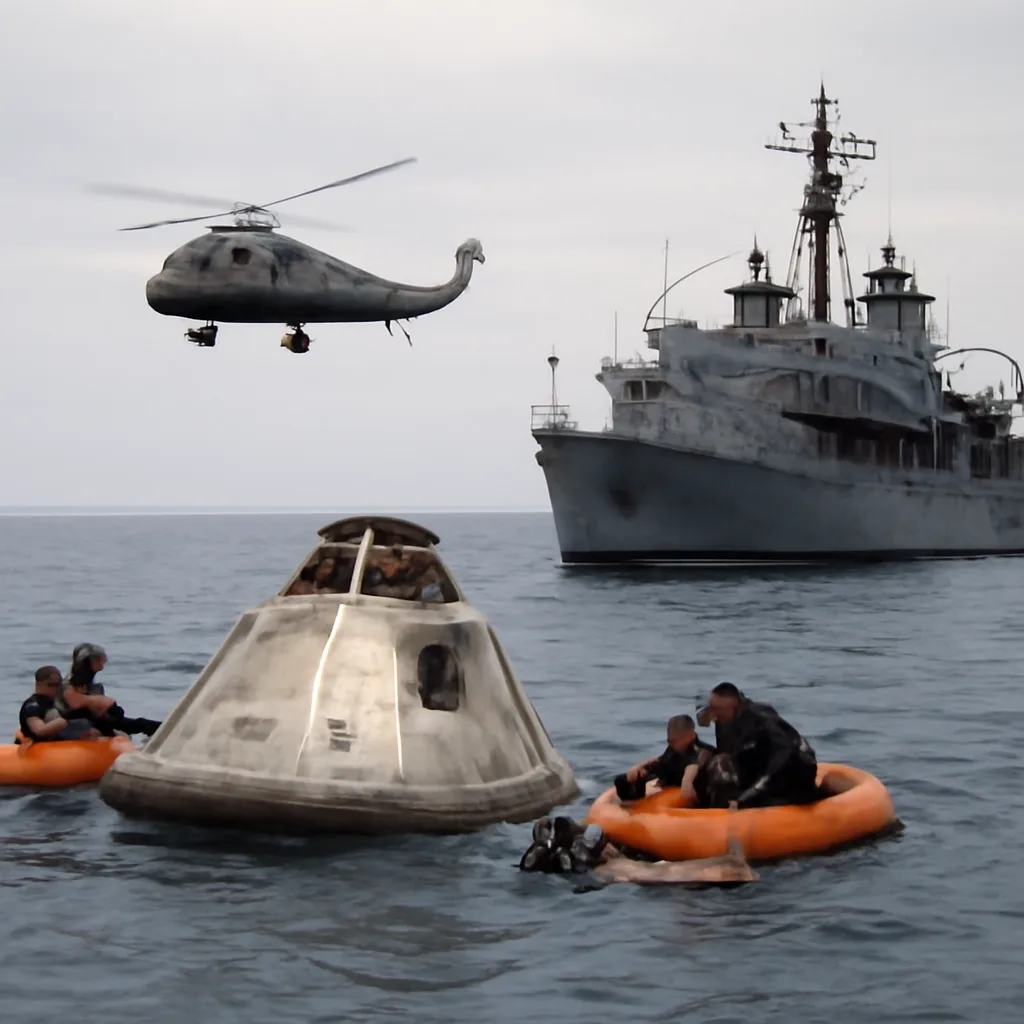
Apollo 11 command module floating in the Pacific with Navy personnel and recovery equipment nearby; open ocean and recovery ship visible.

On July 24, 1969, Apollo 11’s command module Columbia splashed down in the Pacific Ocean and was recovered, bringing Neil Armstrong, Buzz Aldrin and Michael Collins safely home after humanity’s first moon landing.


On July 24, 1969, the Apollo 11 mission concluded when the command module Columbia splashed down in the Pacific Ocean and its three astronauts were recovered by U.S. Navy forces. The mission had achieved the first crewed lunar landing four days earlier when Neil Armstrong and Buzz Aldrin descended to the lunar surface in the lunar module Eagle while Michael Collins remained in lunar orbit aboard Columbia. After completing surface operations and departure from lunar orbit, the crew began the return trajectory to Earth, performing a series of midcourse corrections and spacecraft procedures required for reentry.

The command module reentered Earth’s atmosphere under the protection of its heat shield, enduring temperatures that peaked during atmospheric friction. Parachutes deployed to slow the module’s descent, culminating in a splashdown in the central Pacific Ocean at 16:50 UTC (local date July 24, 1969). Recovery forces from the U.S. Navy, including the aircraft carrier USS Hornet and accompanying helicopters, located and secured the command module. Divers attached flotation collars and the crew transferred to a recovery helicopter and then to the carrier. All three astronauts were reported in good condition.

To protect against potential lunar contaminants, the astronauts entered a Mobile Quarantine Facility (MQF) aboard the Hornet shortly after recovery. The MQF allowed medical personnel to monitor the crew and collect biological samples while minimizing possible exposure to Earth. The quarantine procedure was a precautionary measure based on limited understanding of lunar material at the time and was part of NASA’s planetary protection protocols.

Public and governmental reaction was immediate and widespread. Worldwide audiences had followed the lunar landing and the return through live television and news reports. The successful splashdown and recovery closed the primary objective of the Apollo 11 mission: to demonstrate that humans could travel to the Moon and return safely to Earth. Subsequent analyses and debriefings by NASA teams assessed vehicle performance, crew health, and scientific results, informing later Apollo missions.

Historically, Apollo 11’s safe return stands as a pivotal moment in space exploration, marking the completion of the first human lunar expedition and initiating a period of intense interest in space science, technology, and the geopolitics of the Space Race. The recovered lunar samples, telemetry data, and crew reports contributed to scientific understanding of the Moon and to improvements in spacecraft design and mission procedures for future flights.

Note on sources and accuracy: This summary is based on contemporaneous mission records and widely documented historical accounts of Apollo 11’s timeline and recovery operations. Specific times and operational details are drawn from NASA mission reports and public archives from 1969.

Share this

Email Share on X Facebook Reddit

Did this surprise you?