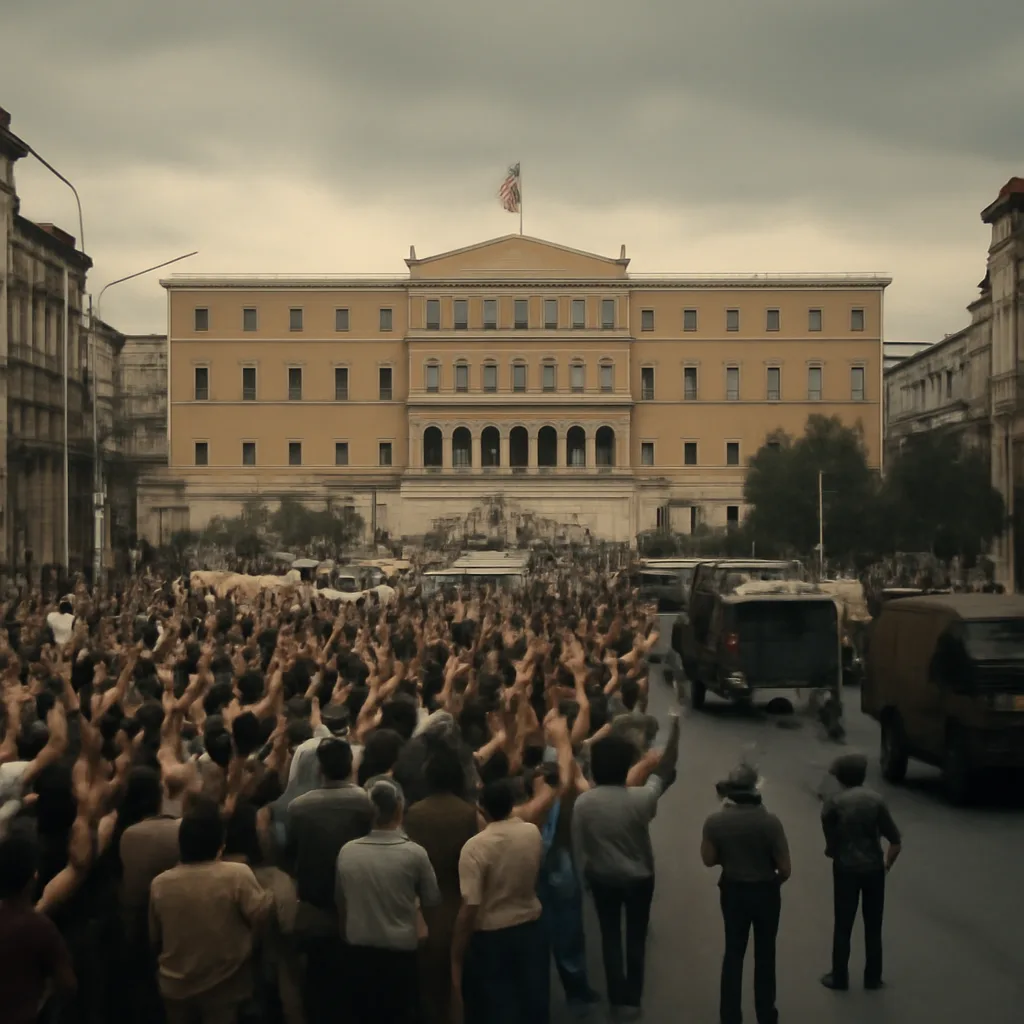
Greek military junta collapses after mass uprising, July 24, 1974
On July 24, 1974, mounting public protests, political isolation, and the crisis over Cyprus precipitated the fall of Greece’s seven-year military junta, paving the way for restoration of civilian rule and the eventual return of former prime minister Constantine Karamanlis.
By late July 1974 Greece’s ruling military junta, which had governed since a coup in April 1967, faced a crisis that combined popular unrest, international pressure, and a geopolitical shock over Cyprus. On July 15, 1974, a coup in Nicosia backed by the Greek junta sought to oust Cypriot leader Archbishop Makarios. That intervention triggered a Turkish invasion of Cyprus on July 20. The rapid escalation exposed the junta’s miscalculation and left its leaders discredited at home and abroad.
In the week that followed, mounting public anger in Greece coalesced with fractures within the security services and the armed forces. Urban demonstrations, strikes and expressions of dissent in Athens and other cities signaled broad social rejection of the regime after seven years of authoritarian rule, censorship and repression. The junta’s inability to manage the Cyprus crisis intensified perceptions of incompetence and illegitimacy.
Faced with loss of control and unwilling to provoke wider civil conflict, the ruling colonels resigned on July 24, 1974. A government of national unity was formed and Constantine Karamanlis, an experienced statesman who had been living in exile in Paris since the 1967 coup, was invited back to lead a transition to civilian government. Karamanlis returned to Athens on July 24 and became prime minister-designate, initiating steps to restore democratic institutions, lift emergency measures and call for elections.
The junta’s collapse did not produce an immediate return to stable democracy; rather, the transition unfolded amid continuing tensions, legal reckonings and debates about accountability. The new government moved to legalize political parties, release political prisoners, and organize elections—measures that culminated in parliamentary elections in November 1974 and a referendum in December that abolished the monarchy.
Internationally, the events around Cyprus reshaped regional security dynamics and deepened Greek-Turkish animosity. The Turkish occupation of northern Cyprus created a lasting division that remains unresolved. Domestically, the fall of the junta opened a period of political renewal known as the Metapolitefsi, during which Greece reestablished democratic norms, revised its constitution, and sought reconciliation and justice for victims of the dictatorship.
Historical assessments emphasize both the agency of mass mobilization and the decisive role of the Cyprus crisis in precipitating the junta’s end. While public uprisings and strikes demonstrated popular rejection of military rule, the immediate catalyst was the regime’s foreign policy blunder and subsequent loss of confidence among its own supporters. The transition overseen by Karamanlis set Greece on a path back to parliamentary democracy, though the legacy of the junta—legal, social and geopolitical—remained a subject of contestation in the years that followed.