
← Back
01/02/1666 • 6 views

Reassessment Raises Death Toll for the Great Plague of 1665–66
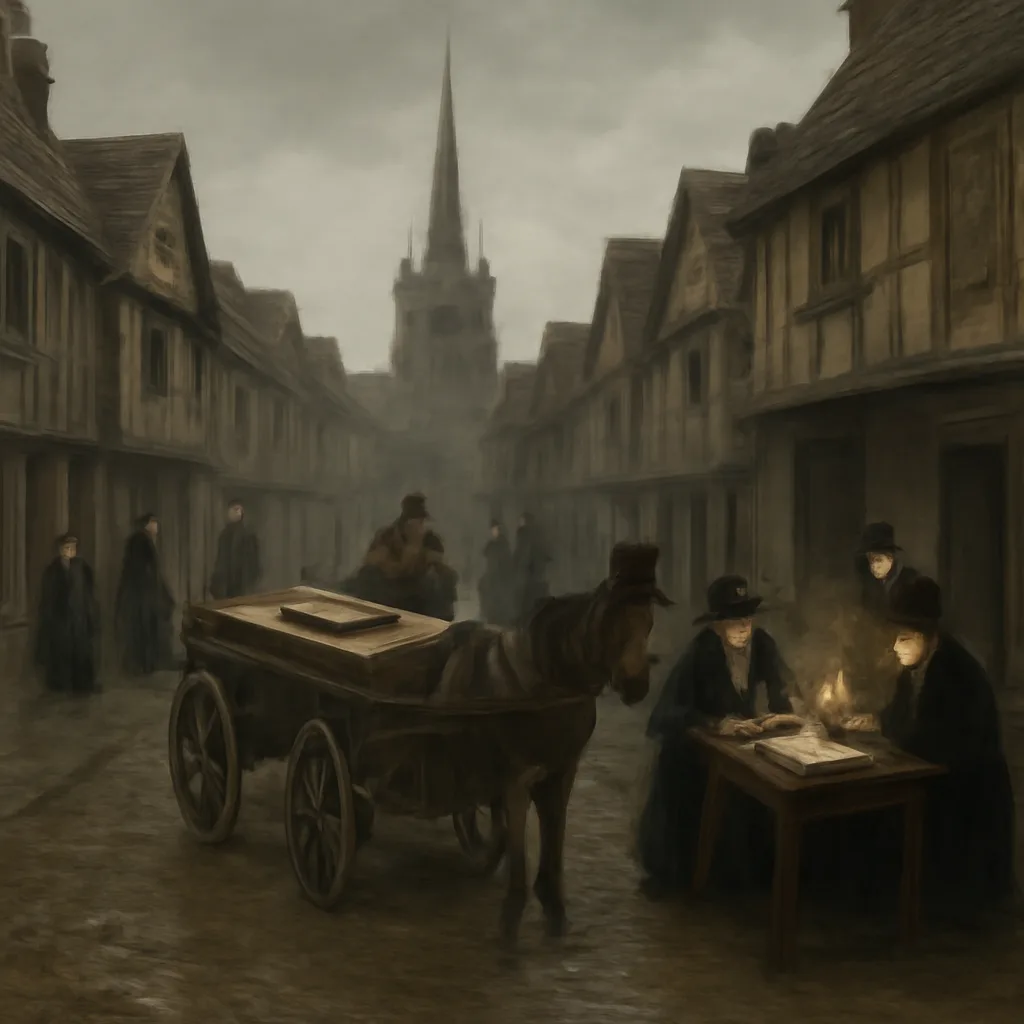
A 17th-century London street scene with shuttered houses, a cart carrying coffins, parish clerks at a table with burial registers, and distant church steeples—no identifiable faces.

New archival analysis has prompted historians to raise estimates of fatalities from the Great Plague that struck London in 1665–66, revising earlier counts upward after reviewing parish records, burial registers, and contemporaneous accounts.


Scholars working with parish registers, burial records, and other contemporaneous documents have published a reassessment that increases the estimated death toll from the Great Plague that afflicted London in 1665–66. The revision follows renewed scrutiny of fragmented records, corrections for missing or misattributed entries, and the incorporation of data from suburbs and surrounding counties that were previously undercounted or excluded.

Background
The Great Plague—the last major outbreak of bubonic plague in England—peaked in London in 1665 and continued into early 1666. Longstanding casualty figures have varied: some contemporary tallies and later summaries placed London deaths in the tens of thousands, while wider regional estimates ranged higher. Recordkeeping in the mid-17th century was uneven. Parish clerks, sextons, and local officials maintained registers, but registers could be lost, damaged, or never compiled, and panic often disrupted formal reporting.

What changed
The recent upward revision is rooted in multi-source cross-referencing. Researchers reexamined surviving parish burial registers alongside wills, probate records, coroner’s bills, tax lists, and household accounts to identify deaths that were not captured in earlier tallies. They also scrutinized movements of the population—evacuations from the city to surrounding villages and the presence of unregistered lodgers—that caused some fatalities to be recorded outside conventional borough compilations.

Methodological adjustments included:
- Filling gaps where registers were damaged or entries abbreviated, using corroborating documents to infer probable unrecorded burials.
- Reassessing entries previously dismissed as clerical error, retaining plausible plague-related deaths when supported by context.
- Including burial data from peripheral parishes and nearby counties that had been omitted in summary counts focused only on central London.

Limits and uncertainties
Despite improved methods, significant uncertainties remain. Many primary sources are incomplete; some parishes have no surviving registers for 1665–66. Contemporary descriptions of symptoms and causes are often imprecise, and distinguishing plague deaths from concurrent causes (like other febrile illnesses) can be problematic. Scholars caution that any aggregate figure should be treated as an estimate with a margin of error rather than an exact count.

Impact on historical understanding
The upward revision affects both local and broader historical narratives. For London, it suggests a greater demographic and social disruption than previously quantified—larger population losses, more abandoned households, and wider economic effects. For historians of epidemic response, the revision underscores how uneven recordkeeping and population movement complicate assessments of mortality and policy effectiveness.

Historiographical context
Estimates of mortality from early modern epidemics have long been debated. Earlier historians relied heavily on surviving published bills of mortality and selective parish reports. Recent scholarship has emphasized triangulating multiple archival sources and applying cautious statistical techniques to compensate for gaps. The present reassessment follows that trend, offering a more inclusive—but still provisional—picture.

Conclusion
The revised death toll for the Great Plague of 1665–66 reflects careful archival work and methodological refinement. While it raises the estimated human cost of the epidemic, historians emphasize remaining uncertainties and the provisional nature of such figures. The finding highlights the continuing value of archival research in illuminating the scale and social consequences of historical crises.

Share this

Email Share on X Facebook Reddit

Did this surprise you?