
← Back
01/01/1929 • 5 views

Roy Riegels’ Wrong-Way Run in the 1929 Rose Bowl
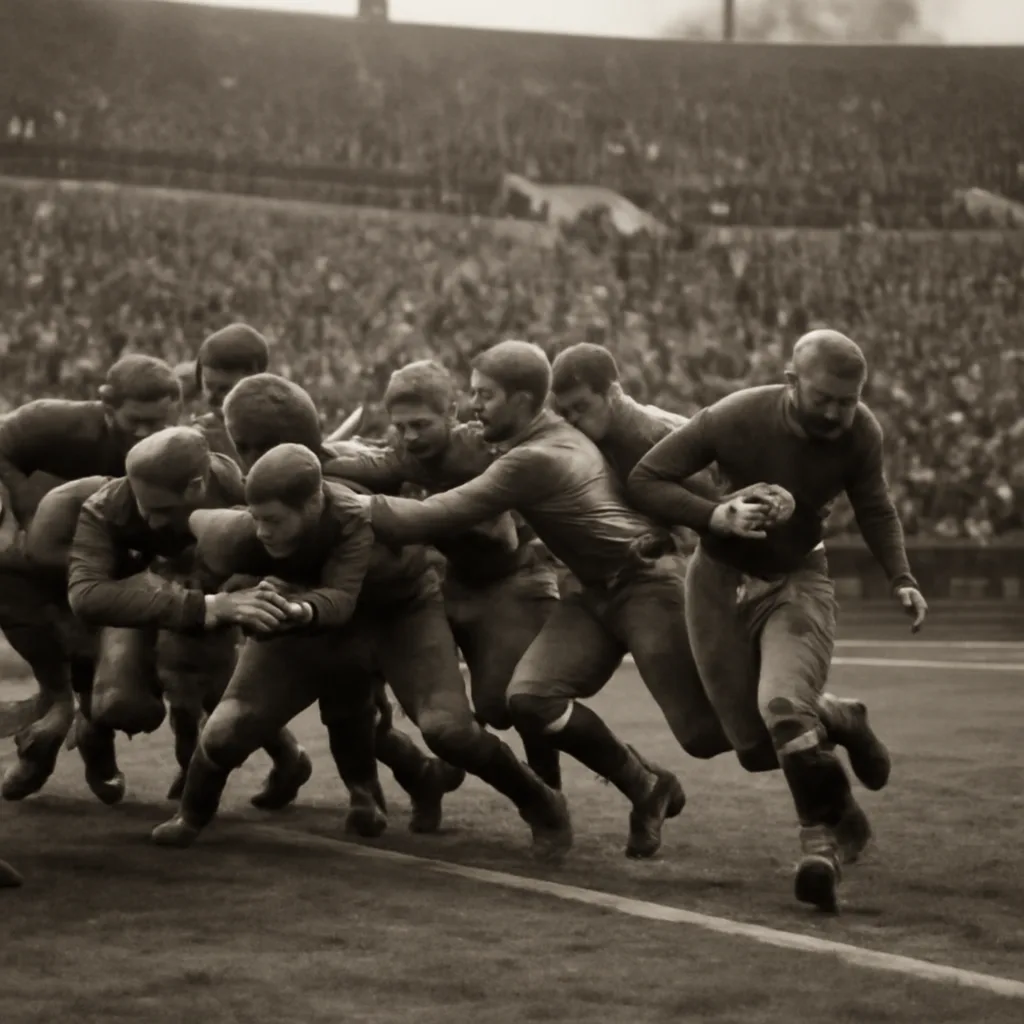
1920s-era Rose Bowl stadium scene showing a chaotic college football play near a goal line, with players in leather helmets and wool uniforms pursuing a player running toward his own end zone.

In the January 1, 1929 Rose Bowl, California center Roy Riegels picked up a fumble and ran 65 yards toward his own goal before being stopped near the end zone—an error that changed the game’s momentum and remains one of college football’s most infamous plays.


On January 1, 1929, the University of California Golden Bears faced the Georgia Tech Yellow Jackets in the Rose Bowl in Pasadena, California. Late in the second quarter, Georgia Tech attempted a punt that was blocked and recovered by California’s center Roy Riegels. Disoriented after gathering the ball, Riegels turned and ran in the wrong direction, carrying the ball some distance downfield toward his own goal line while teammates and opponents attempted to stop and redirect him. He was finally tackled by his own teammate, linebacker Benny Lom, at California’s six-yard line. California attempted to advance out of the trouble but was penalized for being pushed back by his teammates while the ball was still live, forcing them to attempt a punt from close to their goal. Georgia Tech blocked the punt and recovered for a safety, giving Georgia Tech two points. Those two points were decisive in a low-scoring game; Georgia Tech won 8–7.

Contemporary accounts and later histories treat the play as a rare and memorable mistake rather than evidence of incompetence. Newspapers of the era described the confusion on the field and the stunned reaction of the crowd. Riegels—then a sophomore—was vilified briefly in some reports but also received significant sympathy; teammates and coaches defended him, and he remained a respected member of the team. The play is often cited in retrospectives on the Rose Bowl and in compilations of unusual sports moments because of its dramatic visual: a player running deep into his own territory with the opposition pursuing in apparent disbelief.

Historical records agree on the basic facts—the blocked punt, Riegels’ recovery and wrong-way run, the tackle by Benny Lom near the cal end zone, the subsequent blocked punt and safety, and the final 8–7 score—but some details in anecdotal retellings vary, such as the exact distance Riegels ran (often reported as 60 or 65 yards) and the precise sequence of calls and penalties. Riegels’ misdirection had immediate tactical consequences beyond the safety: it shifted momentum and field position at a pivotal moment in a low-scoring contest.

In the years after the game, the incident became part of college football lore. Riegels later served as team captain and graduated from Cal; he went on to a career outside of football and was occasionally interviewed about the play. Over time the moment has been referenced in sportswriting, radio and television features, and museum exhibits as an emblematic example of how a single play can define public memory of a game. Historians note that while the wrong-way run is emphasized in popular memory, California’s overall team performance and other plays in the game were also important to the final outcome.

The episode illustrates how mistakes are magnified in championship settings and how sports narratives can endure. Contemporary reportage and later historical summaries agree on the core sequence while acknowledging small discrepancies in secondary details. The Riegels run remains a frequently cited anecdote in accounts of Rose Bowl history and a cautionary tale in football coaching about situational awareness and composure under pressure.

Share this

Email Share on X Facebook Reddit

Did this surprise you?