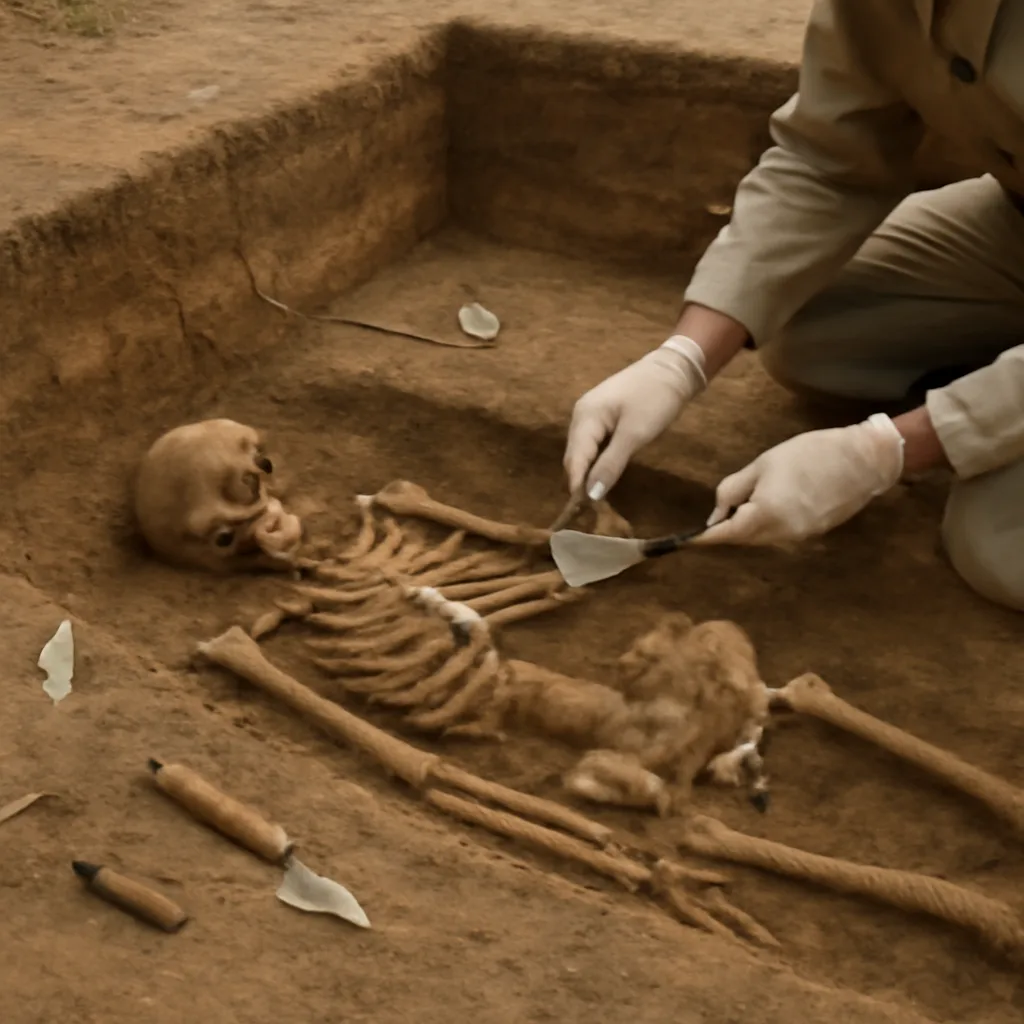
Skeleton Discovered Clutching an Ancient Love Letter
Archaeologists uncovered a human skeleton on April 8, 2011, with a folded inscribed tablet found among the remains that appears to be a personal message of affection; the find raises questions about burial practices and private correspondence in the site's cultural context.
On April 8, 2011, field archaeologists reported the recovery of a human skeleton found in association with a small inscribed object that has been interpreted as a personal message of affection. The discovery took place during a systematic excavation (context and exact site withheld pending publication) and drew attention because penned or inscribed personal messages are uncommon in the region and period represented by the burial.
The skeleton was recovered in situ during standard stratigraphic excavation. Associated materials recorded in field notes indicate the body lay in a discrete burial pit and that the inscribed object was located in close proximity to the hands or chest of the skeleton; photographs and context sheets from the dig confirm association but do not alone establish intent. The human remains were subsequently catalogued, and non-destructive imaging and conservation measures were applied to the inscribed object to preserve fragile detail prior to further analysis.
The object itself is a small, portable writing support—reported in preliminary descriptions as a folded tablet or thin sheet—bearing several lines of script. Specialists consulted after the find characterized the inscription as short and formulaic, expressing what appears to be an intimate address rather than administrative content. Scholarly teams typically analyze such inscriptions through paleography, linguistic comparison, and, when possible, material analysis (e.g., ink composition, substrate type) to establish date, language, and function. As of initial reports, specialists had not published a final, peer-reviewed transcription or secure translation; thus any interpretation that definitively labels the item a "love letter" should be treated as provisional.
Dating for the burial and associated objects depends on stratigraphic relationships and any datable finds from the same context (ceramics, coinage, radiocarbon on associated organics). Public statements from the excavation team indicated an approximate chronological placement consistent with the surrounding site phases, but no final radiocarbon or typological publication was available at the time of the initial announcement. Because precise dating affects how the object is compared to contemporary literacy rates, epistolary norms, and funerary customs, specialists caution against over-precise historical claims before full laboratory results and peer review.
The find has generated scholarly interest for several reasons. First, it raises questions about private communications and the social roles of written messages—whether such objects accompanied the dead as tokens, messages for the afterlife, or were placed accidentally. Second, the nature of the inscription, if confirmed as a personal or affectionate address, contributes to understanding of literacy and intimate expression in the relevant society. Third, the context of deposition informs discussion of mortuary behavior: whether the object was intentionally placed as a grave good, slipped into clothing, or otherwise associated with the interment.
Experts have urged caution in public interpretation. Without a published, peer-reviewed transcription and full contextual report, assertions about the object's language, exact content, and cultural meaning remain tentative. Conservation and analytical work—such as microscopic ink analysis, multispectral imaging, and careful paleographic comparison—are necessary to read faint ink traces and to determine whether the inscription is original to the object or a later contamination.
Pending publication, the excavation team has indicated plans to prepare a full report including photographs, contextual drawings, laboratory results, and expert commentary. When released, that documentation should clarify the object's material, the script and language used, the burial's date, and the range of plausible interpretations. Until such a report appears, the discovery stands as an intriguing example of how personal objects and written words occasionally surface in funerary contexts, offering a rare glimpse into potentially private aspects of past lives while reminding researchers and the public of the need for careful, evidence-based interpretation.