
05/24/1845 • 6 views
The Vanishing of Franklin’s 1845 Expedition
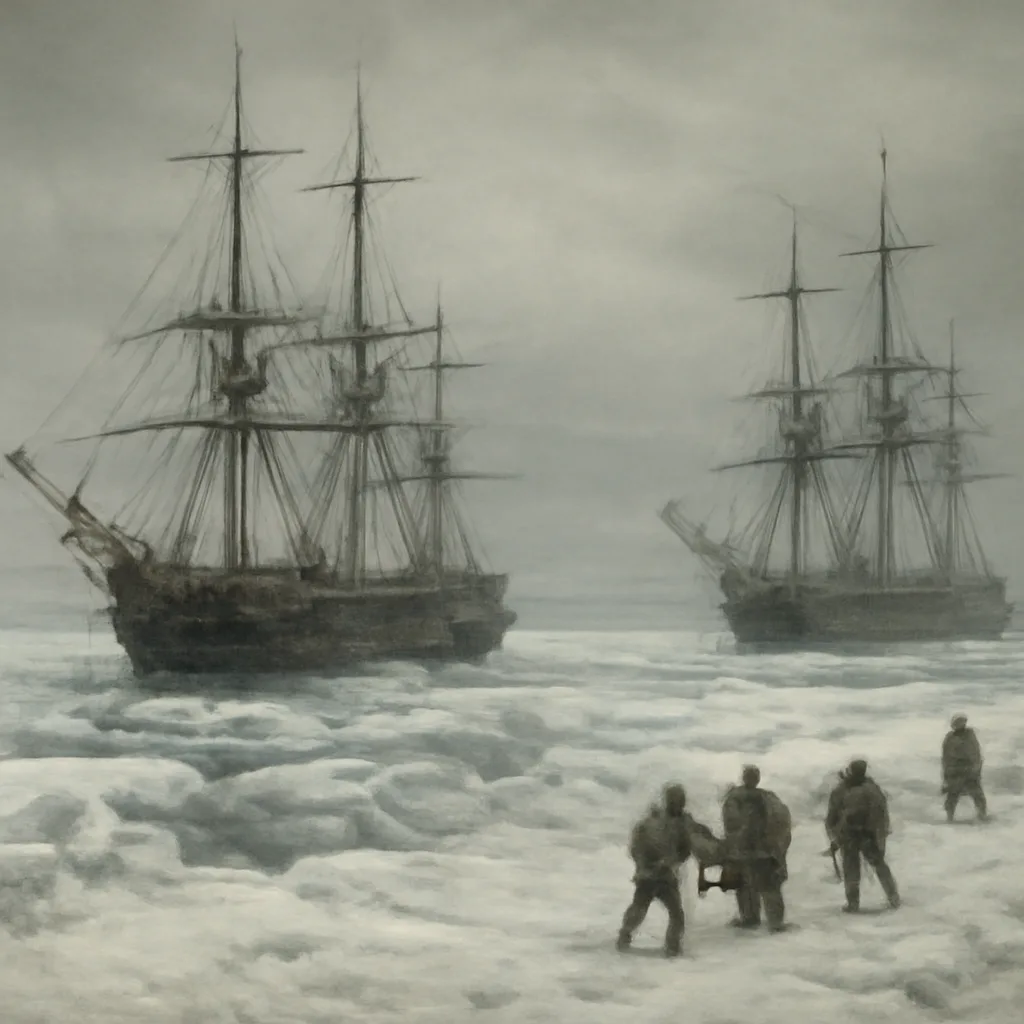
On May 24, 1845, Sir John Franklin’s two-ship Arctic expedition—intended to chart the Northwest Passage—departed England and later became the first widely documented case of an entire exploration force disappearing without clear explanation.
Departure and known timeline
Contemporary records fix the expedition’s departure date as 24 May 1845. The ships made last known sightings and communications during the summer of 1845—visitors at Greenland and Baffin Island reported encounters with Franklin’s party in late July and August. After that point, recorded contact ceased. In 1848, the British Admiralty declared the expedition lost, and frantic search missions began, spanning decades and involving ships, Inuit testimony, and later archaeological efforts.
Immediate search efforts and public reaction
News of the failure to hear from Franklin prompted an extended series of official and private searches beginning in 1848. Search parties ranged geographically from the Canadian Arctic to Greenland and included naval vessels, private sponsors, and explorers such as James Clark Ross, Sir John Richardson, and later, John Rae. The disappearance captured Victorian public imagination and became a political and cultural concern in Britain and the Empire, fueling debates about exploration practices, leadership, and imperial risk.
Sources of knowledge: Inuit testimony, relics, and records
Understanding of the expedition’s fate has been built from multiple strands of evidence rather than a single definitive account. Inuit testimony collected by searchers described encounters with starving and sick Europeans and referenced abandoned ships at locations in the eastern Arctic. Relics and artifacts—clothing, tools, and personal effects—turned up over decades near the Boothia and King William Island regions. Written records found in the ships’ final camp, known as the Victory Point note (discovered in 1859), provided dated entries indicating the abandonment of the ships in April 1848 and reporting Franklin’s death on 11 June 1847, but offered limited explanation for the campaign’s collapse.
Archaeology and recent discoveries
Archaeological work in the 20th and 21st centuries has clarified parts of the story. In 2014 and 2016, Parks Canada announced the discoveries of the wrecks of HMS Erebus and HMS Terror in separate locations—Erebus in the Queen Maud Gulf (2014) and Terror near Terror Bay off King William Island (2016). Underwater surveys and artifact recovery have provided physical context for the expedition’s final movements and condition, including signs that the ships entered shallow waters and were abandoned. Scientific analyses of remains and preserved materials have also revealed evidence consistent with lead exposure, malnutrition, scurvy, and possible tuberculosis among crew members; however, the degree to which lead poisoning, starvation, disease, or other factors (including decisions by leadership) combined to cause the expedition’s loss remains subject to scholarly debate.
Why this disappearance matters historically
The Franklin expedition is historically significant both for its immediate human tragedy and for its lasting effects on Arctic exploration, Indigenous relations, and naval procedure. The scale of the disappearance—an entire, well-documented government expedition—challenged Victorian assumptions about technology and imperial control. It led to changes in search-and-rescue thinking, increased attention to local Indigenous knowledge (albeit belated and often neglected at the time), and a long-running scientific and cultural effort to reconcile documentary, oral, and material evidence.
Uncertainties and continuing questions
Although many pieces of the puzzle have been recovered, important questions remain unresolved. The precise sequence of events leading to the abandonment of both ships, the extent to which crew choices or command decisions influenced outcomes, and the relative contribution of lead, disease, starvation, and exposure continue to be interpreted differently by historians, forensic scientists, and archaeologists. Recent wreck finds and ongoing analysis of artifacts and skeletal remains continue to refine—but not completely close—this longstanding mystery.
Legacy
The disappearance of Franklin’s 1845 expedition endures as a formative Arctic story: a combination of meticulous Victorian planning and unforgiving polar conditions, filtered through Indigenous accounts and iterative scientific discovery. It stands as one of the most documented yet unresolved calamities in exploration history, prompting continued investigation and public interest.