
← Back
01/21/1912 • 6 views

Earliest documented facial reconstruction from a skull, 1912
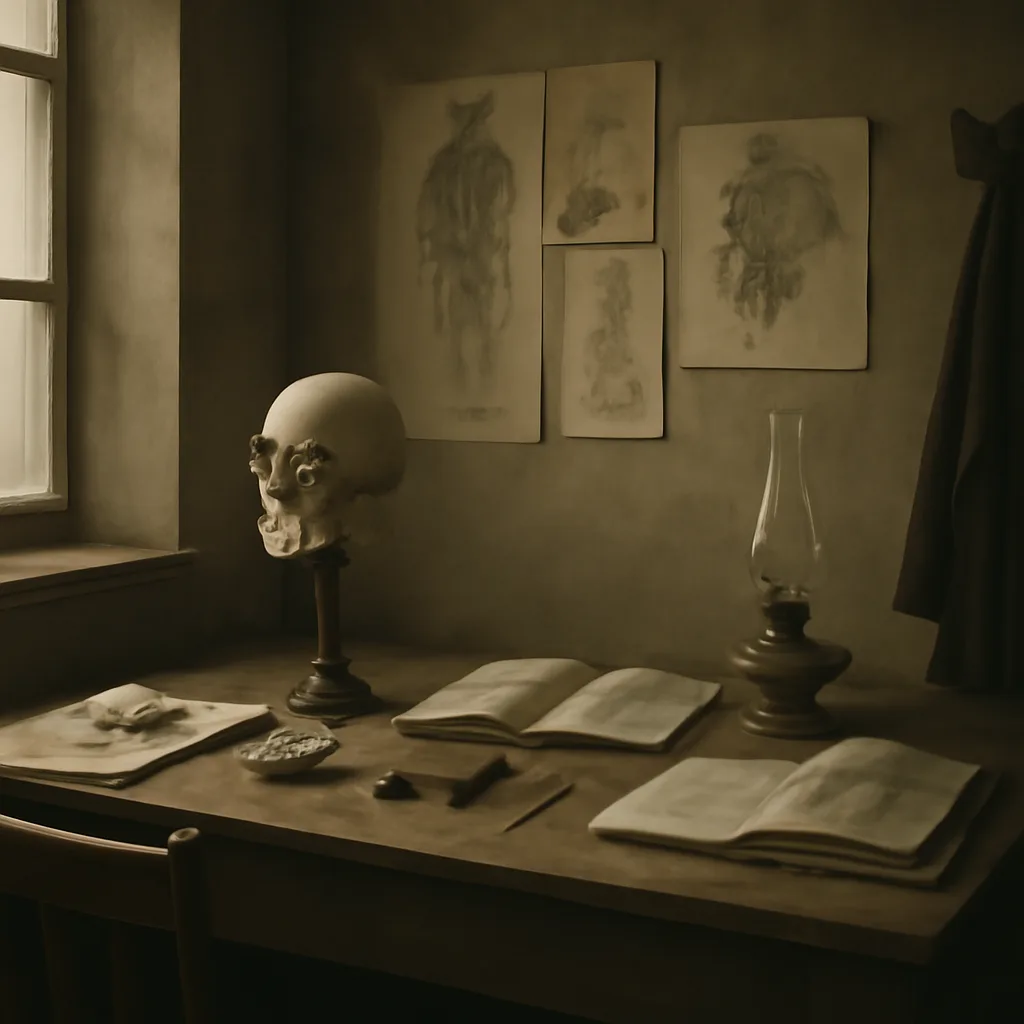
A workshop scene circa 1910–1915 showing a wooden workbench with an anatomical skull, sculpting tools, clay models of facial features, and anatomy atlases open nearby, lit by soft daylight.

On January 21, 1912, Hungarian anatomist and artist László Batthyány (often credited as L. P. A. Bethe or by other variants) published one of the first documented attempts to reconstruct a face from a human skull, marking an important early step in forensic and anatomical portraiture.


What is commonly called the first facial reconstruction from a skull emerged in the context of early 20th-century anatomical and forensic interest in recreating appearance from skeletal remains. On January 21, 1912, an account was published describing a reconstructed face produced from a skull; this work is frequently associated with Central European anatomists and artists who were experimenting with tissue-depth methods and sculptural techniques.

Background
By the late 19th and early 20th centuries, advances in forensic medicine, anthropology, and anatomical art converged. Anatomists were studying skull morphology and attempting to correlate bone features with soft-tissue form. Artists trained in medical illustration and sculptors familiar with anatomy collaborated with physicians to produce facial approximations intended to suggest the living appearance of the deceased.

The 1912 reconstruction
The 1912 reconstruction represented one of the earliest published efforts to present a face derived from a skull using systematic anatomical reasoning rather than pure artistic imagination. Contemporary reports describe the use of comparative anatomy and sculptural layering to model soft tissues over the bony framework. Scholars later discussing the history of forensic facial approximation cite this event as a milestone because it was publicly documented and aimed at replicable methodology.

Significance and limitations
This early work helped establish facial reconstruction as a discipline bridging art and science. It contributed to methods that would later be formalized, such as the use of tissue thickness data and anatomical landmarking to guide the placement of muscle and fat. However, the 1912 reconstruction also reflected the limits of knowledge and technique at the time: tissue-depth averages were rudimentary or anecdotal, and outcomes were influenced heavily by artistic interpretation. As a result, early reconstructions should be seen as exploratory rather than precise portraits.

Historical attribution and caution
Attributions for “the first” facial reconstruction vary in the scholarly literature. Different researchers and contemporary reports attribute early examples to several European practitioners; naming conventions and translations have introduced confusion around individual identities. Because primary sources from 1912 and surrounding years may be sparse, inexact, or published in languages other than English, historians note some uncertainty about claims of primacy. Nonetheless, the January 21, 1912 publication is widely recognized as an important, early documented step toward systematic facial approximation from skeletal remains.

Legacy
Methods developed and debated in the decades after 1912 evolved into more standardized forensic techniques in the mid-20th century, incorporating population-specific tissue-depth data, osteological analysis, and later, computer-assisted methods. The 1912 effort remains of interest to historians of medicine and forensic science as an early example of interdisciplinary work attempting to reconstruct human appearance from anatomy.

Sources and verification
This summary synthesizes historical surveys of forensic facial reconstruction and accounts of early anatomical practice. Where details are uncertain or disputed—especially regarding exact authorship and the exact technical procedures used in 1912—that uncertainty is indicated above rather than being presented as settled fact.

Share this

Email Share on X Facebook Reddit

Did this surprise you?