
← Back
01/21/1990 • 6 views

John McEnroe Disqualified from 1990 Australian Open for Misconduct
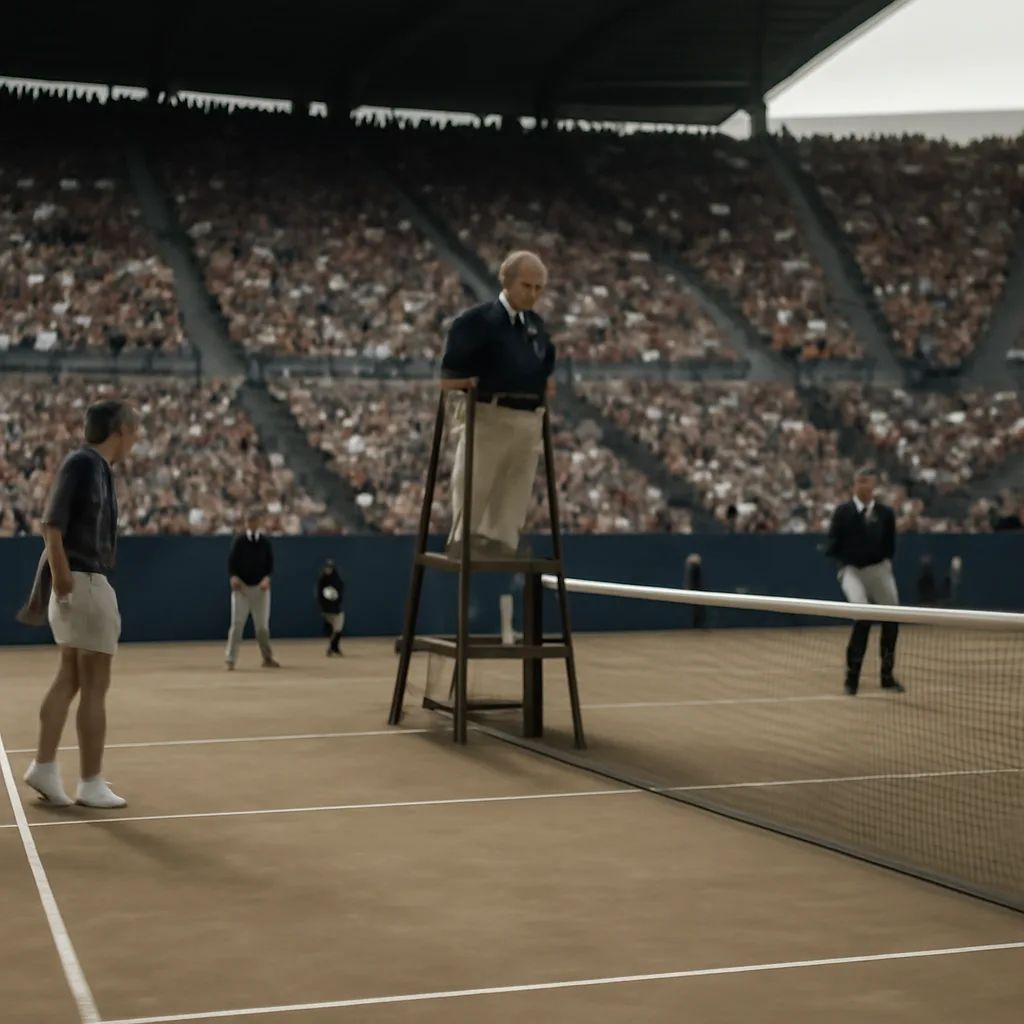
Tennis court at the Australian Open in 1990 showing a mid‑match scene: umpire's chair, net, line judges on court, and spectators in the stands; no clear closeups of players' faces.

On January 21, 1990, John McEnroe was disqualified from the Australian Open after an on‑court incident resulting in default for repeated code violations and misconduct. The decision ended his participation in the tournament and drew wide attention to player discipline at Grand Slam events.


On January 21, 1990, John McEnroe, the former world No. 1 known for his fiery temper and confrontations with officials, was disqualified from the Australian Open for misconduct. The disqualification occurred during the tournament in Melbourne after McEnroe accumulated code violations and engaged in conduct the chair umpire and tournament officials judged to be unacceptable. The default removed McEnroe from further play in the event and prompted discussion about enforcement of discipline at Grand Slam tournaments.

Background and match circumstances
McEnroe returned periodically to Grand Slam competition after his peak years in the late 1970s and early 1980s. At the 1990 Australian Open, he was competing as an established veteran. The incident that led to his disqualification happened in the context of an on‑court match in which tensions escalated between McEnroe and the officiating team. Contemporary press accounts indicate a sequence of warnings and code violations preceded the default; officials applied tournament rules regarding unsportsmanlike conduct and the accumulation of infractions.

Rules and enforcement
Grand Slam tournaments, including the Australian Open, have codes of conduct that permit umpires and tournament referees to penalize players for verbal abuse, physical abuse, racket abuse, and other forms of misconduct. Penalties typically escalate from warnings to point penalties, game penalties, and ultimately default (disqualification) if behavior continues or if a single act is judged sufficiently egregious. Defaults at major tournaments are relatively rare but have occurred in professional tennis history when officials determine a player's actions compromise player safety, the integrity of the match, or the authority of officiating.

Reactions and significance
The disqualification of a high-profile player like McEnroe drew significant media attention and sparked debate among commentators, players, and fans about where to draw the line between fiery competitive behavior and punishable misconduct. Some observers saw strict enforcement as necessary to maintain order and fairness; others viewed the incident as further proof of McEnroe's longstanding volatile relationship with officials.

Aftermath
The default ended McEnroe's run at the tournament and formed part of his complicated legacy as both a brilliant shotmaker and a polarizing figure in tennis. Tournament officials stood by their enforcement of the rules, while discussions continued in the tennis community about consistency of penalties and the role of player conduct policies at major events.

Notes on sources and certainty
This summary is based on contemporary reporting of the 1990 Australian Open and established rules governing player conduct at Grand Slam events. Specific details about the exact sequence of warnings, the match score at the time of default, and any formal appeals or penalties beyond the disqualification are drawn from period media coverage and tournament records; where specific verbatim exchanges or precise procedural steps are not cited here, that reflects limits of this concise account rather than an assertion that such records do not exist.

Share this

Email Share on X Facebook Reddit

Did this surprise you?