
01/04/1966 • 7 views
The Day the United States Lost a Nuclear Bomb
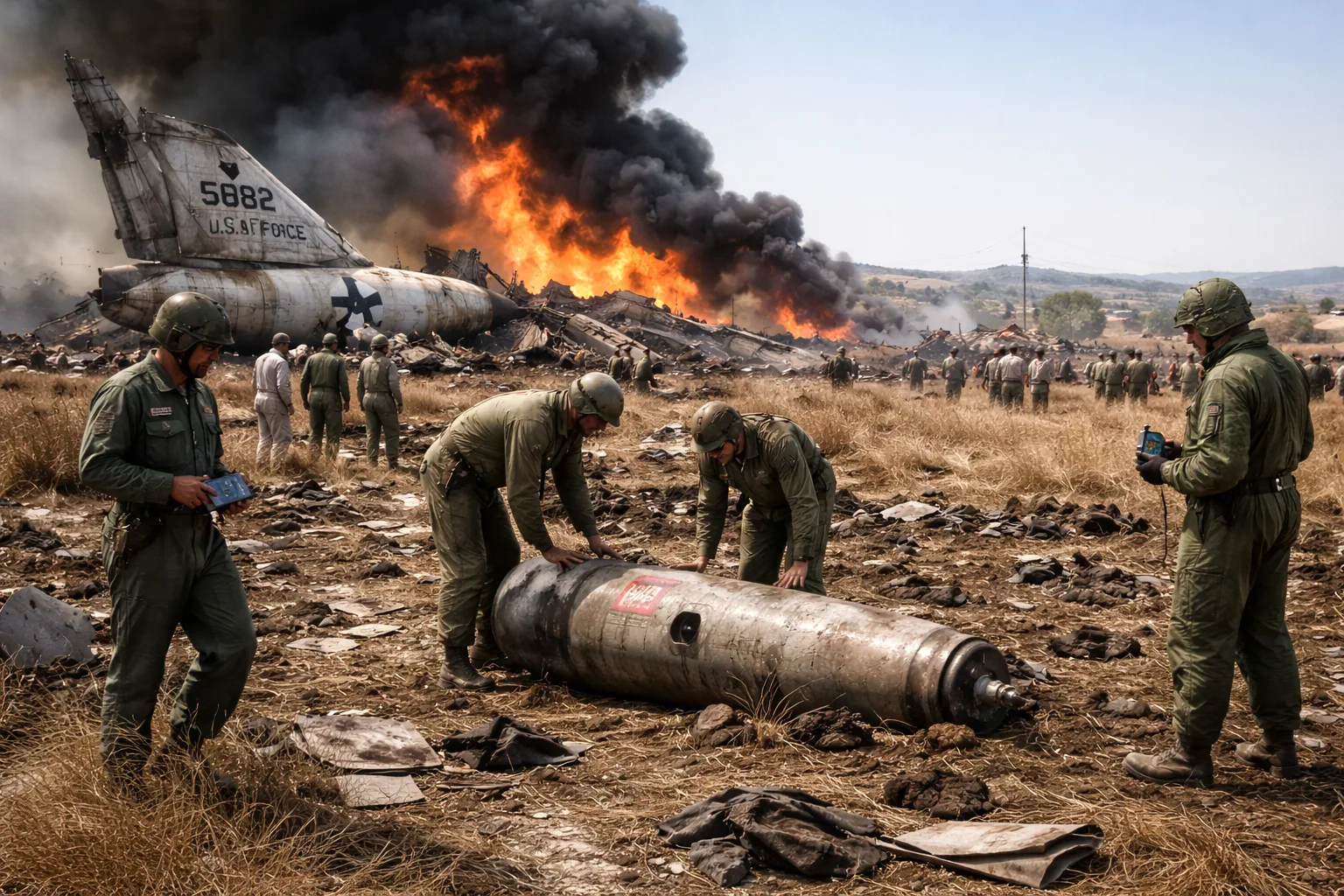
It sounds like an urban legend, the kind of rumor born from Cold War paranoia. But it is historically true: the United States has lost nuclear weapons—multiple times.
This was not a drill.
This was not a test.
This was an accident involving hydrogen bombs.
Cold War Skies, Constantly Armed
During the height of the Cold War, the U.S. military operated under a strategy known as airborne alert. Nuclear-armed bombers were kept in the sky around the clock, flying predetermined routes near Soviet airspace. The idea was simple and horrifying: if war broke out, retaliation would already be airborne.
This meant fully armed nuclear weapons—many times more powerful than the bombs dropped on Hiroshima and Nagasaki—were routinely flown over oceans, allies, and civilian territory.
Accidents were inevitable.
January 17, 1966 — Disaster Over Spain
A U.S. B-52 bomber, carrying four hydrogen bombs, collided midair with a KC-135 refueling plane over Palomares, Spain, during a routine refueling operation.
The result:
The tanker exploded, killing all four crew members
The B-52 broke apart in midair
Nuclear weapons fell toward the Earth
Two of the bombs’ conventional explosives detonated on impact, scattering radioactive plutonium across Spanish farmland. Crops, soil, and villages were contaminated. Entire areas were evacuated.
And then came the most terrifying part:
👉 One hydrogen bomb vanished.
The Missing Bomb
The fourth bomb plunged into the Mediterranean Sea.
For weeks, the U.S. military had no idea where it was.
If the weapon had detonated—even partially—it could have caused:
Massive radioactive contamination
An international crisis
Possible escalation with the Soviet Union
Instead, the U.S. Navy launched a frantic, secretive search involving sonar, deep-sea submersibles, and thousands of personnel. Fishermen were interrogated. Entire coastlines were mapped.
After 80 days, the bomb was finally located nearly 3,000 feet underwater and recovered.
The public was told everything was under control.
It wasn’t.
The Cover-Up
To reassure Spain and the world, U.S. officials staged a now-infamous publicity stunt. The American ambassador to Spain swam in the water off Palomares, smiling for cameras, insisting the area was safe.
Behind the scenes:
Tons of contaminated soil were secretly shipped to the U.S. and buried in South Carolina
Radiation levels remained elevated for decades
Spanish citizens were monitored without fully informed consent
The incident was officially labeled a “Broken Arrow”—military code for an accident involving nuclear weapons.
No criminal charges were ever filed.
Not an Isolated Incident
Palomares was not unique.
Between 1950 and 1980, the U.S. recorded at least 32 serious nuclear weapon accidents, including:
Bombs lost at sea
Weapons dropped from aircraft
Nuclear materials burned in fires
Warheads that were never recovered
In 1958, a nuclear bomb was lost off the coast of Georgia—and is still missing today.
The official line remains: there is no danger.
Why This Still Matters
These incidents reveal a deeply unsettling truth:
The greatest nuclear threats did not always come from enemies—but from routine operations, human error, and mechanical failure.
There were no launch codes entered.
No declarations of war.
No villains.
Just tired crews, midair refueling, and weapons capable of ending cities.
The world survived these moments not because of flawless systems—but because of luck.
The Quiet Horror
What makes the story of the lost nuclear bomb so disturbing is not the explosion that didn’t happen—but how close it came, and how little most people ever knew.
Entire towns were contaminated.
Diplomatic lies were told.
Weapons of unimaginable power vanished into the sea.
And life went on.
The Cold War did not end the world—but not for lack of trying.