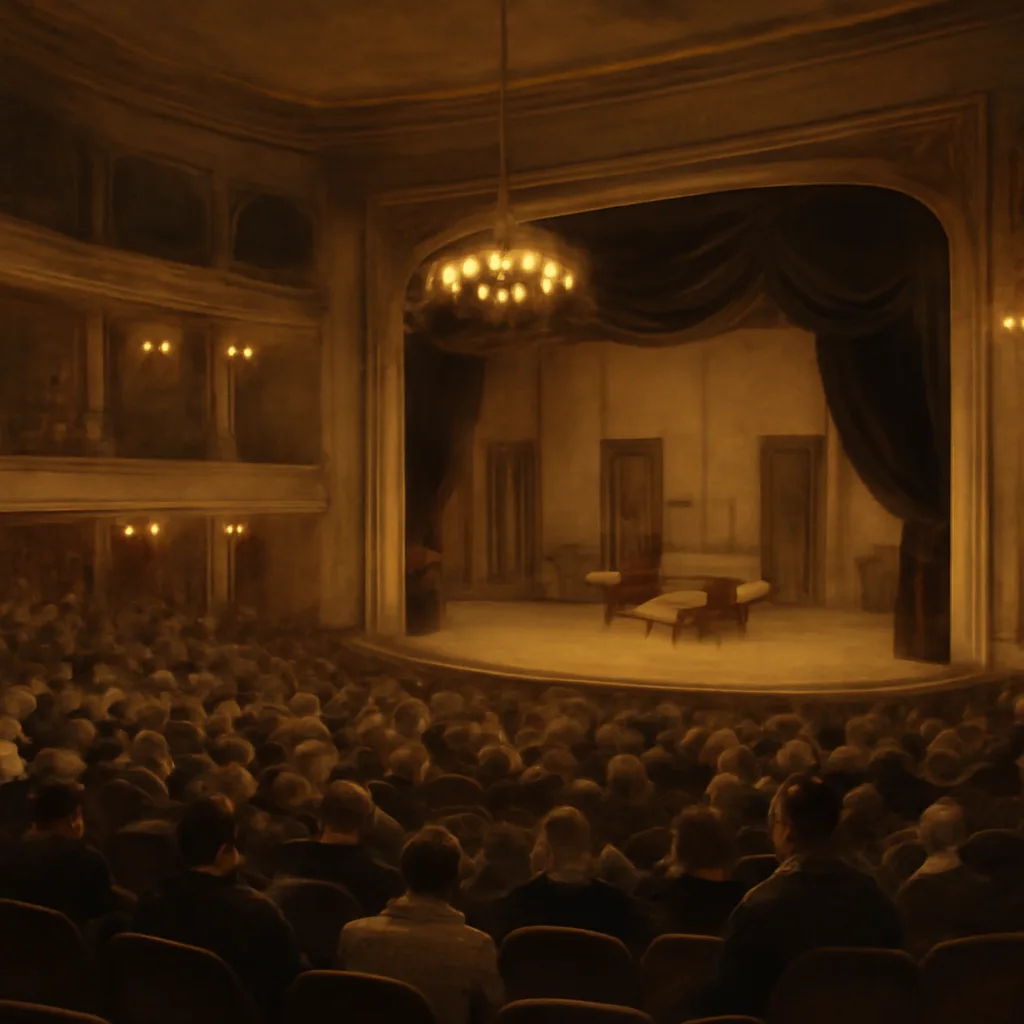
On the evening of April 14, 1865, President Abraham Lincoln was shot while attending a performance at Ford's Theatre in Washington, D.C.; he died the following morning. The attack, carried out by actor and Confederate sympathizer John Wilkes Booth, marked the first assassination of a U.S. president and shocked the nation during the closing days of the Civil War.
On April 14, 1865, President Abraham Lincoln was shot by John Wilkes Booth while attending a performance of the comedy Our American Cousin at Ford's Theatre in Washington, D.C. Lincoln and his wife, Mary Todd Lincoln, were in a private box; also present were Major Henry Rathbone and his fiancée, Clara Harris. Shortly before 10:15 p.m., Booth, a well-known actor and Confederate sympathizer, entered the presidential box, shot Lincoln in the back of the head at close range with a single-shot Deringer pistol, and leaped to the stage, breaking his leg in the fall. He escaped the theater and fled the city.
After the shooting, attendants discovered Lincoln unconscious and bleeding. He was carried across the street to the Petersen House, a boarding house where physicians attended him through the night. Despite efforts to save him, the president never regained consciousness. At 7:22 a.m. on April 15, 1865, Abraham Lincoln died; the cause was the gunshot wound to the brain. His death made him the first U.S. president to be assassinated.
The motive for the assassination was political. Booth, a Maryland-born actor and Confederate sympathizer, had opposed Lincoln's policies and the outcome of the Civil War. He had initially been involved in a broader plot to kidnap Lincoln and exchange him for Confederate prisoners, but by April 1865 he had embraced a plan to kill the president. Booth's attack was part of a coordinated plot that included planned assaults on other senior government officials; Secretary of State William H. Seward was gravely wounded in a separate attack that same night, while Vice President Andrew Johnson's attacker failed to act.
Following the assassination, a massive manhunt for Booth and his co-conspirators ensued. Booth eluded capture for 12 days before Union soldiers cornered him in a tobacco barn on a farm in Virginia on April 26. Booth was shot—accounts differ as to whether the fatal shot was self-inflicted or fired by a soldier—and died shortly thereafter. Several conspirators were arrested, tried by a military commission, and four were hanged in July 1865; others received prison sentences.
Lincoln's assassination had immediate and long-lasting effects. The nation was plunged into mourning, with public memorials and an extended funeral procession that transported the president's body to Springfield, Illinois, for burial. Politically, the death intensified tensions during Reconstruction: Andrew Johnson assumed the presidency and pursued policies and appointments that were controversial and consequential for the postwar settlement. Historians continue to debate how different Reconstruction might have been had Lincoln lived; his measured approach to reconciliation and plans for reintegrating the Southern states are central to those discussions.
Contemporaneous reporting, eyewitness testimony, surviving medical notes, and official records provide the basis for our understanding of the assassination and its aftermath. Some details—such as exact motives of all conspirators, the finer points of Booth's intentions in his final hours, and disputed eyewitness recollections—remain subjects of scholarly analysis. What is firmly established is that Lincoln's killing was a watershed event in American history, occurring days after Confederate General Robert E. Lee's surrender at Appomattox and altering the nation's trajectory at a pivotal moment.