
04/14/1912 • 7 views
Titanic Strikes an Iceberg and Begins to Sink
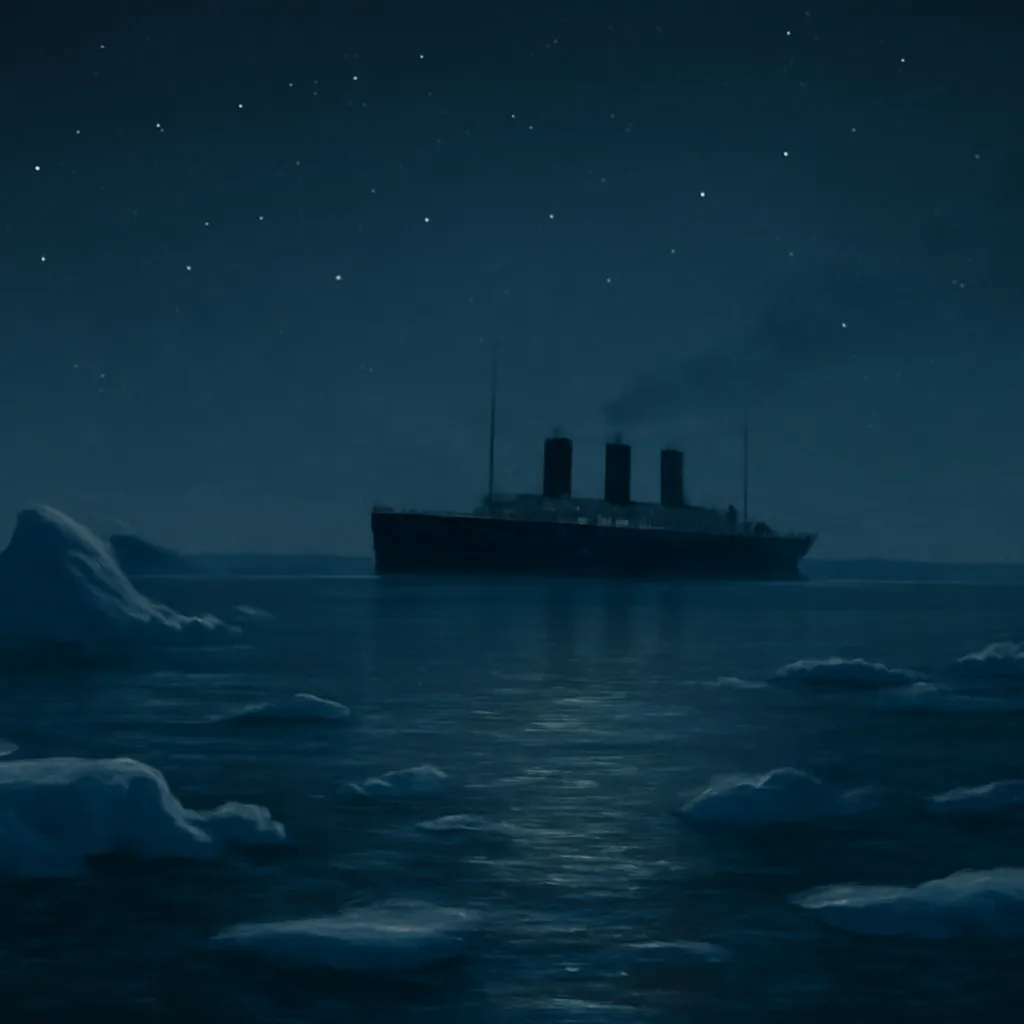
On the night of April 14, 1912, the RMS Titanic struck an iceberg in the North Atlantic and began taking on water; within hours the ship’s design and safety limitations would be tested as passengers and crew faced an unfolding maritime disaster.
The Titanic had been navigating an ice field that night, and warnings of ice from other ships had been received earlier in the day. Visibility, the temperature, and the speed at which Titanic was steaming have all been examined by historians and investigators seeking to explain how the ship came to strike the iceberg. The design of Titanic’s watertight compartments—intended to make her capable of remaining afloat with some compartments flooded—contributed to the belief among some at the time that she was virtually unsinkable. However, the iceberg breach spanned multiple compartments, compromising buoyancy in a manner that the ship’s design could not contain.
In the hours after the collision, crew members assessed the damage and began to organize the evacuation of passengers. Titanic carried lifeboats, but not enough for all aboard; the ship’s complement of lifeboats met or exceeded the Board of Trade regulations then in force but fell far short of the total number of people on board. Contemporary accounts and subsequent inquiries have documented confusion and disorder during loading: some lifeboats launched partially filled, while elsewhere passengers and crew struggled with the reality of an evacuation at night in cold conditions.
Distress signals were sent, and nearby vessels responded as they were able. The wireless operators aboard Titanic transmitted calls for assistance that were picked up by ships including the RMS Carpathia, which steamed through the night toward the distress position. Despite these efforts, rescue was constrained by distance and the time required for assistance to arrive.
The sinking of Titanic revealed shortcomings in maritime safety practices of the era and prompted public outrage and regulatory change. In the immediate aftermath, several official inquiries—most notably by British and U.S. authorities—investigated the causes of the disaster and the conduct of the ship’s officers and company. Findings from these inquiries and public reaction led to changes in lifeboat requirements, continuous wireless watch rules, and the establishment of the International Ice Patrol to monitor North Atlantic ice dangers.
The human cost of the event was substantial. The number of people aboard, the survival rates among different passenger classes and crew, and the specific sequence of lifeboat launches have been the subject of extensive historical research. The disaster has remained a focal point for study of early 20th-century maritime practices, ship design, and social responses to catastrophe.
While the vessel itself has since been located on the ocean floor and extensively documented by deep-sea exploration, many aspects of the night’s human experience—individual decisions, conversations, and private moments—are known only through survivor testimony and records, which sometimes vary. The sinking of Titanic on the night of April 14–15, 1912, therefore stands both as a well-documented maritime disaster and as a subject of continuing historical interest and interpretation.