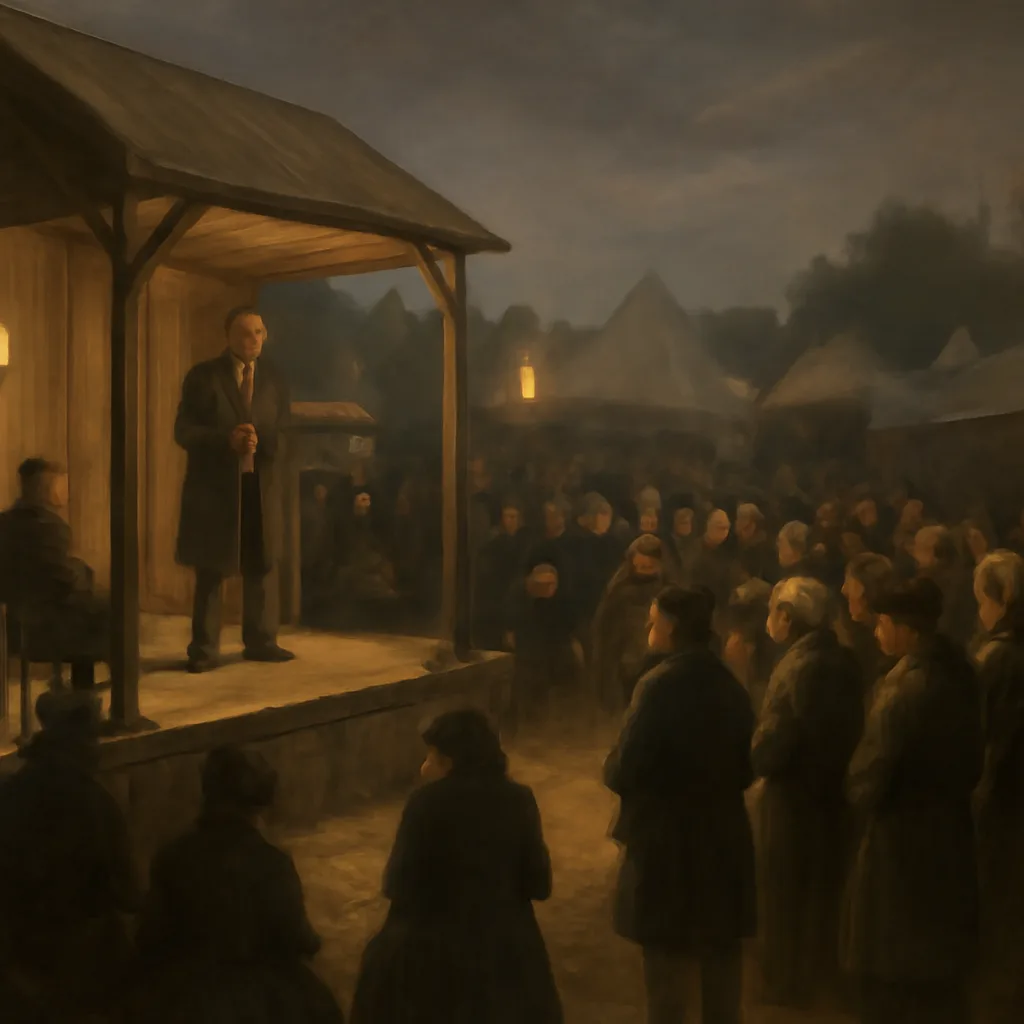
1894 Reported Mass Hypnosis at a French Fairground
On January 15, 1894, French press and medical journals reported an incident at a provincial fairground in which dozens of spectators appeared to enter a trance after watching a hypnotist’s demonstration—an episode later discussed in debates over suggestion, crowd psychology and the medical legitimacy of mesmerism.
On 15 January 1894 several contemporary French newspapers and medical periodicals covered an episode commonly described at the time as a case of “mass hypnosis.” The event took place at a travelling fairground demonstration in a provincial town; accounts vary in detail, but the core claim was that a stage hypnotist’s public performance was followed by multiple members of the audience falling into trance-like states. Physicians and journalists who reported the episode framed it within ongoing late-19th-century controversies over mesmerism, suggestion and the boundaries between entertainment and medical practice.
Context: Mesmerism, suggestion and public demonstrations
Since the earlier decades of the 19th century, practitioners of mesmerism and, later, of what became clinical hypnosis staged public demonstrations that blurred entertainment, scientific curiosity and therapeutic ambition. By the 1880s and 1890s, hypnotism had attracted both serious physicians—some interested in its therapeutic potential—and popular entertainers who used suggestive techniques for spectacle. Debates among neurologists, psychiatrists and lay commentators in France, Britain and elsewhere centered on whether hypnotic phenomena were physiological, psychological, or simply theatrical.
The 1894 incident and contemporary reporting
Contemporary reports describe a travelling stage performer announcing a public demonstration at a fairground on 15 January 1894. Witnesses said the performer induced a subject into trance and then addressed the larger crowd; shortly afterward, several spectators—numbers reported range from a handful to “dozens” depending on the source—showed signs variously described as catalepsy, loss of voluntary movement, fixed stare, or unresponsiveness. Local physicians were summoned in some accounts; they examined those affected and in at least one report declared the individuals to be under a hypnotic influence rather than suffering from a neurological disease.
Disputes and interpretation
Reports from the period are uneven, sometimes sensationalized, and occasionally conflicting. Some accounts emphasized the novelty and danger of “mass suggestion,” warning about the susceptibility of crowds; others treated the episode as an extension of well-known public demonstrations that could be explained by suggestion, imitation (contagion), or psychological expectation. Medical commentators of the time were divided: some saw the event as evidence that suggestion could spread rapidly through a crowd under certain conditions, while skeptics attributed the reactions to attention-seeking, mass hysteria (then variously labeled), or theatrical manipulation.
Modern perspective and historiography
Historians of psychiatry and science treat such incidents cautiously. Documentation is limited to contemporary press reports and occasional clinical notes; there is no surviving definitive clinical record that would meet modern standards for diagnosis. Scholars therefore interpret the 1894 episode as illustrative of several overlapping phenomena of the period: the popularity of hypnotic spectacle, anxieties about crowd behaviour, and the contested professionalization of psychiatry and neurology. The event also highlights how medical authority and popular entertainment interacted in public spaces.
Significance
While historians do not treat the 15 January 1894 episode as a singularly decisive discovery about hypnosis, it remains a useful documented example of how late-19th-century societies responded when suggestive techniques moved from consulting rooms to public stages. The case contributed to contemporary debates over the power of suggestion, the responsibility of performers, and the need for clearer medical and legal frameworks governing public demonstrations of psychological techniques.
Sources and limits
This summary is based on contemporaneous newspaper and medical-journal reporting typical of late-19th-century coverage of mesmerism and hypnotism. Specific details (exact location, precise number of people affected, and clinical findings) vary between sources and are not uniformly preserved, so definitive claims beyond the existence of press and medical interest in the 15 January 1894 episode would exceed the surviving documentation.