
04/07/1935 • 7 views
First Public Demonstration of Radar: 7 April 1935
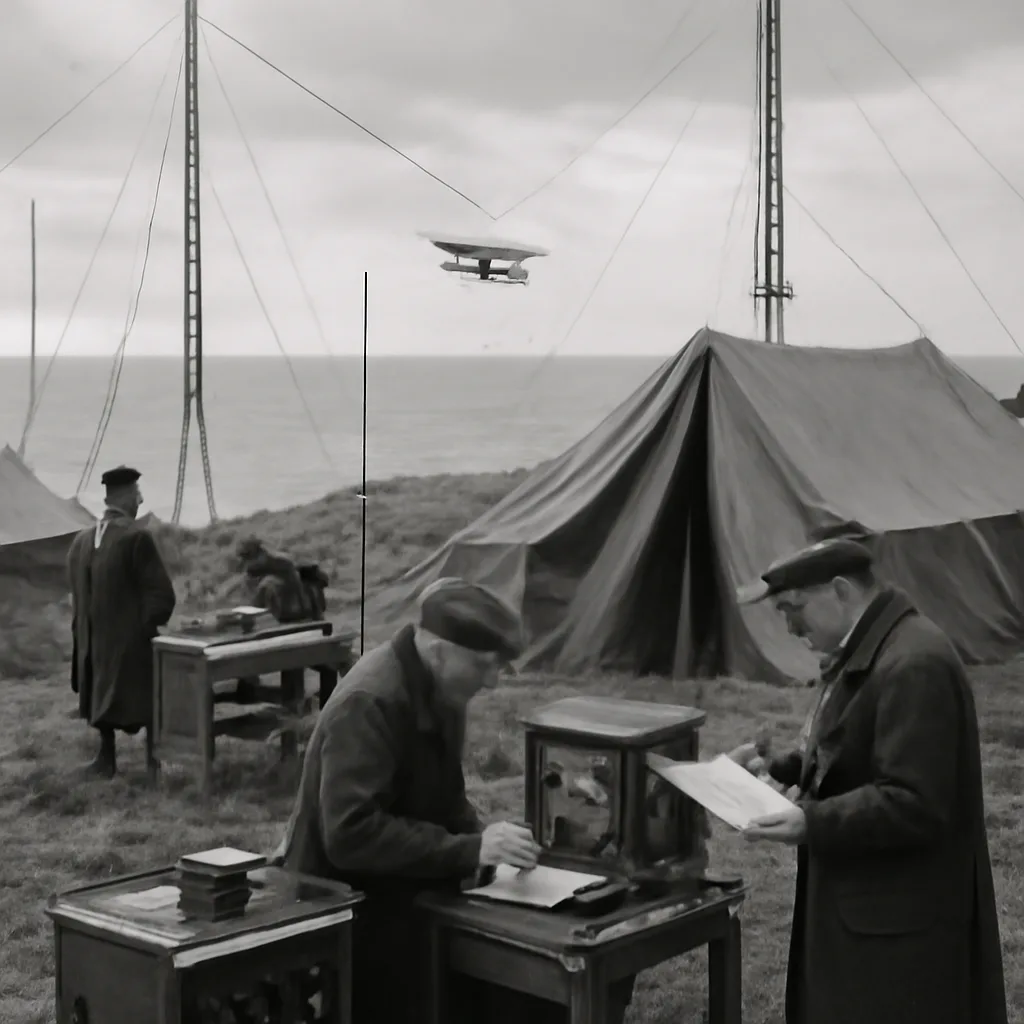
On 7 April 1935, British researchers gave the first widely reported public demonstration of radar—showing that radio waves could detect distant objects—marking a milestone in the development of electronic detection and foreshadowing its pivotal role in World War II.
The demonstration was the culmination of experiments that repurposed pulsed and reflected radio signals to reveal the presence and approximate position of aircraft. Prior laboratory experiments and more limited field trials had already suggested the technique’s promise; the April 1935 public event made the capability visible to government officials, military planners and the press. Reports from the period described how radio pulses produced echoes from aircraft at ranges sufficient to confirm the method’s practicality for air defence.
This public display helped convert scientific curiosity into a government-supported program. Within months, the British government accelerated funding and organized a coordinated effort to develop operational systems. That effort led to the Chain Home network of coastal radar stations, which by 1939–1940 formed a critical part of Britain’s air-defence system during the early years of World War II.
Historians note that “first demonstration” can be framed in different ways. Earlier laboratory experiments and independent work in other countries—by researchers experimenting with radio waves and echoes—preceded the April event. What made the 7 April demonstration significant was its public, government-attended nature and the direct link it established between experimental research and rapid military development.
The technical principle demonstrated was straightforward: a transmitter emits radio waves that reflect from a target; a receiver detects the returning echo and, by measuring time delay and signal characteristics, estimates range and bearing. The demonstration and follow-up engineering tackled many practical issues: suitable transmitter power, pulse timing, receiver sensitivity, antenna design, and methods for distinguishing useful echoes from noise and ground clutter.
The legacy of the 7 April 1935 demonstration is substantial. It catalyzed organized radar development in Britain, influenced parallel programs abroad, and altered military strategy by enabling early warning and control of airspace. While subsequent technological advances—frequency modulation, microwave components, cavity magnetrons and more sophisticated displays—greatly extended radar’s capabilities, the mid-1930s demonstrations remain a key turning point where radar moved from laboratory possibility to field-applicable system.
Because multiple researchers and institutions contributed to radar’s invention and early demonstrations, accounts sometimes differ on precise dates and attributions. The 7 April 1935 event stands out in many historical narratives as a clear public moment that helped secure official support for rapid wartime development, even as the broader story of radar’s origins spans international, parallel efforts.