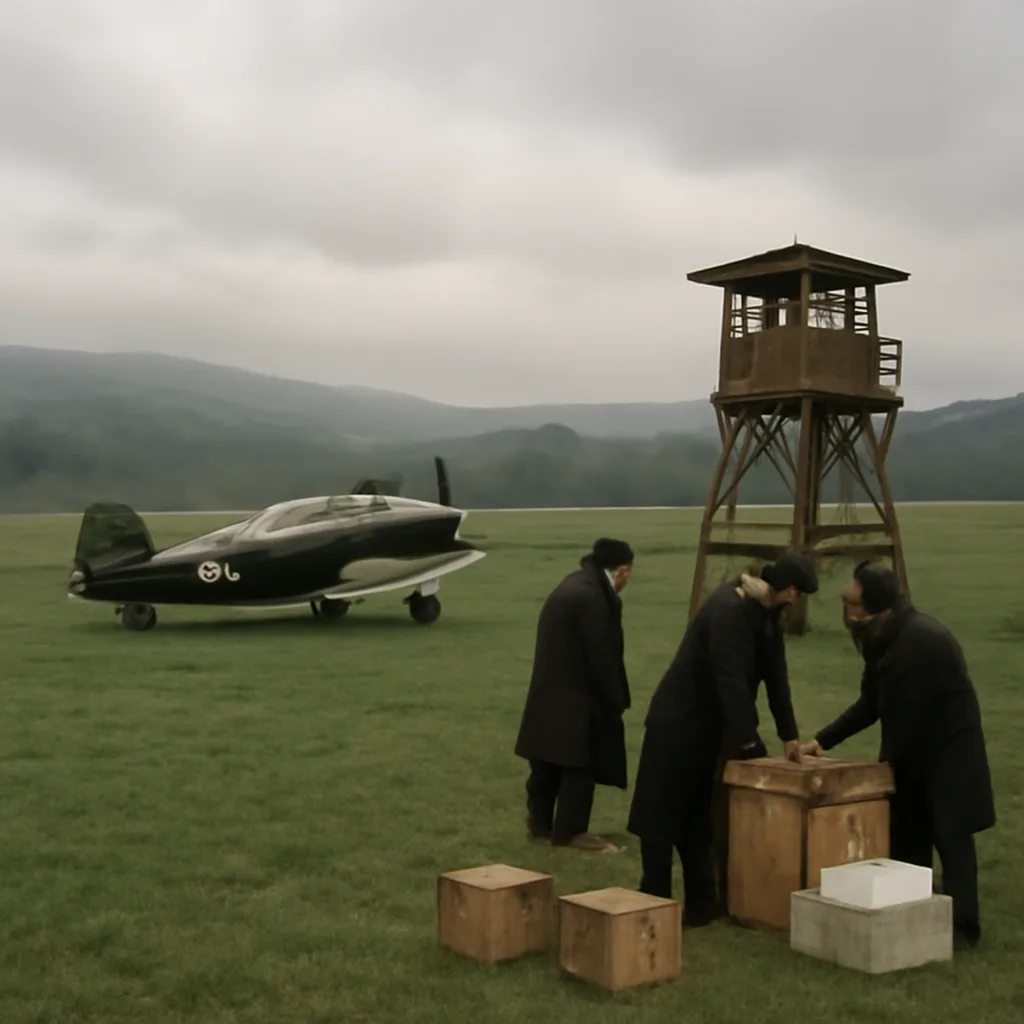
1947 Public Demonstration of Cloud Seeding in Mount Gretna, Pennsylvania
On April 7, 1947, meteorologist Vincent Schaefer carried out one of the earliest public demonstrations of cloud seeding near Mount Gretna, Pennsylvania, showing that dry ice could induce ice crystal formation in supercooled clouds—an event that helped launch weather modification research.
On April 7, 1947, Vincent J. Schaefer, a researcher at General Electric’s Research Laboratory in Schenectady, New York, performed a public demonstration of cloud seeding near Mount Gretna, Pennsylvania. The demonstration followed laboratory work earlier that year and a successful in-flight experiment on November 13, 1946, when Schaefer and colleague Bernard Vonnegut showed that solid particles could induce ice crystals in supercooled clouds. The April event is often cited as the first public demonstration that weather could be influenced intentionally.
Schaefer’s method used small fragments of dry ice (solid carbon dioxide) dropped into a cloud layer. Dry ice cools surrounding air as it sublimates, producing conditions that cause supercooled water droplets to freeze and form ice crystals or snow. During the Mount Gretna demonstration, Schaefer reportedly released dry ice from atop a tower and from aircraft; local observers noted snow or ice formation where the material entered the cloud, providing visible evidence that the intervention had altered precipitation processes.
The demonstration occurred amid growing scientific interest in cloud physics and practical interest from agriculture, water managers, and the military. Earlier theoretical and laboratory work had established that ice-forming nuclei were central to precipitation formation in many cold clouds; Schaefer’s public trials helped move the field from laboratory curiosities to field applications. After 1947, cloud seeding experiments expanded worldwide using dry ice and later silver iodide and other materials to encourage ice nucleation.
Contemporaries and later historians emphasize that early cloud seeding demonstrations showed that cloud microphysics could be influenced under certain conditions, but they did not prove broad, reliable control over rainfall. Results varied with cloud type, temperature, moisture content, and delivery technique. The Mount Gretna event and subsequent experiments sparked both enthusiasm and skepticism: some hailed weather modification as a tool for drought relief or hail suppression, while others cautioned that effects were inconsistent and difficult to attribute conclusively to seeding rather than natural variability.
Ethical, legal, and scientific questions followed the initial demonstrations. Through the mid-20th century, governments and private firms funded experiments to assess efficacy and explore applications. Scientific standards and statistical techniques for evaluating seeding outcomes improved over decades, but disagreement continued about the magnitude and reliability of anthropogenic influence on precipitation. Modern cloud seeding programs still reference early demonstrations like Schaefer’s as foundational, while acknowledging the complexity and uncertainty that remain in modifying weather.
In historical accounts, the April 7, 1947 demonstration stands as a notable public moment: a clear, tangible display that human interventions could prompt ice formation in certain clouds. It catalyzed expanded research into cloud physics and operational seeding projects, even as scientists stressed the limitations and context-dependence of the technique. The episode is best viewed as the beginning of systematic weather-modification research rather than proof of easily controllable weather.