
← Back
05/06/1937 • 8 views

Hindenburg Airship Catches Fire Over Lakehurst, New Jersey
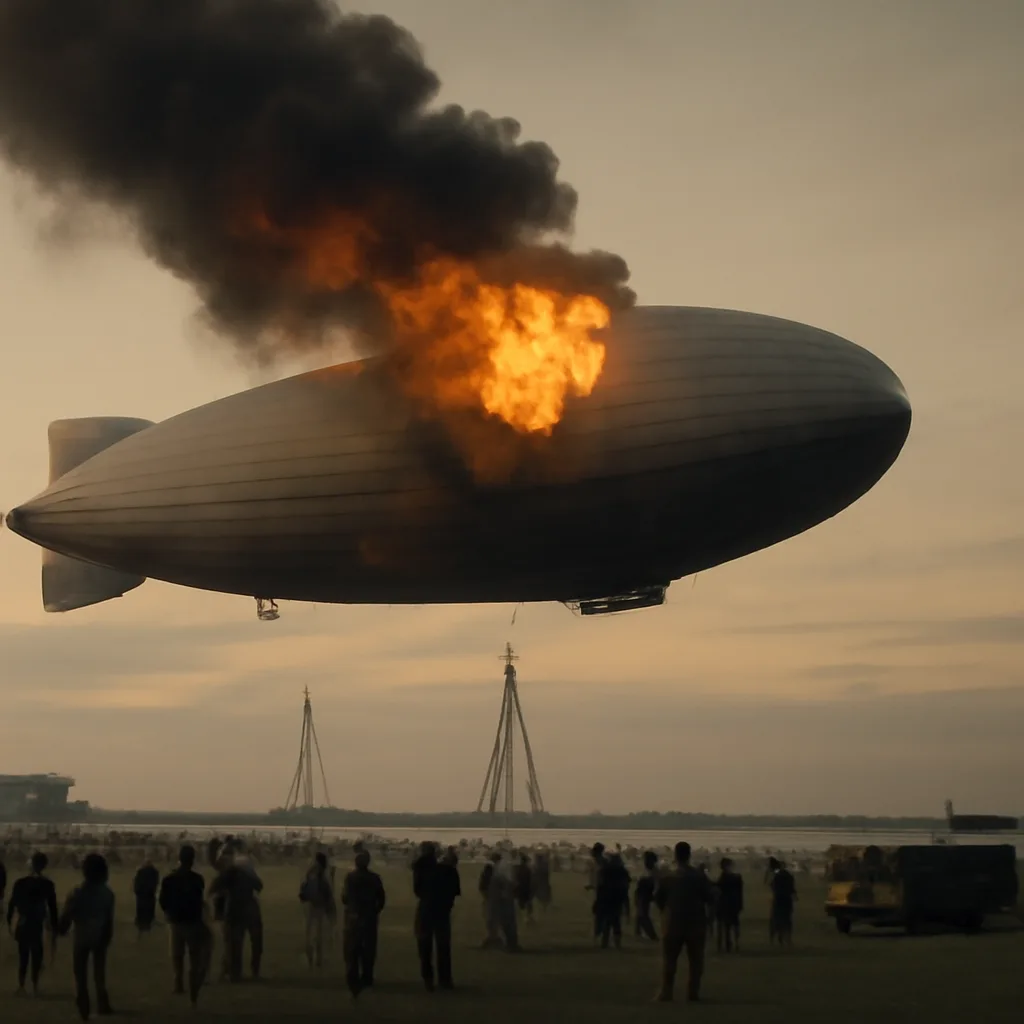
The German passenger airship Hindenburg descending toward the Lakehurst mooring mast with smoke and flames beginning at the forward section, ground personnel and onlookers on the airfield in 1937.

On May 6, 1937, the German passenger airship LZ 129 Hindenburg ignited while attempting to land at Naval Air Station Lakehurst, New Jersey, producing a rapid conflagration that killed 36 people and ended the era of passenger rigid airships.


On the evening of May 6, 1937, the German passenger airship LZ 129 Hindenburg approached Naval Air Station Lakehurst in Manchester Township, New Jersey, after a transatlantic voyage from Frankfurt. Witnesses and newsreel footage recorded the airship as it dropped mooring lines during its landing maneuver when a sudden fire consumed the forward section and rapidly spread through the hydrogen-filled hull. The Hindenburg descended and collapsed onto the mooring field in less than a minute.

The Hindenburg was a 803-foot (245-meter) German Graf Zeppelin Company rigid airship designed for transoceanic passenger service. It was filled with hydrogen, which was chosen because U.S. export restrictions limited access to nonflammable helium. The ship carried passengers and crew, along with ground handlers involved in the landing. As the airship came in to land, weather and ground handling conditions complicated the operation: gusts and charged atmosphere have been cited in subsequent investigations and analyses as possible contributing factors in the ignition, though consensus about a single definitive cause remains elusive.

Immediate reporting documented dramatic scenes: flames engulfed the nose and forward gondola, then raced aft. Passenger, crew, and ground personnel escaped in various ways—some leapt from the descending wreckage, others were pulled clear by helpers on the ground. Rescue efforts began quickly, but the intensity of the blaze and structural collapse limited time for evacuation. Official accounting of casualties recorded 36 deaths (13 passengers, 22 crew members, and one worker on the ground). Many others were injured.

Investigations into the disaster included inquiries by U.S. and German authorities and technical examinations of the wreckage and surviving materials. Early speculation offered multiple hypotheses: static electricity igniting a hydrogen leak, a spark from electrical equipment, or an incendiary source such as a fuel leak. Later forensic and archival work has emphasized that a hydrogen ignition, once started, would have spread extremely rapidly through the ship’s gas cells and interior fabrics. Some researchers have focused on the fabric coating and possible flammability; others have pointed to the sequence of handling operations and weather-induced electrical effects. No single explanation has been universally accepted as the definitive cause.

The disaster had immediate and lasting effects on public confidence and commercial aviation policy. The Hindenburg was among the largest and most advanced of the rigid airships, and its loss—captured in photographs, film, and the famous radio commentary—shocked international audiences. Scheduled passenger service by rigid airships declined sharply. Within months, commercial use of hydrogen-filled passenger airships effectively ended, and the Hindenburg disaster became a central reason for accelerating development of heavier-than-air aircraft for long-distance passenger travel.

Cultural impact was profound: newsreels and photographs brought the catastrophe into homes around the world, and the event entered collective memory as a symbol of technological risk and human tragedy. Memorials and museums preserve artifacts and accounts from the Hindenburg and its passengers; historians continue to study the disaster using surviving documents, technical analyses, and contemporary reports.

While many details about the sequence of events and technical factors are well-documented, certain elements—such as a single, universally accepted ignition source—remain debated among historians and engineers. The Hindenburg disaster stands as both a specific historical tragedy and a turning point in the history of air travel, marking the end of the rigid airship era and influencing aviation safety and regulatory approaches in the decades that followed.

Share this

Email Share on X Facebook Reddit

Did this surprise you?