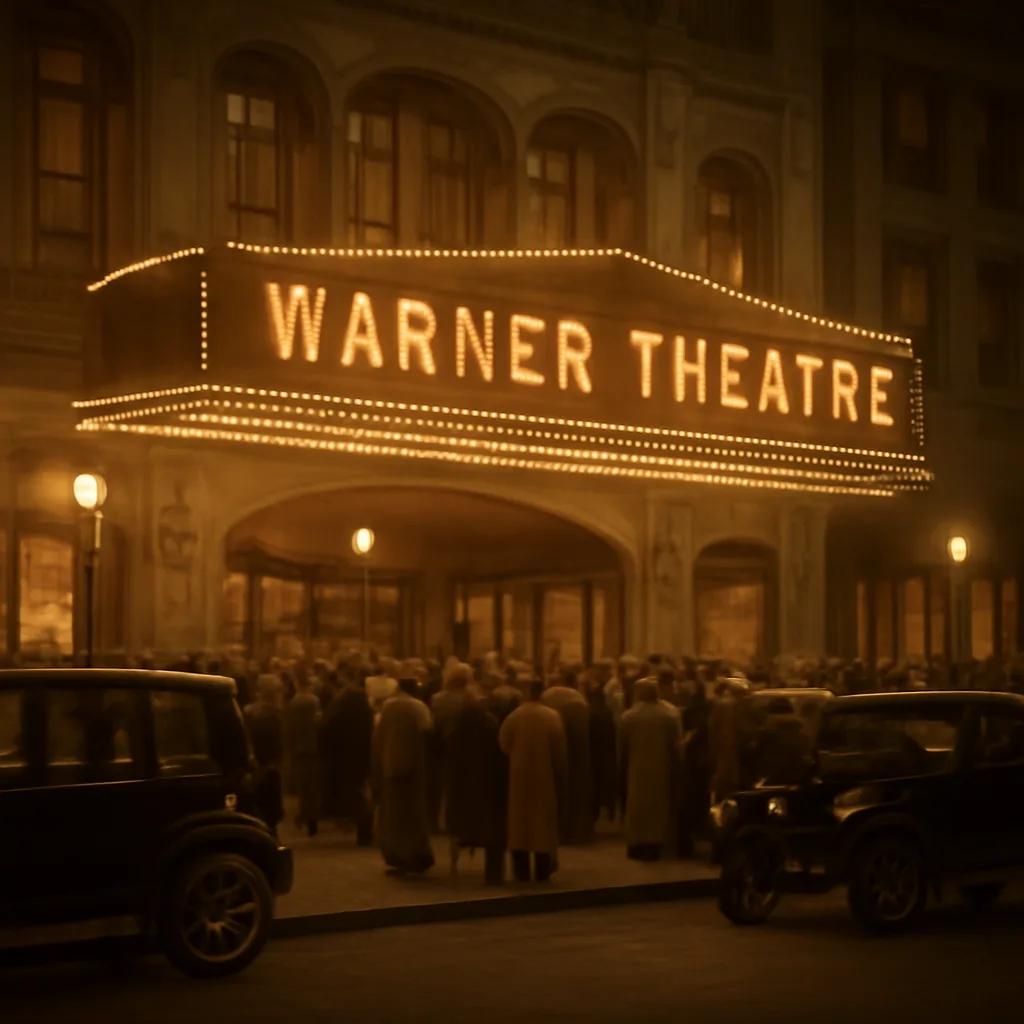
The First Public Premiere of a Feature-Length Sound Film, May 6, 1927
On May 6, 1927, Warner Bros. held the premiere of The Jazz Singer in New York City, widely regarded as the first commercially successful feature film to include synchronized recorded sound and musical performances, marking a pivotal shift in cinema exhibition.
On May 6, 1927, in New York City, Warner Bros. premiered The Jazz Singer at the Warner Theatre. The film, starring Al Jolson, combined silent sequences with synchronized musical performances and brief spoken lines recorded on Vitaphone discs. While short sound films and experiments with synchronized sound had appeared earlier, this event is widely recognized as the moment that brought synchronized recorded sound into mainstream commercial cinema and accelerated the industry’s transition from silent pictures.
Background
Experiments in synchronizing recorded sound with motion pictures date back to the late 19th and early 20th centuries. Inventors and filmmakers tried a variety of approaches—phonograph accompaniment, sound-on-film systems, and disc-based synchronization. Warner Bros., a smaller studio at the time, invested in the Vitaphone system, a sound-on-disc technology developed by Bell Telephone Laboratories and Western Electric and marketed by Western Electric and Vitaphone Corporation. Vitaphone synchronized a phonograph record with the projector so that music, effects, and limited spoken lines could be heard in sync with the picture.
The Film and Its Premiere
The Jazz Singer was adapted from a 1925 play of the same name. Though primarily a silent film—using intertitles for most dialogue—it included several musical numbers and brief spoken segments recorded on Vitaphone discs. Al Jolson’s performance, particularly his onstage musical numbers and a few spoken lines, drew the audience’s attention and became emblematic of what sound could add to film storytelling and spectacle.
The premiere at the Warner Theatre was heavily promoted and attended by members of the press, industry figures, and paying patrons. Contemporary reports emphasized both the novelty of hearing synchronized music and the dramatic effect of hearing an actor’s voice during key moments. The commercial success of The Jazz Singer’s release signaled to other studios and exhibitors that audiences were eager for sound films, prompting rapid investment in sound technologies and changes to theater equipment and production practices.
Significance and Caveats
The Jazz Singer’s premiere is often cited as the watershed event that launched the sound era in Hollywood. Its importance rests less on being the absolute first use of synchronized sound and more on its commercial impact: it reached wide audiences, demonstrated the market potential of sound pictures, and triggered industry-wide adoption.
Historians note important qualifications. Earlier short films and demonstrations had synchronized sound, and other systems—particularly sound-on-film technologies—were being developed contemporaneously. Additionally, The Jazz Singer contains mostly silent sequences; its status as the first ‘‘sound film’’ depends on how the term is defined. Nonetheless, the May 6, 1927 premiere stands as a clear turning point in film exhibition and industry practice.
Aftermath
Following The Jazz Singer’s success, studios accelerated the conversion of production and exhibition facilities to sound. By the early 1930s, the industry had largely completed the transition to talking pictures, and new narrative and performance conventions emerged around recorded dialogue and music. The premiere of The Jazz Singer remains a milestone in film history for its role in demonstrating the commercial viability and audience appeal of synchronized recorded sound.