
← Back
05/09/1943 • 7 views

First Successful Test of a Kidney Dialysis Machine, May 9, 1943
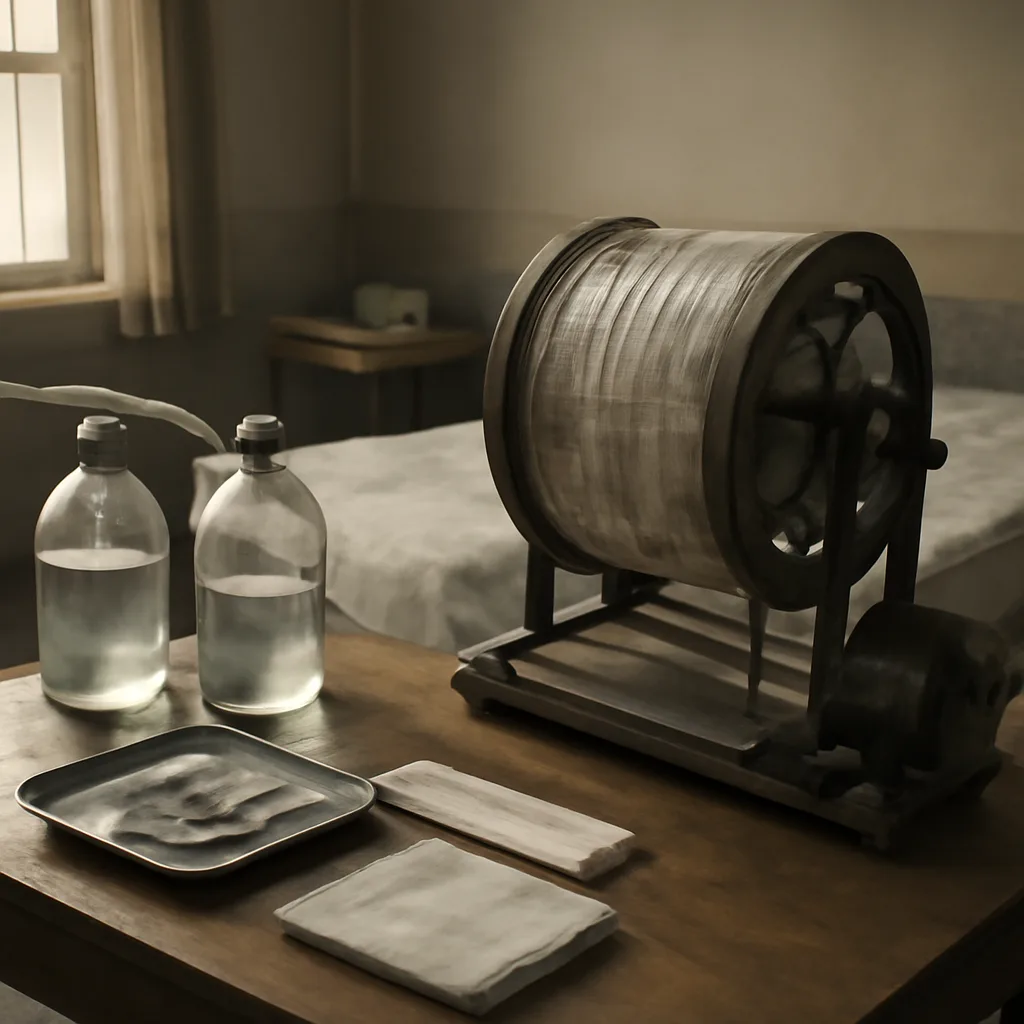
A 1940s-era rotating drum dialyzer made from coiled cellophane tubing and a wooden drum with nearby medical equipment on a simple table in a small clinical room.

On May 9, 1943, a team led by Dutch physician Willem Kolff completed the first successful clinical test of an artificial kidney — an early dialysis machine — marking a foundational moment in renal medicine that paved the way for modern hemodialysis.


On May 9, 1943, in Kampen, the Netherlands, physician Willem J. Kolff performed the first successful clinical test of an artificial kidney, an event widely regarded as the origin of practical hemodialysis. Working during the German occupation in World War II and constrained by scarce materials, Kolff constructed a rotating drum dialyzer from readily available parts — sausage casings for cellophane tubing, a wooden drum, an electric motor, and hospital supplies. The device removed waste products from a patient's blood by perfusing blood through cellophane tubes bathed in a cleansing fluid, demonstrating that toxic metabolites could be cleared when the patient’s kidneys had failed.

Context and motivations
Kidney failure (uremia) had been almost uniformly fatal in the early 20th century, with only limited and largely ineffective treatments available. Kolff, trained in internal medicine and inspired by prior physiological and experimental work on diffusion and dialysis, sought a practical method to substitute for kidney function. His approach built on earlier laboratory research by others on dialysis principles, but Kolff’s design emphasized clinical applicability using improvised materials under wartime shortages.

The machine and the first test
Kolff’s apparatus, often called the Kolff rotating drum dialyzer, consisted of long lengths of cellophane tubing coiled around a rotating drum submerged in a bath of dialysis fluid. Blood flowed through the tubing while the dialysis fluid outside the tubing carried away uremic toxins by diffusion. The rotation refreshed the dialysis fluid and improved clearance. On May 9, 1943, Kolff used the device on a patient with renal failure; although early treatments were far from the safety and efficiency of later machines, this instance demonstrated the principle that extracorporeal removal of waste could sustain life or improve outcomes.

Immediate aftermath and development
Initial clinical results were mixed, owing to limitations in anticoagulation, infection control, vascular access, and dialyzer efficiency. Nevertheless, Kolff continued refining his design and treating patients after the war. His work attracted attention internationally and inspired other physicians and engineers to improve materials, blood access techniques, and pump systems. Over the 1940s and 1950s, progressive innovations — including stainless-steel and later synthetic membrane dialyzers, cellulosic and synthetic membranes, better anticoagulants, and reliable blood pumps — transformed dialysis from an experimental rescue therapy into a reproducible clinical treatment.

Significance and legacy
The May 9, 1943 test did not immediately create a routine cure for renal failure, but it established dialysis as a feasible clinical concept. Kolff’s pioneering effort is widely cited as the practical origin of modern hemodialysis, a therapy that has since saved and prolonged millions of lives. The development involved many contributors over subsequent decades: engineers, nephrologists, and industry partners who addressed vascular access, anticoagulation, membrane technology, and home- and hospital-based delivery models.

Notes on attribution and sources
Historical accounts attribute the first successful clinical dialysis to Willem Kolff’s work in the Netherlands in 1943; descriptions of the apparatus and early cases appear in contemporaneous reports and later historical reviews of nephrology. Exact details of individual patients, immediate outcomes, and successive trial dates can vary among sources; where specifics are disputed, historians rely on Kolff’s notes, wartime records, and later retrospectives by medical historians. This summary avoids inventing patient-level details that are not consistently documented in primary sources.

Share this

Email Share on X Facebook Reddit

Did this surprise you?