
← Back
05/09/1902 • 7 views

Collapse at Ibrox: Britain’s first major modern stadium disaster
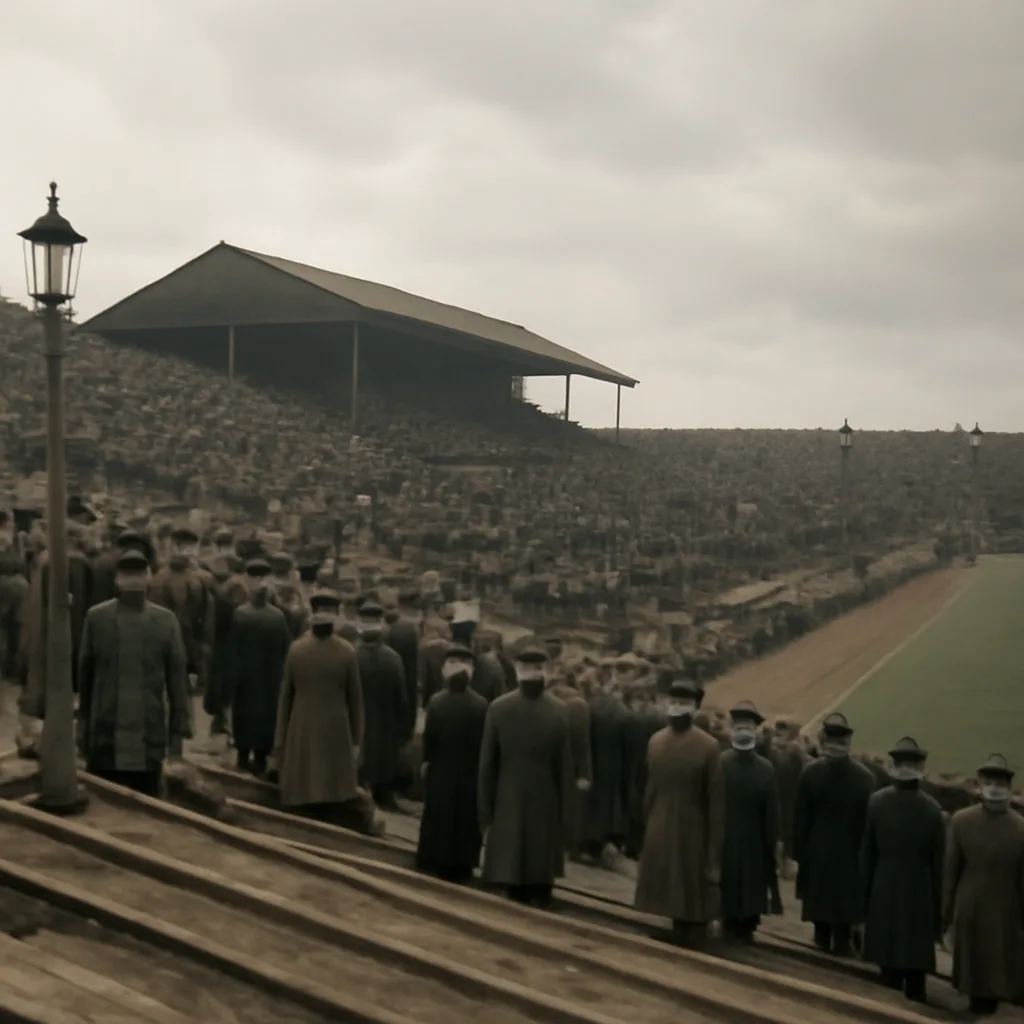
Crowded early-20th-century wooden terracing at a football ground with people standing and walking; scene viewed from a slight distance showing the scale of the stand and surrounding earthworks, pre-collapse.

On May 9, 1902, part of the terracing at Ibrox Park in Glasgow collapsed during a Scotland vs. England football match, killing 25 people and injuring hundreds — the deadliest stadium structural failure of its era and a watershed for crowd-safety standards.


On the afternoon of May 9, 1902, Ibrox Park (commonly called Ibrox) in the Cessnock district of Glasgow hosted an international football match between Scotland and England. Contemporary accounts and later investigations record that a section of newly rebuilt wooden terracing failed under the weight of thousands of spectators, producing a collapse that killed 25 people instantly or shortly thereafter and injured some 500 more. The disaster drew immediate public attention and led to questions about stadium design, materials and crowd management that reverberated through Britain and beyond.

Background and setting

Ibrox Park had been developed by Rangers Football Club and, like many late-Victorian and Edwardian sports grounds, combined older earthworks with newer construction — in this case, wooden terraces and stands intended to increase capacity for high-profile matches. International fixtures attracted very large crowds, and safety standards for large public structures were in a formative stage; modern building codes and systematic crowd-safety engineering did not yet exist.

Sequence of events

On the day of the match, eyewitnesses reported a dense crowd on the western terracing (sometimes called the West Stand or West Tribune) when a section of the wooden structure gave way. Contemporary newspaper reports describe people falling and being trampled as the collapse propagated. Rescue efforts began immediately, with spectators, police and medical personnel assisting the injured and retrieving the dead. Hospitals in Glasgow received large numbers of casualties, and official tallies were compiled over the following days.

Casualties and immediate response

Authorities ultimately recorded 25 fatalities and hundreds of injuries; sources differ slightly on exact injury counts, reflecting the chaotic aftermath and record-keeping practices of the time. The disaster prompted inquests and public inquiries that examined the causes of the collapse and the adequacy of the construction and maintenance of the terraces.

Investigations and causes

Official investigations attributed the failure primarily to structural weaknesses in the wooden terrace, including inferior materials and insufficient foundations for the loads imposed by a large crowd. Reports highlighted the combined effects of heavy rainfall in the preceding days, which may have softened supporting earthworks, and the limited understanding of dynamic crowd loads. The incident exposed the risks inherent in rapid expansion of spectator facilities without standardized engineering oversight.

Legacy and reforms

The Ibrox disaster of May 1902 is widely regarded by historians of sport and engineering as one of the first major modern stadium disasters. Its significance lay not only in the tragic loss of life but in the policy responses it provoked. The inquiries that followed led to stricter attention to construction standards for stadia in the United Kingdom and contributed to evolving practices in crowd control, exit routing and the use of more durable materials. Over subsequent decades, these lessons influenced the gradual adoption of metal and reinforced-concrete stands and more rigorous inspection regimes.

Commemoration and historical perspective

The 1902 Ibrox collapse remains a somber chapter in the history of British sport. Modern discussions of stadium safety commonly reference early disasters such as this one when tracing the development of regulations and engineering practice. While later incidents — including other collapses and crushes in the 20th century — led to further reforms, the events of May 9, 1902 helped frame public and professional awareness that spectator venues require careful structural design and ongoing oversight.

Notes on sources and certainty

Details such as exact casualty figures and some eyewitness descriptions vary across contemporary newspapers, official inquest records and later histories. Where disagreement exists, scholars typically present the 25-fatality figure as the accepted count while acknowledging variability in reported injury numbers and inferences about contributory factors like soil conditions. No direct quotations are invented here; the account synthesizes widely reported facts from period reporting and subsequent historical analysis.

Share this

Email Share on X Facebook Reddit

Did this surprise you?