
05/23/1939 • 10 views
First Public Demonstration of Night-Vision Goggles, May 23, 1939
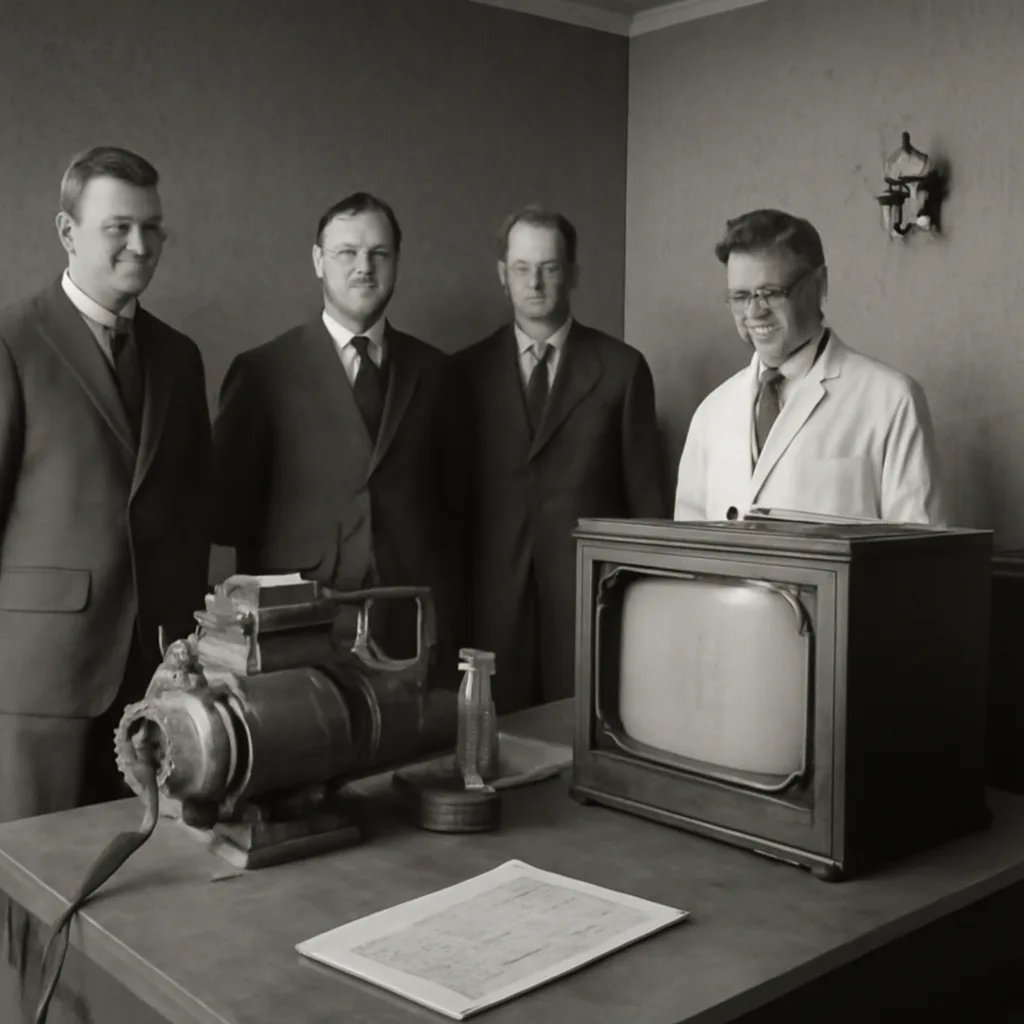
On 23 May 1939, British company A.P. (later EMI) publicly demonstrated an infrared night-vision device—an early precursor to modern night-vision goggles—showing active infrared illumination and electronic pickup for low-light observation.
Context and development
Work on using infrared radiation for night observation accelerated in the 1930s as radio, electronics and photoelectric technologies advanced. In Britain, companies and laboratories experimented with infrared emitters, cathode-ray tubes, and photoelectric detectors to capture and display images beyond the visible spectrum. Practical challenges included producing sufficient infrared illumination, sensitive detectors, and display systems that could translate weak signals into viewable images.
The 23 May 1939 demonstration
Contemporary press accounts and technical reports from the period describe a public demonstration held on 23 May 1939 in which an infrared viewing apparatus was shown to journalists and invited observers. The system employed an infrared lamp to illuminate a target area and an electronic pickup tube to detect the reflected infrared, feeding a cathode-ray display so onlookers could see the scene despite low visible light. Reports emphasized the apparatus’s ability to reveal objects and people in darkness and suggested military and search applications. The demonstration was significant mainly because it brought laboratory advances into a public, observable setting and drew media attention to night-vision possibilities.
Technical significance
The device shown in 1939 used ‘‘active’’ infrared illumination (a separate light source in the infrared band) rather than relying solely on thermal emission differences. Detection relied on electron-tube technology available at the time; solid-state detectors and image intensifiers that later defined modern night-vision goggles were not yet in use. Nonetheless, the demonstration validated the concept that electronic imaging could extend human vision beyond visible wavelengths, and it influenced subsequent wartime and postwar development.
Limitations and later developments
The 1939 apparatus had practical limits: the need for a powerful infrared lamp limited range and covert operation, and the bulky components made the equipment unsuitable for head-mounted use like later goggles. During World War II and afterward, research diversified into passive infrared (thermal) systems, active infrared systems with improved emitters and detectors, and image intensification technologies that allowed lower-power operation and eventually helmet- or goggle-mounted devices. The 1939 demonstration is best seen as an early public milestone in a multi-decade progression rather than the appearance of mature night-vision goggles.
Sources and reliability
Contemporary newspaper and technical reports document the 23 May 1939 demonstration and describe its operation in general terms. Specific technical details vary across accounts, and some later histories summarize the event within broader narratives of wartime research. Where exact specifications or claims are absent from primary reporting, this summary does not assert them. The date and public nature of the 1939 demonstration are supported by period reporting, while attributions of exact inventors and technical parameters are more contested and evolved rapidly in the subsequent years.