
← Back
01/08/1934 • 5 views

Nikola Tesla Publicly Describes His Proposed 'Death Ray' Concept
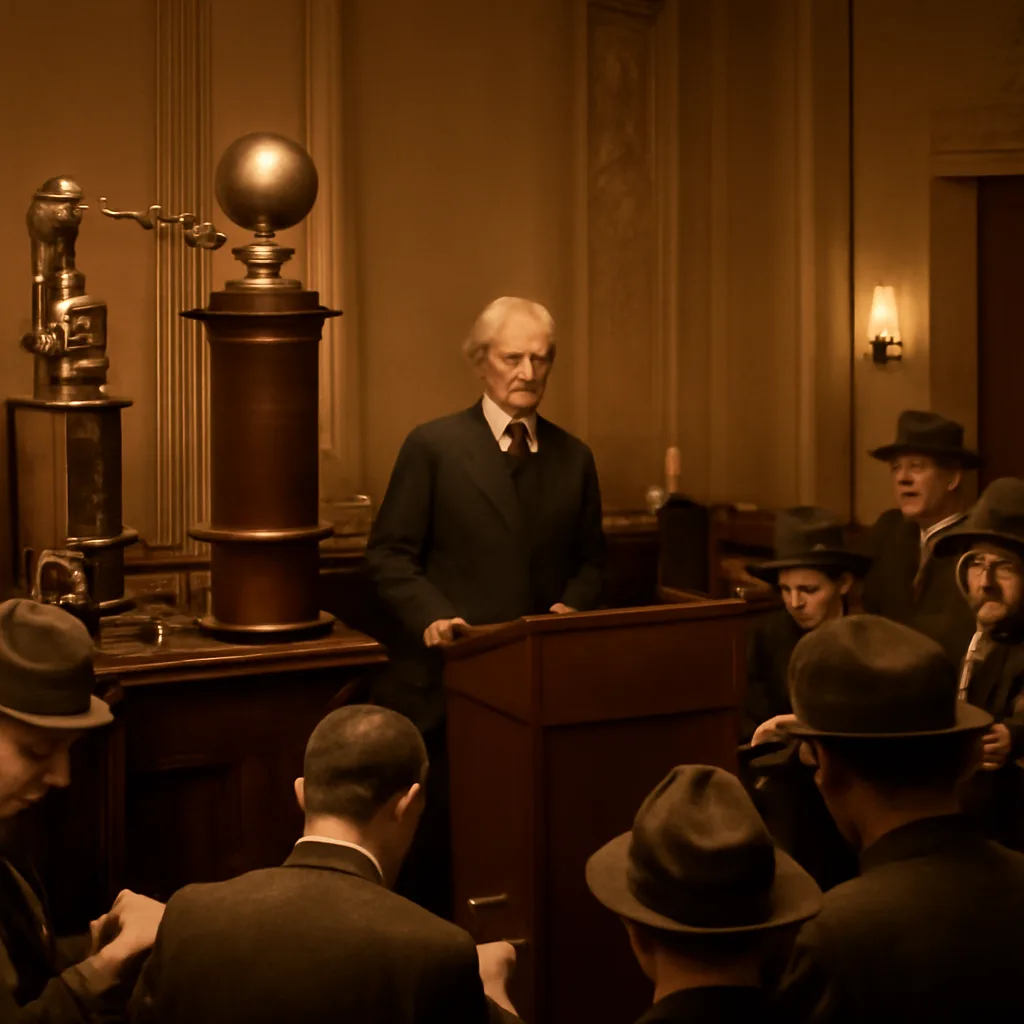
1930s indoor press conference scene with an older Nikola Tesla speaking beside early electrical equipment and journalists with notebooks and cameras.

On January 8, 1934, inventor Nikola Tesla outlined a weaponized directed-energy concept—popularly dubbed a 'death ray'—claiming it could destroy aircraft and armies at a distance and serve as a deterrent to war.


On January 8, 1934, Nikola Tesla held a press conference in New York at which he presented plans for a high-powered, directed-energy weapon that the press and public soon labeled a "death ray." Tesla framed the device as both a defensive deterrent and an instrument that, if realized, could make war impossible by rendering military attack prohibitively destructive.

Tesla described a system that, in his view, would transmit concentrated beams of energy at a distance to disable or destroy targets such as aircraft, ships or massed troops. He spoke of generating tremendous voltages and directing the resultant energy through a form of focusing apparatus. He asserted that such a device could be built to project a beam that would be effective over great distances and that multiple such installations could protect entire nations.

Tesla had discussed various concepts of wireless transmission of power and directed radio-frequency energy for years prior to 1934. His public statements in the 1920s and 1930s combined speculative engineering ideas with claims about untapped physical principles; contemporaries often treated his pronouncements with a mix of fascination and skepticism. By 1934, advances in radio, vacuum-tube technology and high-voltage engineering had captured public imagination about novel weapons, and reporters amplified Tesla’s more dramatic assertions.

Contemporaneous press accounts reported Tesla’s claims but also noted technical objections raised by physicists and engineers. Major challenges included the physics of beam propagation and focusing at the scales Tesla suggested, the enormous power requirements, and the difficulty of efficiently converting and transmitting the necessary energy without excessive losses. While Tesla was a proven inventor with recognized achievements earlier in his career, later proposals like the "death ray" lacked detailed engineering plans and peer-reviewed demonstrations that would satisfy the broader scientific community.

Historically, Tesla’s 1934 statements fed into broader interwar anxieties about technological leaps changing the nature of warfare. The idea of a single defensive system capable of preventing aggression appealed to the public yearning for security after World War I. The phrase "death ray" became shorthand in newspapers for any purported terror weapon that might upend military balance. Militaries and governments pursued a range of weapons research in subsequent decades, including developments in directed-energy and radar, but there is no evidence that a device matching Tesla’s popularized description was ever built or that his specific methods were realized as he described.

Modern historical assessments treat Tesla’s 1934 announcement as part invention, part publicity, and part speculative vision. Scholars note that while Tesla contributed valuable work to electrical engineering and radio science, many of his late-career claims were unsubstantiated by reproducible experiments or detailed, peer-reviewed designs. The "death ray" episode illustrates both the enduring public fascination with charismatic inventors and the limits of claims made without transparent technical validation.

This event is documented in contemporary newspaper coverage and later historical summaries of Tesla’s life and public pronouncements. Where details of Tesla’s proposed mechanisms differ across sources, historians emphasize the absence of surviving, rigorous engineering blueprints that would validate the extraordinary performance Tesla described. Accordingly, Tesla’s 1934 announcement remains a notable episode in his career and in interwar technological lore rather than a realized breakthrough in weaponry.

Share this

Email Share on X Facebook Reddit

Did this surprise you?