
05/07/1936 • 7 views
First Public Demonstration of Radar Tracking Aircraft, May 7, 1936
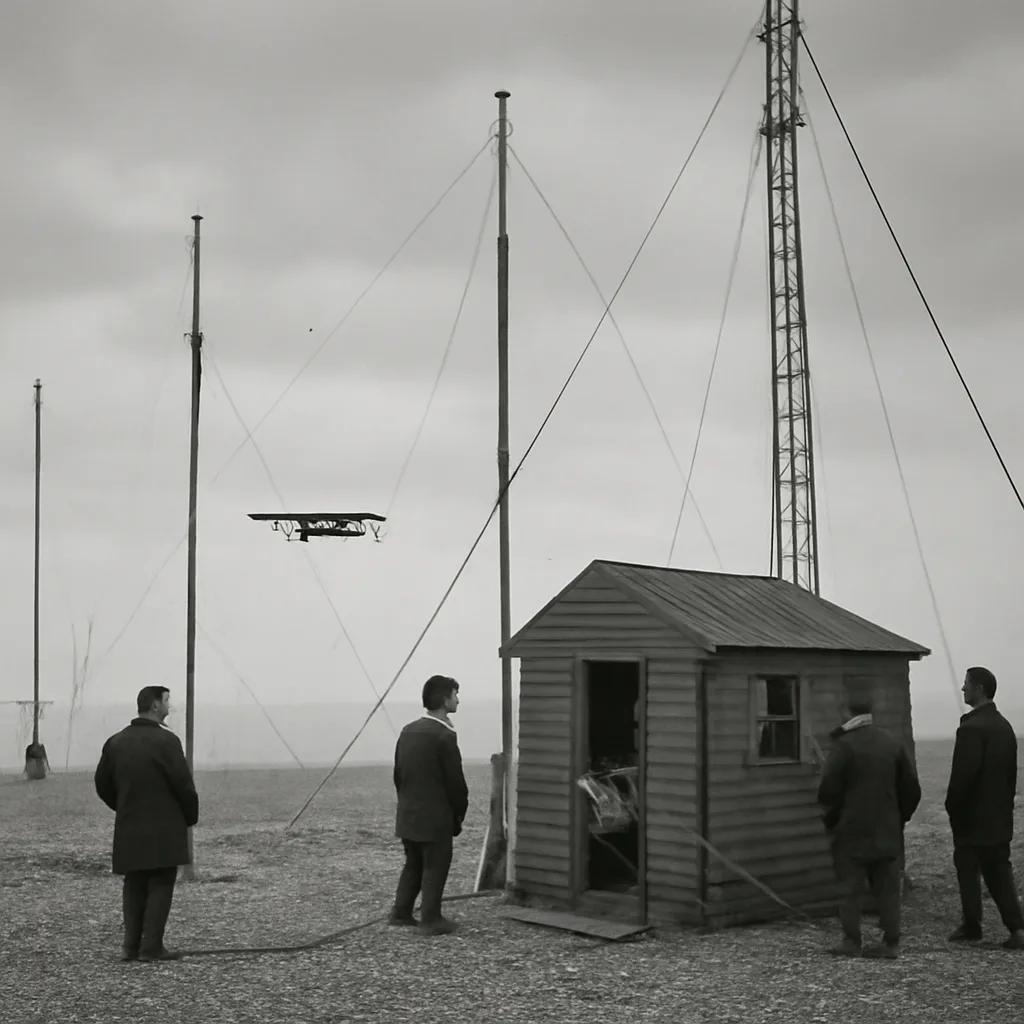
On 7 May 1936, British scientists gave the first public demonstration that radio echoes could detect and track aircraft, a pivotal step in the development of radar for air defence.
Background
During the early 1930s investigators in several countries explored the use of radio waves for detecting objects at a distance. In Britain, researchers at the RRS (based at Slough) and engineers at Marconi were investigating radio reflections from aircraft and other targets. By emitting short pulses of radio energy and measuring the time delay of returned echoes, experimenters could infer range. The technique was gaining technical maturity but had not yet been demonstrated in a public setting with airborne targets.
The demonstration
The event at Orfordness used a pulse transmitter and receiver system installed on the shingle spit and a tracked display that indicated range to an aircraft reflecting the pulses. Aircraft from nearby RAF units flew predictable runs while the apparatus transmitted pulses and recorded echoes. Observers at the site, including military officers and invited technical press, watched operators interpret the display to show that a plane could be detected at useful ranges. Contemporary accounts emphasised the practicality of using radio echoes for early warning and fighter direction—functions that would later underpin wartime radar networks.
Technical significance
The Orfordness demonstration validated several practical elements: transmitting sufficiently short pulses, receiving and amplifying weak echoes, discriminating true echoes from noise and sea clutter, and presenting range information that could be interpreted by operators. While prior laboratory tests had shown echoes from reflecting objects, this field demonstration established the method’s viability against a real airborne target over operationally relevant distances and under environmental conditions such as sea reflections and variable aircraft attitude.
Immediate and later impact
The public demonstration accelerated interest within the British military and industry. It helped justify further funding and development of radar systems—known then by various names including "radio direction-finding" or "radio detection and ranging"—that would be expanded and networked in the late 1930s. The technical concepts validated at Orfordness were developed into chain-linked coastal and air-defence stations before and during World War II, culminating in systems that played a critical role in detecting and directing responses to incoming aircraft.
Caveats and context
Historical descriptions sometimes conflate multiple demonstrations and experiments from the mid-1930s, and other laboratories in Britain and abroad were conducting related work in the same period. While 7 May 1936 is widely cited for the Orfordness public demonstration of aircraft detection by radio echoes, earlier laboratory results and parallel experiments elsewhere contributed to the rapid development of radar technology.
Legacy
The Orfordness demonstration is remembered as an early, public turning point from laboratory curiosity to operational possibility for radar-based air surveillance. It signalled that radio-echo techniques could provide practical warning of aircraft at ranges and under conditions relevant to national defence—a realization that shaped prewar and wartime investments in radar infrastructure.