
05/07/1945 • 6 views
Site for First Atomic Blast Decided in Secret
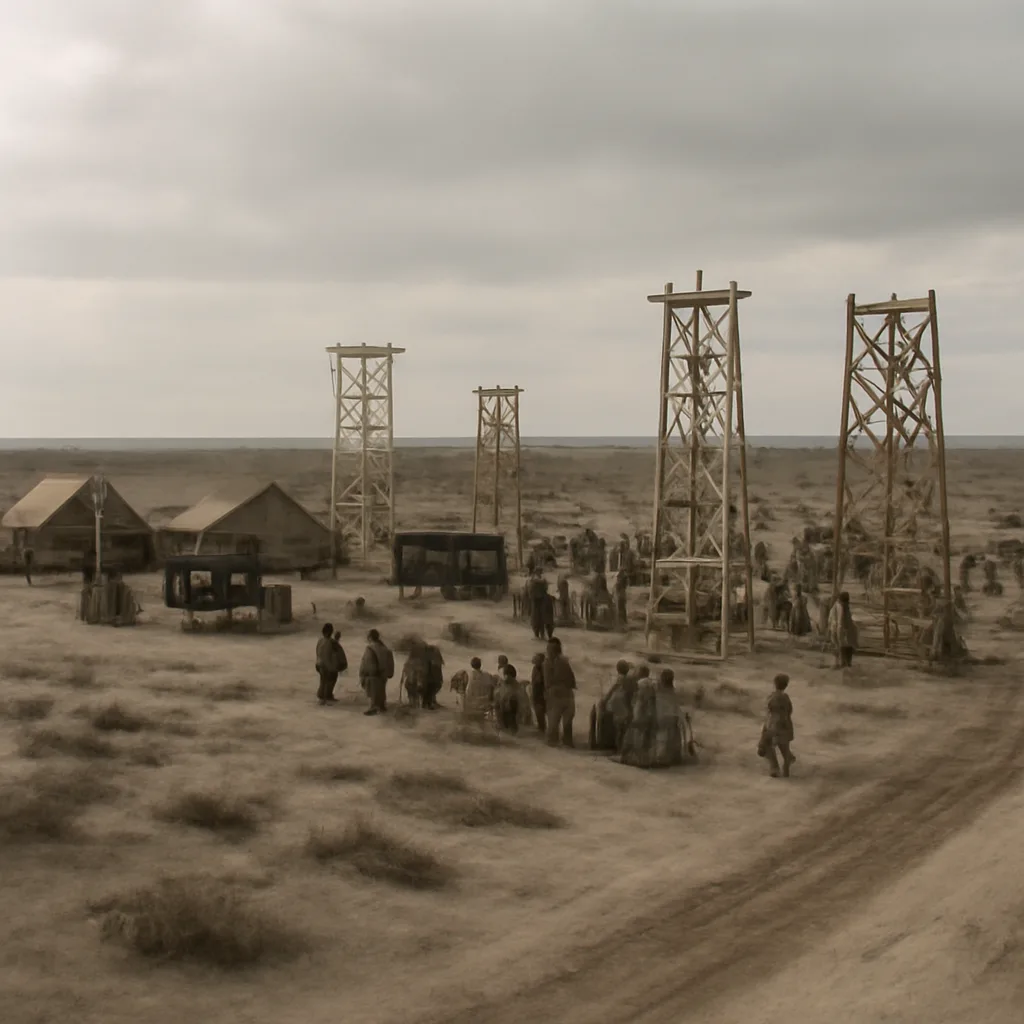
On May 7, 1945, U.S. military and scientific leaders finalized a remote test location for the first atomic bomb—decision made under tight secrecy as World War II neared its end.
Technical and safety requirements drove the selection process. Project leaders needed an isolated site with sufficient range to observe blast effects, conduct instrumentation, and minimize risk to civilians and infrastructure. The site also had to accommodate construction of instrumentation towers, observation posts, support camps, and the delivery and assembly of bomb components. Weather patterns and terrain were evaluated to provide clear observation and predictable blast propagation.
Security and secrecy were paramount. The Manhattan Project had operated on strict need-to-know principles since its inception. Choosing a test site required limited personnel access, controlled transportation routes, and the ability to restrict air and radio traffic. Military and civilian personnel involved in the decision and subsequent preparations were bound by security protocols to avoid leaks that might alarm the public or adversaries.
Logistics shaped the final selection. The chosen location needed existing or rapidly improvable access for trucks, rail, and personnel while remaining remote enough to reduce chance of accidental exposure. Support facilities—barracks, medical services, workshops, and fuel supplies—had to be established quickly and with minimized outside visibility. The proximity of military bases for security and air support was also considered.
While documentation of the specific deliberations is fragmented across military and Manhattan Project records, contemporary primary sources and later histories make clear that planners prioritized isolation, clear observation lines, and secure transport. The decision in early May 1945 set in motion construction of towers, cameras, and instrumentation and the relocation of a dedicated workforce to prepare for the unprecedented trial.
The selection and preparation were carried out without public announcement. Only a limited circle of scientists, engineers, and military officers knew the exact site and schedule. This secrecy aimed to prevent espionage, public alarm, or interference and to preserve the strategic advantage that a successful test could provide.
The site’s eventual use for the first full-scale nuclear detonation represented a turning point in military technology and global history. That the location choice was finalized in this clandestine manner reflects the wartime environment and the sensitivity of the work underway. Many of the records and personal accounts produced in subsequent years corroborate the combination of technical, security, and logistical considerations that converged in May 1945 to fix the test site, although specific contemporaneous discussions were often recorded in compartmented files and need careful cross-referencing in archival research.
Historians continue to rely on declassified documents, oral histories, and contemporaneous military records to reconstruct the selection process. Some details of private deliberations remain sparse because of compartmentalization and later loss or classification of documents, so certain aspects of the internal debate are unevenly documented. Nonetheless, the broad contours—the emphasis on isolation, instrumentation needs, and secrecy—are well supported in the historical record.