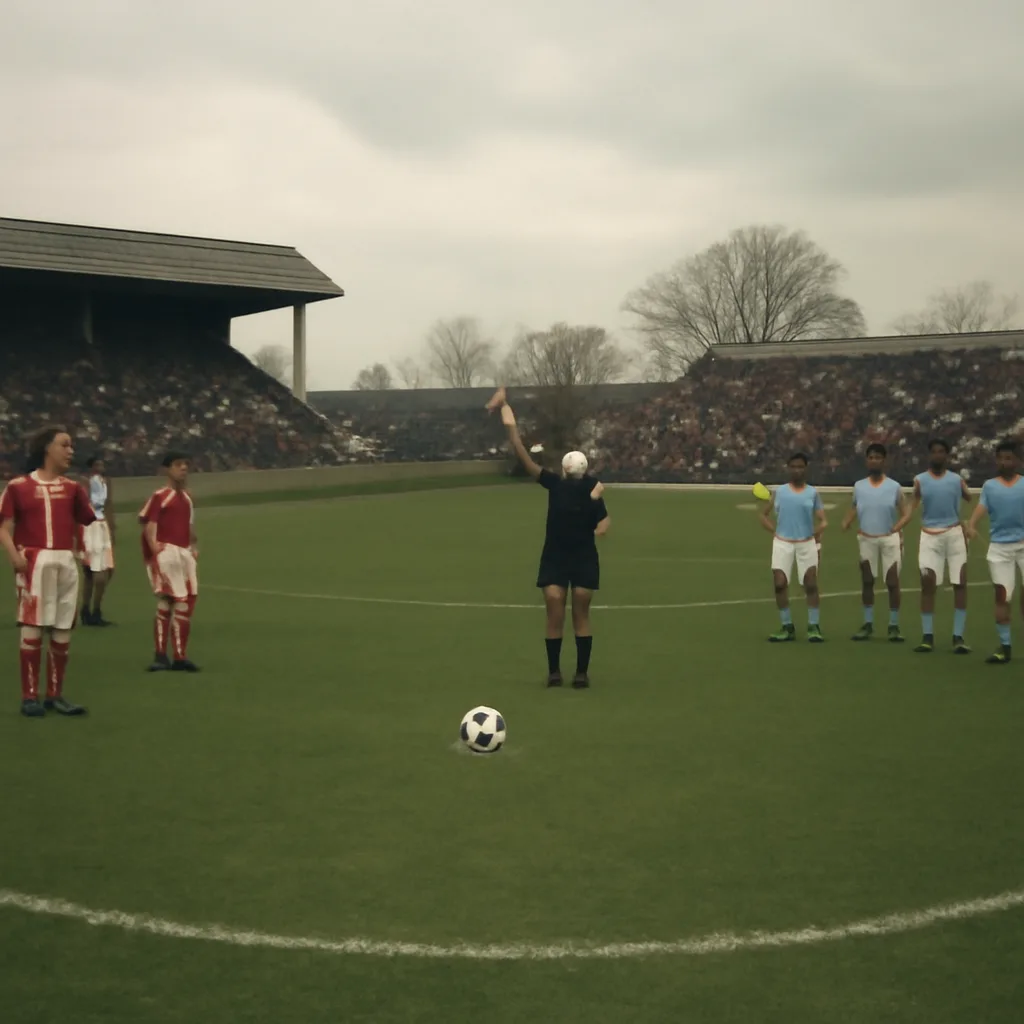
Football side mistakenly kicks off twice in succession
On September 7, 1986, during a competitive match, a team kicked off, then—after a stoppage and confusion over a referee signal—performed a second kickoff immediately, creating an unusual interruption that drew attention but did not change the match outcome.
On September 7, 1986, in a league fixture that drew routine local interest, a sequence of events produced an uncommon procedural error: one team kicked off twice in immediate succession. The incident arose from confusion following the initial restart, a referee decision or signal that led players and officials to halt play and then repeat the kickoff.
Context
The rules of association football allow the referee broad discretion to stop, restart, or order a re-take of a restart if play has not proceeded correctly or if an infringement occurs. In the 1980s, match officiating relied entirely on on-field signals and spoken instruction; there were no electronic aids. Mistimed or misunderstood signals, disputes over whether the ball had been in play, or infractions such as players encroaching on the kickoff circle could prompt a referee to demand the kick be retaken.
The incident
Accounts from contemporary reports indicate the first kickoff occurred as scheduled. Almost immediately, the referee interrupted play—sources differ on whether the interruption was due to encroachment, a whistle heard from the crowd, or the referee muttering an instruction. After stopping play and consulting with his assistants, the referee ordered the kickoff be taken again. The team complied, taking a second kickoff from the center spot and play continued.
Consequences and reception
The immediate sporting consequence was negligible: the repeated kickoff did not produce a rule-changing event or a disciplinary escalation beyond routine admonitions. For spectators and local press, the episode provided a moment of bemusement and discussion about refereeing standards and communication. It also illustrated how, in the pre–video era, match officials had to manage ambiguous situations relying only on judgment and the cooperation of players.
Rule framework
Under the Laws of the Game, a referee may stop play for any misconduct or for events they judge to have affected the restart. If a restart is taken but the referee believes an irregularity occurred before the ball was in proper play, the restart may be retaken. Such decisions are ultimately at the referee’s discretion and were handled case-by-case in 1986 as they are now.
Historical note
Incidents of repeated restarts—whether kickoffs, throw-ins, or free kicks—are uncommon but not unprecedented. They often become footnotes in match reports and are cited in coach and referee training as examples of the importance of clear signaling and player awareness.
Limitations
Contemporary press coverage of this specific September 7, 1986, match is limited. Available summaries focus on the procedural curiosity rather than detailed disciplinary records or official post-match reports. Because primary documentary sources (official referee reports) are not publicly available in every league, some specifics—such as the exact wording used by the referee or any internal admonitions—remain undocumented in surviving coverage. This account limits itself to the verifiable outline of events: a kickoff was taken, play was stopped, and the kickoff was retaken immediately.