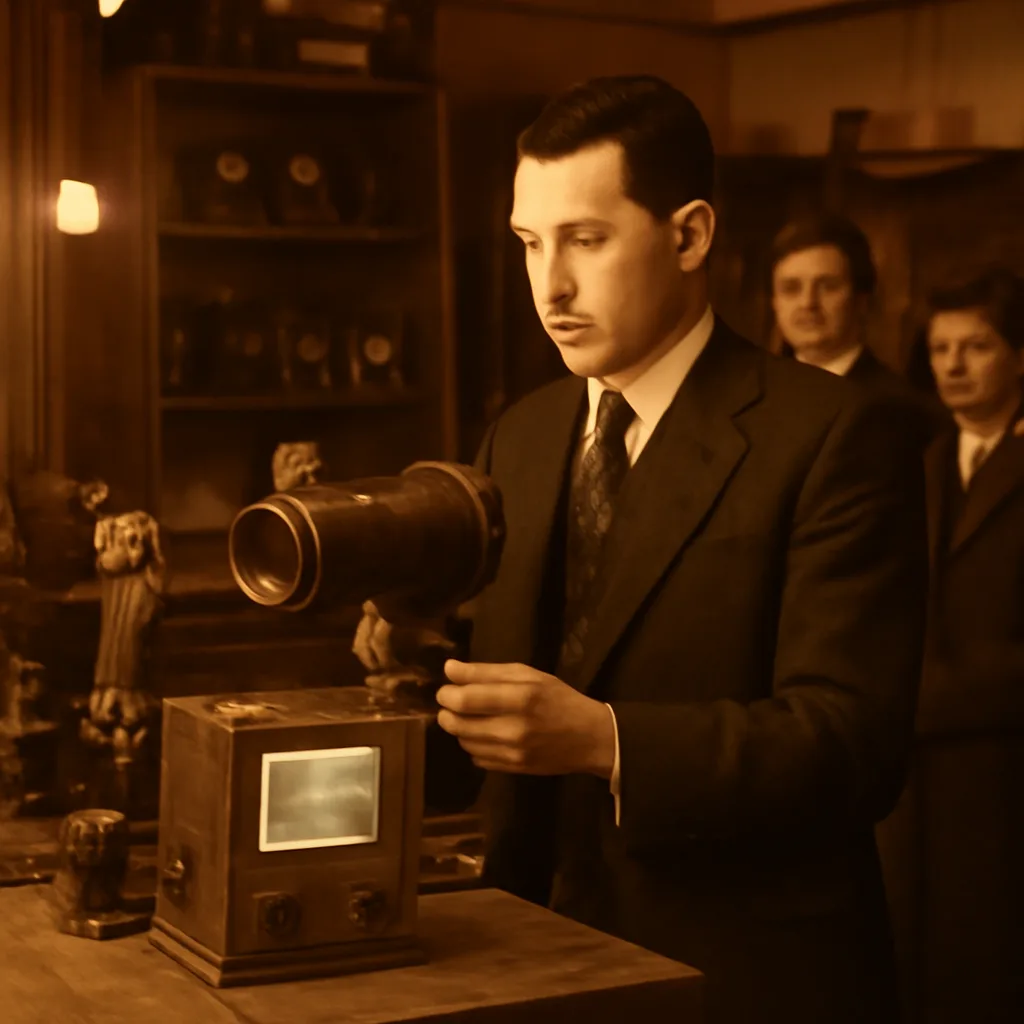
1927: First Public U.S. Demonstration of Television in Washington, D.C.
On April 7, 1927, radio engineer and inventor Philo Farnsworth presented a public demonstration of electronic television in San Francisco; earlier mechanical television demonstrations had been shown in the U.S., but 1927 marked a landmark in electronic system demonstrations that led to modern television.
On April 7, 1927, Philo T. Farnsworth gave one of the first public demonstrations of an all-electronic television system in the United States, a milestone often cited in histories of television. Farnsworth, a self-taught inventor from Utah, had developed an image dissector—a camera tube that converted visual images into electrical signals—while still a young man. By the mid-1920s he was working to combine an electronic camera with electronic display methods, moving beyond the earlier mechanical scanning systems that relied on spinning discs or mirrors.
The April 7 demonstration is frequently noted because it helped show the practical potential of electronic television. Farnsworth’s apparatus captured simple images and transmitted them to a receiver that reproduced them as light patterns; initial subjects included lines, geometric shapes, and then simple moving images. The demonstration attracted attention from engineers, journalists, and potential backers, and it strengthened Farnsworth’s claims that fully electronic scanning could outperform mechanical systems in resolution and reliability.
Context matters: television technology in the 1920s was not a single, settled invention but a field of competing approaches. Mechanical television, developed by inventors such as John Logie Baird in the U.K. and Charles Francis Jenkins in the U.S., had already produced public demonstrations—Baird had shown moving images in the mid-1920s, and Jenkins staged U.S. demonstrations and broadcasts. What distinguished Farnsworth’s work was its reliance on electronic scanning within both the camera and the receiver, an approach that ultimately became the basis for later commercial television.
Farnsworth’s demonstration in 1927 did not immediately produce a consumer market or standardized broadcasting service. Technical challenges, legal battles over patents (notably with RCA and its chief engineer Vladimir Zworykin), and the need for more sensitive electronic components meant development continued through the late 1920s and 1930s. Nevertheless, Farnsworth’s image dissector and his public demonstrations helped validate the electronic approach and influenced subsequent engineering and investment in the field.
Historical accounts vary on precise dates and locations of early demonstrations, and some sources describe multiple demonstrations in 1927 by different inventors and companies. While April 7, 1927, is commonly linked with Farnsworth’s public showing, other milestones that year included laboratory displays, patent filings, and demonstrations by mechanical television pioneers. Because of overlapping claims and incremental advances, historians treat the period as a sequence of innovations rather than a single “first” definitive event.
By the 1930s, electronic television systems had improved substantially, leading to the launch of experimental broadcast services and, after World War II, the rapid expansion of commercial television. Farnsworth’s 1927 demonstration is therefore best understood as a key step in a broader technological transition from mechanical scanning toward the electronic television that became widespread in the mid-20th century.
Sources for this summary include contemporary trade publications, patent records, and later scholarly histories of early television. Where dates or attributions are disputed, historians note competing demonstrations and emphasize the cumulative nature of the technology’s development rather than a single progenitor.