Remington Rand Sells the First Commercial Computer
On April 7, 1951, Remington Rand delivered and sold the UNIVAC I, the first commercially produced electronic digital computer marketed for business use, marking a turning point in commercial computing.
On April 7, 1951, Remington Rand (maker of the UNIVAC I) completed delivery of the Universal Automatic Computer I (UNIVAC I) to the U.S. Census Bureau and thus established the first widely acknowledged sale and commercial deployment of an electronic digital computer intended for business and governmental data processing. The UNIVAC I had been developed by J. Presper Eckert and John Mauchly, who previously built the ENIAC; their company, Eckert–Mauchly Computer Corporation, was acquired by Remington Rand in 1950, which then manufactured and marketed the machine.
Technical and commercial context
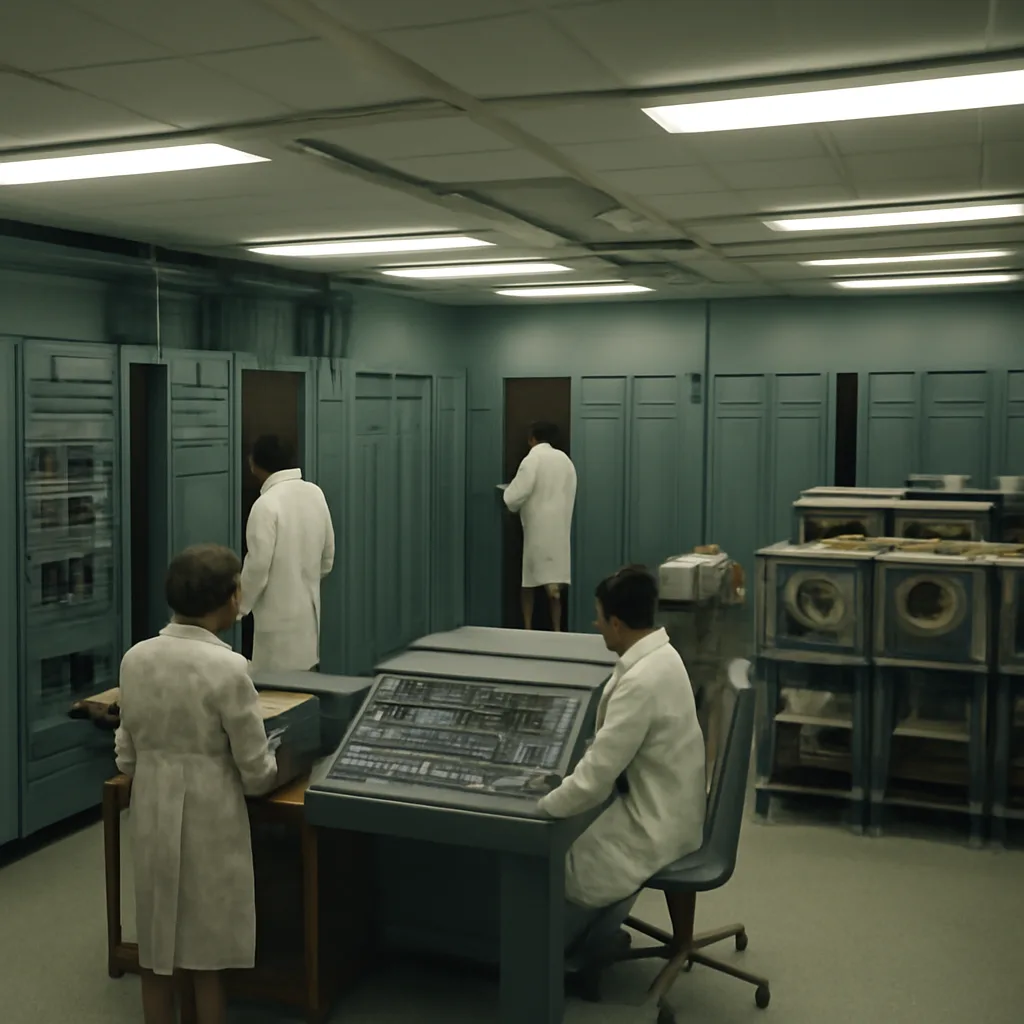
The UNIVAC I was vacuum-tube–based, stored-program, and used mercury delay line memory with a capacity of roughly 1,000 12-character words (about 12,000 characters). It performed arithmetic and data-handling tasks far faster than electromechanical tabulators used previously. Weighing several tons and occupying a large room with consoles and tape drives, the UNIVAC I was not a personal or small-office machine; it was a system sold to organizations with substantial data-processing needs and budgets.
The 1951 delivery followed earlier experimental and military computers, such as ENIAC (1945) and various research prototypes. What made the UNIVAC I notable was that it was produced in quantity for commercial customers rather than being a one-off research instrument. Remington Rand ultimately sold 46 UNIVAC I units to government agencies, large corporations, and research institutions.
Impact and significance
The UNIVAC I demonstrated that electronic digital computation could be applied to civilian administrative tasks like census tabulation, payroll, and inventory management. Its successful operation helped shift public and commercial perception about the practicality and economic value of electronic computers. The machine’s visibility—most famously when a UNIVAC correctly predicted the outcome of the 1952 U.S. presidential election on live television—contributed to broader awareness and demand for computing services and hardware.
Limitations and legacy
Despite its historical importance, the UNIVAC I had limitations: high cost, significant maintenance needs, limited memory by later standards, and dependence on large physical infrastructure and specialized operators. Over the following decade, transistorized and then integrated-circuit computers supplanted vacuum-tube designs, and computer manufacturers evolved rapidly. Nonetheless, the UNIVAC I established the commercial computer industry’s basic model: selling complete electronic data-processing systems to organizations, including hardware, peripherals, and service.
Historiography and precision
Historians commonly cite the 1951 UNIVAC I deliveries as marking the start of the commercial computing era. Some nuance exists about whether other machines or leases might be considered “commercial” in different senses, but the UNIVAC I’s production and sale to multiple paying customers are widely accepted as the watershed moment for commercial electronic computers.
Today the UNIVAC I is remembered as a pioneering commercial product that bridged experimental computing and the industry that followed, laying groundwork for the diversified computer market of subsequent decades.