
← Back
09/16/1999 • 5 views

1999 Russian apartment bombings kill hundreds across several cities
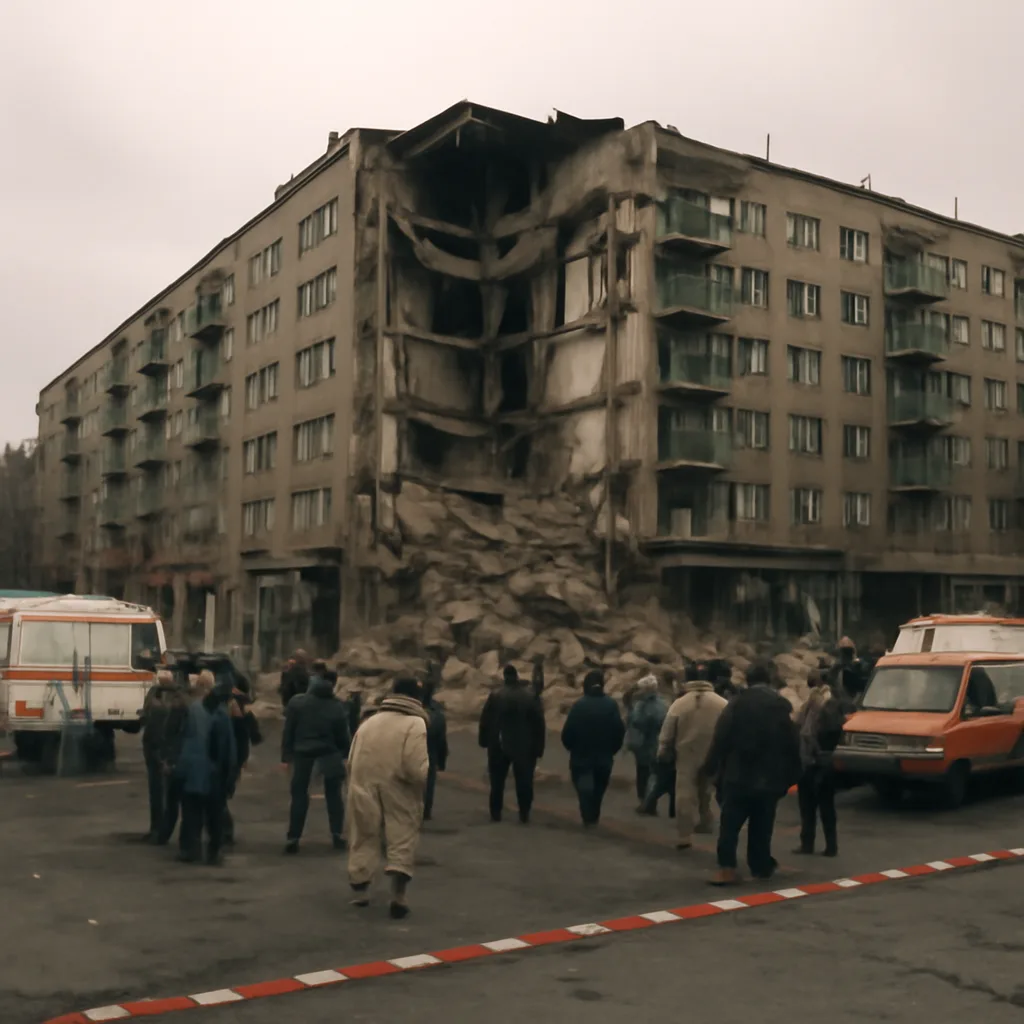
Damaged multi-story apartment building with rubble in front, emergency responders and residents on site, late-1990s Russian city street scene.

In September 1999 a series of deadly bombings targeting residential apartment buildings in Russia killed and injured hundreds, triggering a national security crisis and a contentious investigation that remains disputed.


Between September 4 and September 16, 1999, a string of powerful explosions destroyed or heavily damaged residential apartment buildings in several Russian cities, killing hundreds of residents and injuring many more. The worst attacks occurred in Buynaksk (Dagestan) on September 4, Moscow on September 9 (an explosion on Kashirskoye Highway destroyed an apartment block), and Volgodonsk on September 16. The total death toll from these and related incidents is commonly reported as several hundred, with many more wounded and thousands left homeless.

The bombings took place against the backdrop of a violent insurgency in the North Caucasus and a rising security crisis in Russia. Official Russian investigations attributed the attacks to Chechen separatist militants and cited the incidents as justification for a renewed large-scale military campaign in Chechnya that began in late 1999. Russian authorities, including the Federal Security Service (FSB), presented evidence and statements blaming terrorists tied to forces from Chechnya and Dagestan.

However, the events have been the subject of controversy and dispute. Independent journalists, researchers, and some political figures raised questions about the official narrative, pointing to apparent investigative gaps, disputed forensic findings, and the rapid political consequences that followed the attacks, including a sharp increase in public support for then-Prime Minister Vladimir Putin and his hardline policies. Allegations and theories have circulated suggesting alternative perpetrators or possible involvement by state actors, but these claims remain unproven and are contested. Court verdicts and official reports affirming responsibility by militants exist for some attacks, while other aspects have not been conclusively resolved in the public record.

The bombings had immediate political and social effects. The incidents heightened public fear, strengthened demands for security, and were instrumental in mobilizing support for a second Chechen war. They also coincided with a shift in Russian domestic politics: Vladimir Putin, appointed prime minister earlier in 1999, saw his national profile and approval ratings rise rapidly as he emphasized security and counterterrorism. The campaign in Chechnya that followed led to large-scale military operations, significant civilian casualties, and long-term instability in the region.

Investigations and accountability have varied by case. Russian courts convicted a number of individuals for involvement in some of the bombings, and the official position has consistently blamed Chechen-related extremists. Independent inquiries by journalists and human rights groups have criticized the thoroughness and transparency of official probes and highlighted instances—such as a 1999 explosion in Ryazan that the FSB later described as a training exercise—that fueled public skepticism. International observers and scholars continue to debate aspects of the evidence and the adequacy of investigations.

The legacy of the 1999 apartment bombings endures in Russian politics and public memory. The attacks were a pivotal factor in shaping post-1999 counterterrorism policy, the reassertion of central authority over restive regions, and the political consolidation that followed. For victims and communities directly affected, the bombings resulted in profound loss and long-term disruption. For historians and analysts, the events remain a focal point for examining the interplay between terrorism, state response, political change, and the challenges of transparent investigation in a crisis.

Given contested claims and incomplete public records on certain aspects, some details about responsibility and the full sequence of investigative findings remain disputed among scholars, journalists, and officials. Established facts include the dates and locations of the major attacks, the substantial civilian casualties, and the ensuing military and political responses that reshaped Russia’s early-21st-century trajectory.

Share this

Email Share on X Facebook Reddit

Did this surprise you?