
06/06/1933 • 5 views
America’s First Drive-In Movie Opens in Camden County, New Jersey
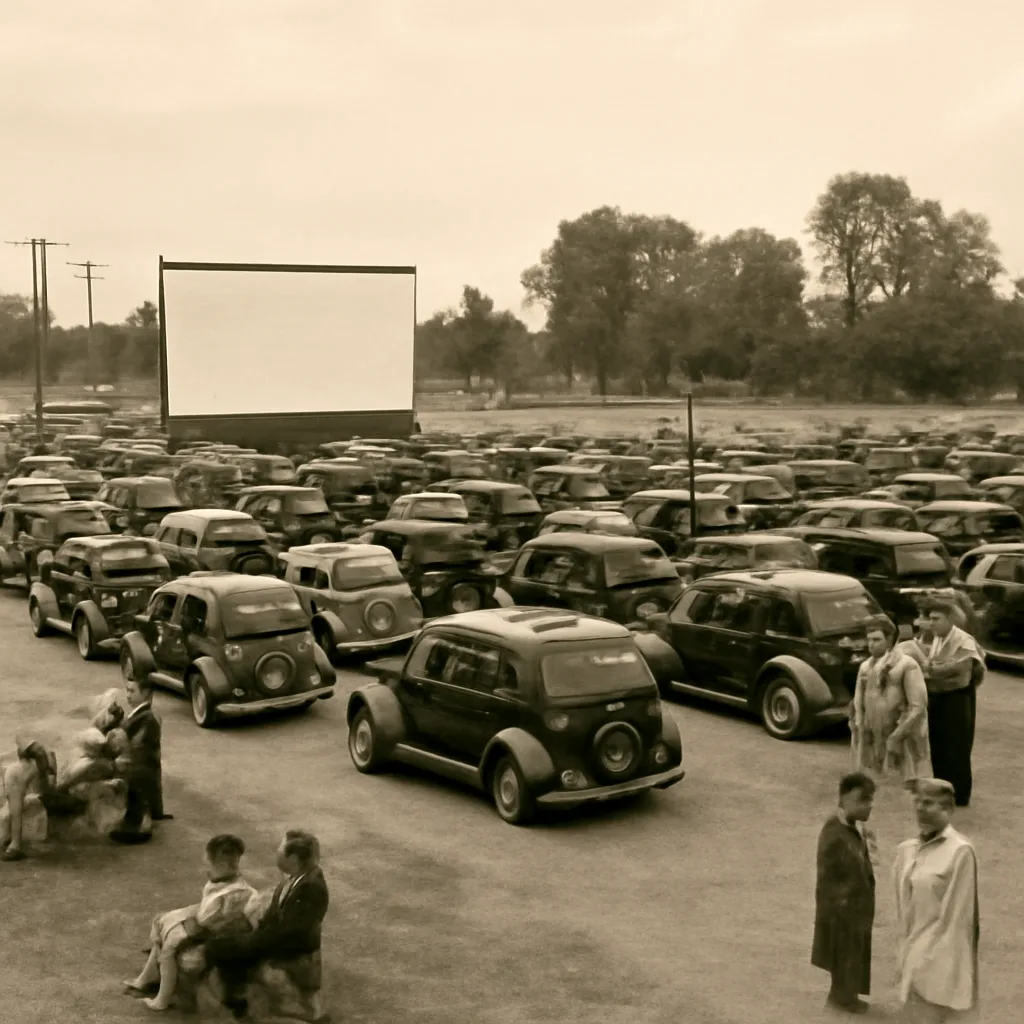
On June 6, 1933, entrepreneur Richard Hollingshead Jr. opened the world’s first commercial drive-in movie theater in Camden County, New Jersey, introducing a novel outdoor cinema format that combined automobiles and film exhibition.
Hollingshead secured a patent in 1933 for a “passenger comfort station” and exhibition method proposing that viewers remain inside their cars while watching films projected on a large screen. He selected a site on Admiral Wilson Boulevard in Pennsauken for the inaugural operation. The layout used a large outdoor screen at one edge of a wide paved lot; cars parked in angled rows facing the screen. Initially the operation was modest and seasonal, constrained by equipment and weather.
Early technical and practical challenges included sound delivery, sightlines, parking arrangement, and lighting. In the first site’s earliest iterations, speakers were placed on poles near parking spaces; later innovations—such as individual car-mounted speakers and AM radio transmission—would emerge as drive-ins evolved. The novelty drew local attention and small audiences curious to try the format.
The Pennsauken drive-in’s commercial and cultural significance lies in how it anticipated a new mode of film exhibition tied to automobile culture. Drive-ins offered families and couples a way to attend films with greater privacy, flexibility, and affordability than many indoor theaters. Over the following decades, the concept spread rapidly across the United States, peaking in popularity in the 1950s and 1960s when thousands of drive-ins operated nationwide.
Historians note that while Hollingshead is widely credited as the inventor and operator of the first commercial drive-in, elements of outdoor and auto-related exhibition had earlier precedents—such as outdoor summer screenings and mobile projection for community events. The Pennsauken site, however, is distinctive as the first documented, commercially operated facility explicitly designed for patrons to view films from their automobiles and supported by Hollingshead’s patent.
The initial drive-in’s operation was short-lived at that first location, but its influence endured. Technological advances (improved projection, better sound systems, and automotive-friendly amenities) and postwar suburbanization fueled a boom in drive-ins from the late 1940s onward. Drive-ins also became associated with mid-20th-century American social life, car culture, and family leisure. By the late 20th century, many drive-ins declined due to land values, competition from indoor multiplexes, and changing entertainment habits, though a number have persisted or been revived for their cultural resonance.
Documentation for the June 6, 1933 opening comes from contemporary press reports, Hollingshead’s patent filings, and later historical accounts tracing the development of exhibition practices. Where exact details—such as precise attendance numbers at the first screening—are not consistently recorded, historians rely on patent records, newspaper coverage from the era, and local archives to reconstruct the event’s context and significance.
The opening of the Pennsauken drive-in marks a notable moment in cinematic and social history: a point when film exhibition adapted visibly to the automobile-dominated landscape of 20th-century America and helped create a distinct communal form of entertainment that resonated for decades.