
← Back
08/22/1983 • 4 views

Argentina's military junta falls as elections set for October 1983
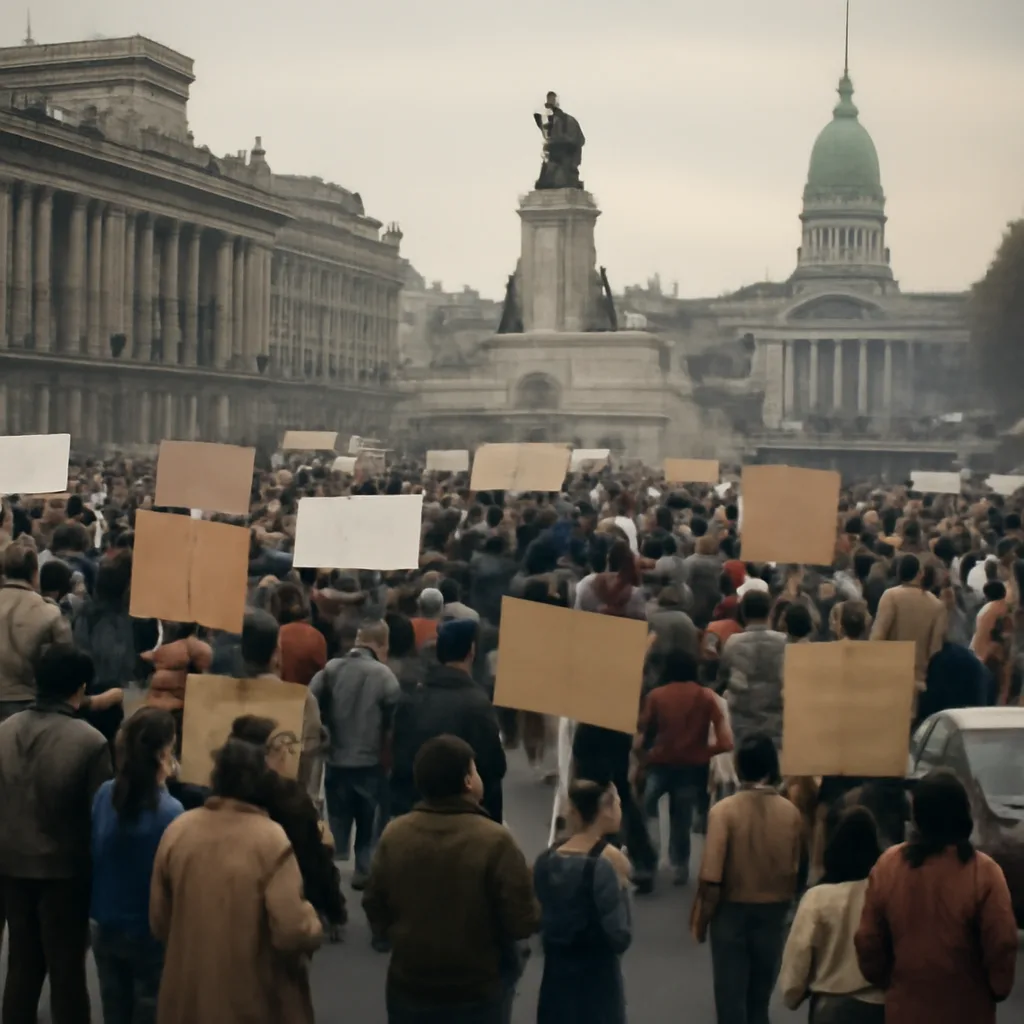
Crowd outside government buildings in Buenos Aires in 1983, with protesters, banners and military vehicles present, indicating a tense transition from military rule to civilian authority.

Facing economic collapse, mass protests and the legacy of the Falklands War, Argentina's ruling military junta resigned on August 22, 1983, ceding power and paving the way for democratic elections later that year.


On August 22, 1983, Argentina's last ruling military junta stepped down, ending a seven-year period of military dictatorship that began with the 1976 coup. The junta's collapse followed a cascade of political, economic and social pressures: catastrophic economic mismanagement, widespread human rights protests over enforced disappearances, and the political fallout from the 1982 Falklands (Malvinas) War with the United Kingdom.

By 1983 the governing military faced severe internal divisions and a loss of legitimacy. The defeat in the Falklands War had discredited the junta's leadership and exposed its strategic misjudgments. Economically, Argentina was suffering from runaway inflation, mounting foreign debt and declining living standards; these conditions intensified popular discontent and eroded support among sectors that had previously tolerated or backed military rule.

Human rights organizations and families of the disappeared sustained persistent pressure through demonstrations, public inquiries and international advocacy, keeping state abuses in the public eye. The regime's record—characterized by forced disappearances, torture and censorship—remained a central factor in the growing political mobilization for change. Civil society actors, labor unions and political parties pressed for a return to constitutional rule and accountability.

The junta's resignation did not happen in a single dramatic moment but as a political transition engineered by elements within the military and civilian leaders seeking an orderly handover. Rather than an immediate restoration of full civilian control, the resignation marked the end of the final triumvirate of military rulers and the installation of a transitional civilian president, Reynaldo Bignone, who had been appointed earlier in 1982. Bignone announced steps toward elections and a timetable for returning to democratic governance, including the lifting of some restrictions and the scheduling of a presidential election for October 1983.

The announcement set in motion political campaigning under constrained conditions: banned parties and leaders began to re-emerge publicly, though deep institutional and societal wounds remained. Key issues in the campaign were economic stabilization, democratic restoration, and how to address human rights violations committed under military rule. Discussions about trials, amnesty and truth commissions would dominate Argentine politics for years to come.

The transition culminated with the October 30, 1983, presidential election, widely regarded as Argentina's return to electoral democracy. Raúl Alfonsín of the Radical Civic Union won the presidency, assuming office in December and initiating a process of democratic consolidation and human rights prosecutions. The junta's fall thus initiated a fraught but consequential shift: the end of direct military governance and the reinstatement of competitive elections, alongside a long national reckoning with the abuses of the dictatorship.

Historical assessments emphasize that the junta's collapse resulted from a combination of military defeat, economic crisis and sustained civic resistance rather than a single cause. While the transfer of power opened political space for democracy, it also left unresolved questions about institutional reform, accountability and social healing—issues Argentina continued to confront in the decades after 1983.

Share this

Email Share on X Facebook Reddit

Did this surprise you?