
← Back
03/31/1879 • 7 views

Demonstration of the First Indoor Electric Lighting System, 1879
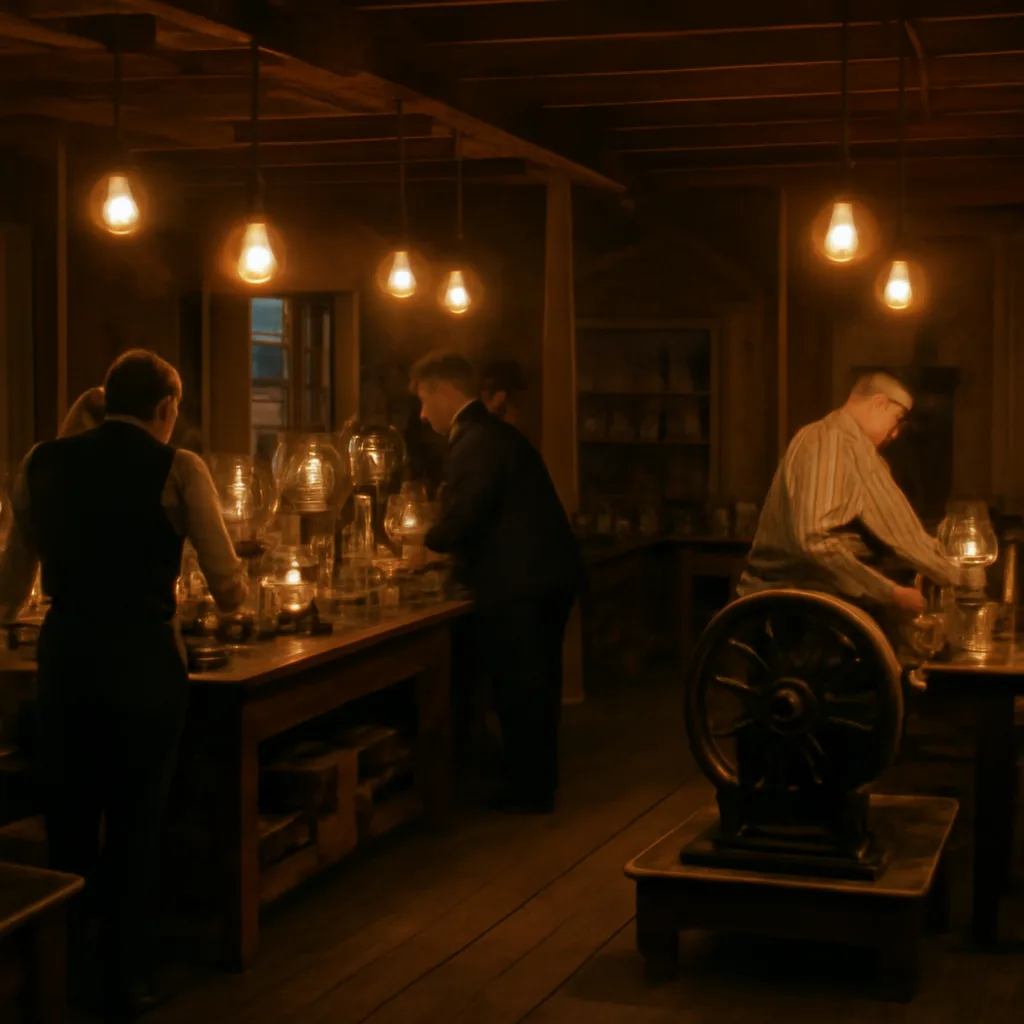
Late 19th-century laboratory interior with glass light bulbs mounted in simple fixtures, a belt-driven dynamo in the background, benches with glassware and electrical apparatus, and technicians in period clothing working on wiring and lamps.

On March 31, 1879, Thomas Edison demonstrated a complete indoor electric lighting system in Menlo Park, New Jersey, marking a pivotal step toward practical electric illumination for buildings and homes.


On March 31, 1879, Thomas Alva Edison and his Menlo Park laboratory team demonstrated a functioning indoor electric lighting system that incorporated a practical incandescent lamp, supporting fixtures, wiring, and a central generator. While prior inventors had produced incandescent glows and arc lamps, Edison’s system emphasized a durable filament, improved vacuum, and an integrated distribution system designed for everyday indoor use.

Edison’s work in the late 1870s built on decades of experimentation with electric lighting. Early arc lamps, used for street and large-space illumination, were bright but noisy and required frequent adjustment. Many inventors had produced incandescent effects—where a filament is heated until it glows—but they often suffered from short filament life or impractical vacuum techniques. Edison’s approach combined several refinements: he tested thousands of filament materials, improved methods for creating high vacua in glass bulbs, and designed a dynamo and wiring suitable for powering multiple lamps within a building.

The March 1879 demonstration at Menlo Park is often cited not as the invention of an incandescent bulb in isolation but as the unveiling of a functioning, integrated indoor lighting system. Edison’s lamp that year used a carbonized filament and an improved glass bulb that, when coupled to his electrical distribution equipment, provided steadier, longer-lasting light than many predecessors. Edison and his team continued iterations after 1879; notable improvements include the later adoption of higher-resistance carbonized bamboo filaments, which extended lamp life and enabled more practical commercial distribution systems.

The demonstration’s significance lies in its system-level focus. Edison pursued a complete solution: generators (dynamos), regulation and distribution equipment, sockets and switches, and the lamps themselves. That systems perspective paved the way for commercial utility networks and indoor lighting in homes, workplaces, and public buildings during the following decades.

Historical accounts emphasize that Edison’s achievements were cumulative and collaborative. Assistants such as Francis Upton, Charles Batchelor, and others played technical roles, and contemporaneous inventors—most prominently Joseph Swan in Britain—were pursuing related filament and bulb improvements. Swan obtained a British patent for an incandescent lamp and, after legal and commercial negotiations, later formed a joint operation with Edison’s interests in the United Kingdom. Thus, the move from isolated laboratory demonstrations to widespread indoor electric lighting resulted from multiple inventors’ contributions and subsequent industrial development.

After 1879, Edison’s methods and business activities accelerated the commercialization of electric lighting. He established companies to manufacture lamps and electrical equipment and promoted direct-current (DC) distribution systems in urban areas. Over time, alternating-current (AC) systems led by other engineers and companies would expand the geographic reach and economics of electric power distribution. Nonetheless, the Menlo Park demonstration on March 31, 1879, remains a recognizable milestone in the transition from gas, oil, and candle lighting to practical, integrated electric illumination inside buildings.

Because historical innovation is complex, historians note nuance: no single moment created indoor electric lighting, and Edison was one of several key figures whose cumulative work produced the modern electric lighting industry. The March 1879 demonstration is best understood as a pivotal step in that broader process rather than the sole origin of indoor electric light.

Share this

Email Share on X Facebook Reddit

Did this surprise you?