
03/31/1912 • 6 views
RMS Titanic Completed at Harland & Wolff Shipyard
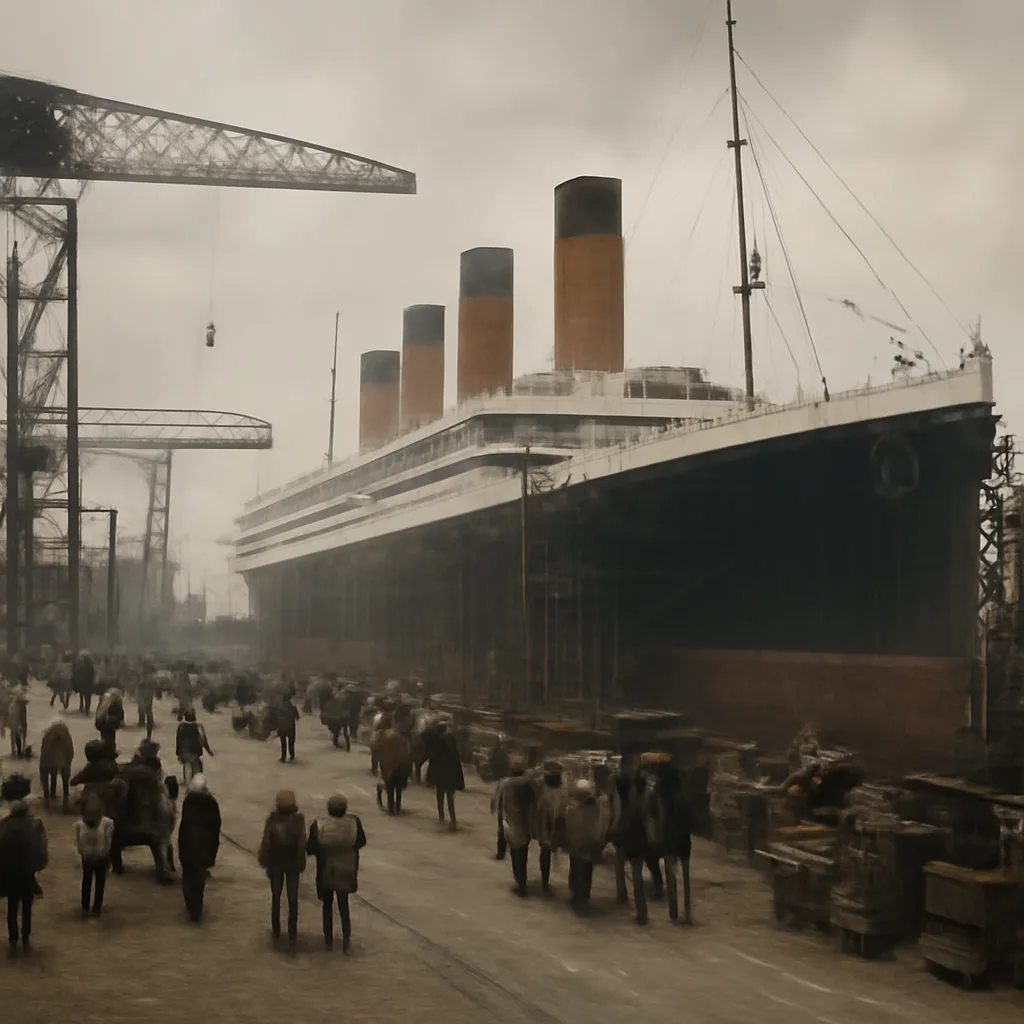
On 31 March 1912 the White Star liner RMS Titanic was formally completed at Harland & Wolff’s shipyard in Belfast and prepared for sea trials and its maiden voyage scheduled for April 1912.
Construction and outfitting
Titanic was one of three Olympic-class liners ordered by the International Mercantile Marine Company’s White Star Line to compete in the North Atlantic trade. Built on slipway number 1 at Harland & Wolff, she shared many design features with her sister ship Olympic but incorporated refinements intended to improve passenger comfort and operational efficiency. By late March 1912 workforce activity concentrated on finishing first- and second-class public rooms, completing crew quarters, installing heavy machinery such as her triple-expansion steam engines and turbine, and conducting dockside tests of pumps, boilers and auxiliary systems.
Sea trials and preparations for departure
Following the formal completion on 31 March, Titanic underwent brief harbour manoeuvres and final inspections before proceeding to sea trials, a standard practice to verify speed, steering and machinery performance. After successful trials, the ship was scheduled to make a short voyage to Southampton where baggage, mail and provisions would be loaded and passengers would embark for the planned maiden voyage to New York commencing in April 1912.
Safety equipment and standards
At the time of completion Titanic carried lifeboats and other lifesaving apparatus that met or exceeded British Board of Trade regulations then in force; however, those regulations were based on a ship’s tonnage rather than passenger capacity, and the number of lifeboats provided has since been widely criticised. The distinction between legal compliance and later judgement by historians and the public is important: contemporary builders and regulators followed the standards of the era, even as subsequent events prompted major changes in maritime safety rules.
Context and aftermath
Titanic’s completion came amid intense public interest in transatlantic travel and shipbuilding. Belfast’s Harland & Wolff was a centre of maritime construction and employed thousands; the completion of Titanic represented both a technical achievement and a commercial milestone for White Star Line. Within weeks of leaving Belfast, Titanic would embark on her maiden voyage from Southampton on 10 April 1912. The ship’s loss during that voyage after striking an iceberg has made the completion date a significant point in a story that reshaped maritime regulation and public perceptions of ocean travel.
Notes on sources and certainty
The completion date of 31 March 1912 is recorded in contemporary shipyard and company records and is widely cited in historical accounts of Titanic’s construction. Specific details about the sequence of final tests and interior work are drawn from shipbuilding and archival sources; where contemporary records differ in minor particulars, historians note those discrepancies rather than asserting uncertain specifics as fact.