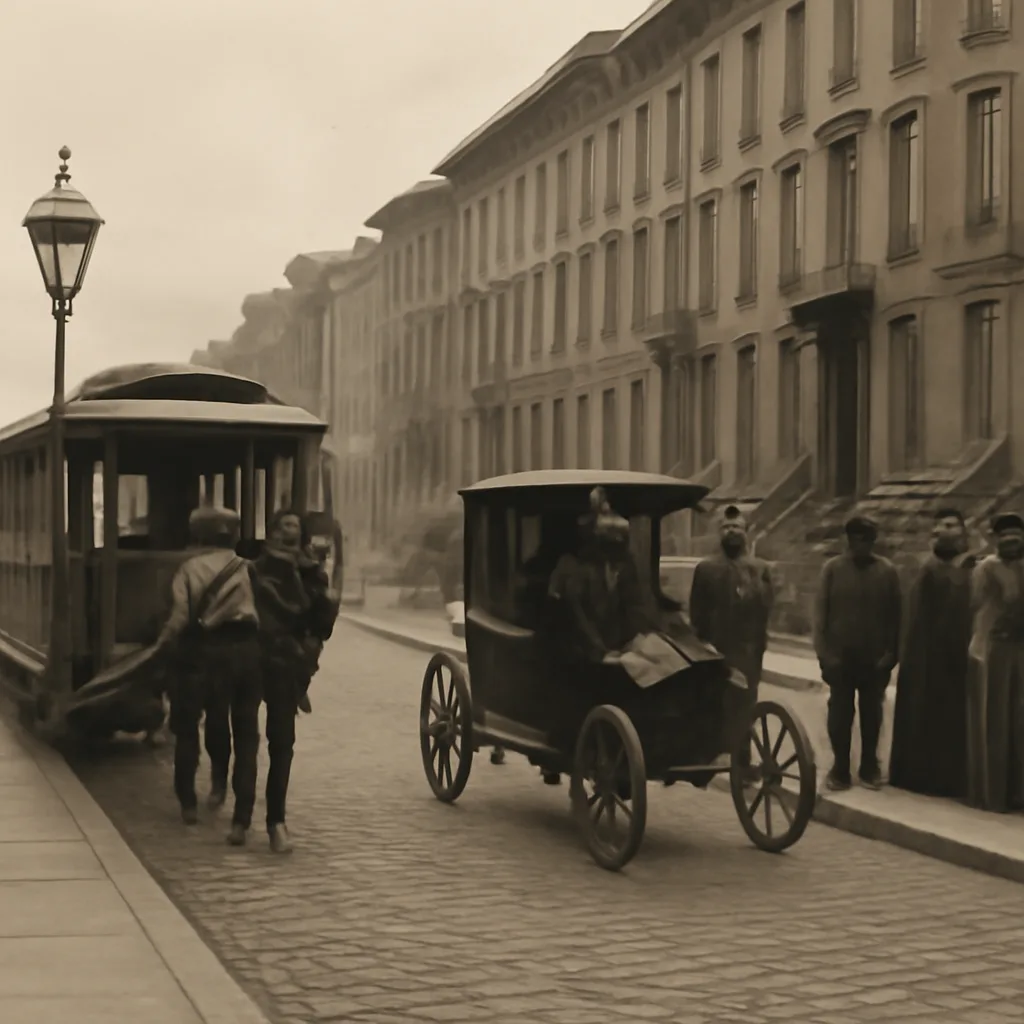
First U.S. Automobile Fatality Recorded, March 31, 1899
On March 31, 1899, businessman Henry H. Bliss is widely reported as the first person in the United States to be fatally injured in an automobile accident after being struck by an electric taxicab in New York City; contemporary sources and later historians treat the claim with some caution about earlier, less-documented incidents.
On the morning of March 31, 1899, Henry Hale Bliss, a 68-year-old real estate dealer and former lecturer, was struck by an electric taxicab as he alighted from a streetcar at West 74th Street and Central Park West in Manhattan. Bliss suffered severe head injuries and was taken to Roosevelt Hospital, where he died the following day. Contemporary newspapers reported the incident widely, and Bliss’s death has since been cited in many histories as the first recorded automobile fatality in the United States.
The vehicle involved was an electric hansom cab operated by taxi driver Arthur Smith (sometimes reported as Arthur N. Smith in period accounts). At the time, electric and gasoline-powered vehicles coexisted with horse-drawn conveyances in American cities. Street traffic, vehicle controls, lighting, and traffic regulation were all in an early and evolving stage, and urban sidewalks and curbs were not yet adapted for frequent interactions between pedestrians and motorized vehicles.
Primary coverage of the accident appeared in New York newspapers in April 1899, which noted Bliss’s injuries and the novelty of motor-vehicle involvement. The case drew attention because motor cars were still uncommon; the notion of a person killed by an automobile captured public and journalistic interest. Legal follow-up included an inquest and local reporting on whether the cab driver exercised due care. Accounts of the driver’s culpability varied among sources, and some contemporary coverage suggested the incident resulted from a combination of factors that were not yet well understood in court or legislative settings.
Historians and reference works frequently identify Bliss as the first person in the United States to die as a result of being struck by an automobile. That characterization, however, is shaped by the limits of surviving documentation: record-keeping and reporting standards at the end of the 19th century were uneven, and some earlier incidents involving motorized road vehicles might have gone unreported or been categorized differently. Scholars therefore treat the “first” designation as accurate in the sense of the earliest well-documented and widely reported automobile fatality, while acknowledging uncertainty about earlier, less-documented cases.
The Bliss case influenced public awareness and policy discussions concerning motor vehicles. As automobiles became more common in the early 20th century, governments introduced traffic laws, licensing, and vehicle safety regulations. The publicity around early tragic incidents like Bliss’s contributed to debates over speed limits, driver responsibility, and the need for clearer rules governing interactions between pedestrians and motorized transport.
Beyond its legal and regulatory implications, the incident sits in cultural memory as an emblem of a technological transition. Late 19th-century cities were sites where new forms of mobility—electric cars, internal-combustion vehicles, and trolley systems—met established patterns of street use shaped by horses and pedestrians. The death of Henry Bliss is often invoked in historical narratives to mark the moment when the costs of mechanized personal transport became painfully visible in urban life.
In summary, March 31, 1899, marks the widely reported and documented case of Henry H. Bliss being fatally injured by an electric taxicab in New York City—commonly cited as the first recorded automobile fatality in the United States. Historians accept the case as the earliest well-documented example, while noting that incomplete records from the era mean absolute certainty about it being the very first possible automobile-related death in the country cannot be guaranteed.