
← Back
03/11/1845 • 6 views

The First Documented Sleepwalking Murder Trial (1845)
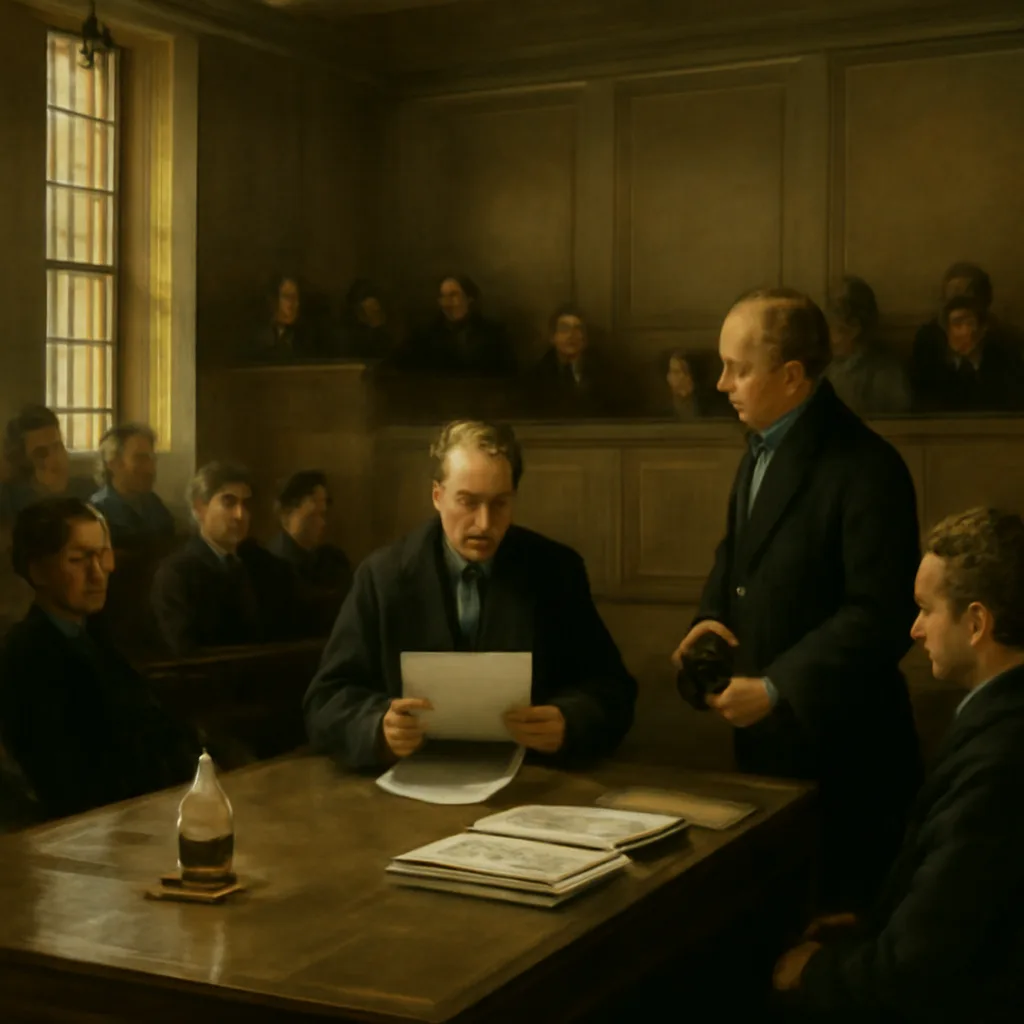
A mid‑19th‑century courtroom or coroner's inquest scene: wooden benches, men in period dress, a coroner taking notes, gaslight or daylight through tall windows.

On March 11, 1845, a British coroner's inquest and subsequent trial examined whether a fatal stabbing was committed during sleepwalking—the earliest widely cited legal case to consider automatism as a defense.


On 11 March 1845 a case in England drew attention because it raised the question of whether a person could commit homicide while sleepwalking. The incident involved a man named Franz Müller (sometimes reported as a German or continental resident in contemporary press accounts) whose actions and state were scrutinized in coroner's and criminal proceedings that have since been cited in legal and medical discussions of automatism and criminal responsibility.

Contemporary reporting and later legal histories identify the 1845 proceedings as an early, documented instance in which sleepwalking (somnambulism) was advanced or considered in relation to a violent crime. Medical testimony in mid‑19th‑century Britain was often tentative about the boundaries between involuntary acts and culpable conduct; sleepwalking was poorly understood and carried both medical and moral connotations. Coroners, judges, and physicians of the period relied on prevailing medical theories, eyewitness testimony about the accused's prior behavior, and the circumstances of the incident to assess whether an act could have been involuntary.

The relevance of the 1845 case to modern legal doctrine comes from its status as an early recorded instance where automatism—actions performed without conscious control—was debated in a legal forum. Subsequent jurisprudence elaborated distinct legal paths for defenses based on mental state: insanity (a disease of the mind) versus non‑insane automatism (a temporary, external cause producing involuntary action). The 1845 proceedings did not establish the detailed legal tests later developed in nineteenth and twentieth‑century case law, but they contributed to an evidentiary and conceptual record that courts and commentators later examined.

Sources from the period include newspaper reports, coroner's records where available, and retrospective legal and medical commentaries. Nineteenth‑century reportage can be uneven: names, nationalities, and specifics sometimes vary across contemporary accounts. Modern summaries that cite the 1845 trial use it primarily to illustrate early instances in which courts grappled with whether involuntary conduct like sleepwalking could exculpate an accused person, rather than as a definitive turning point that set a single legal standard.

Historians and legal scholars caution against overstating the precision of the record: isolated nineteenth‑century cases were handled in varied local forums, documentation can be incomplete, and later retellings sometimes conflate separate incidents. Nevertheless, the 1845 matter remains historically significant as one of the earliest documented criminal proceedings to focus public and professional attention on sleepwalking as a possible explanation for violent acts and to prompt legal consideration of automatism.

In the decades after 1845, scientific understanding of sleep disorders slowly advanced and courts developed more structured rules for assessing claims of involuntary action. The 1845 case is therefore best seen as an instructive early episode in a longer legal and medical trajectory rather than as the sole origin of contemporary automatism defenses.

Notes on sources and uncertainties: Nineteenth‑century press accounts and later legal histories are the primary bases for identifying the 11 March 1845 matter as an early documented sleepwalking murder trial. Details such as exact names, nationality, and courtroom outcomes are reported inconsistently in surviving accounts; where specifics are disputed or poorly documented, this summary avoids asserting a single uncontested version.

Share this

Email Share on X Facebook Reddit

Did this surprise you?