
01/19/2001 • 4 views
Match Abandoned After Ritual Performed on Pitch
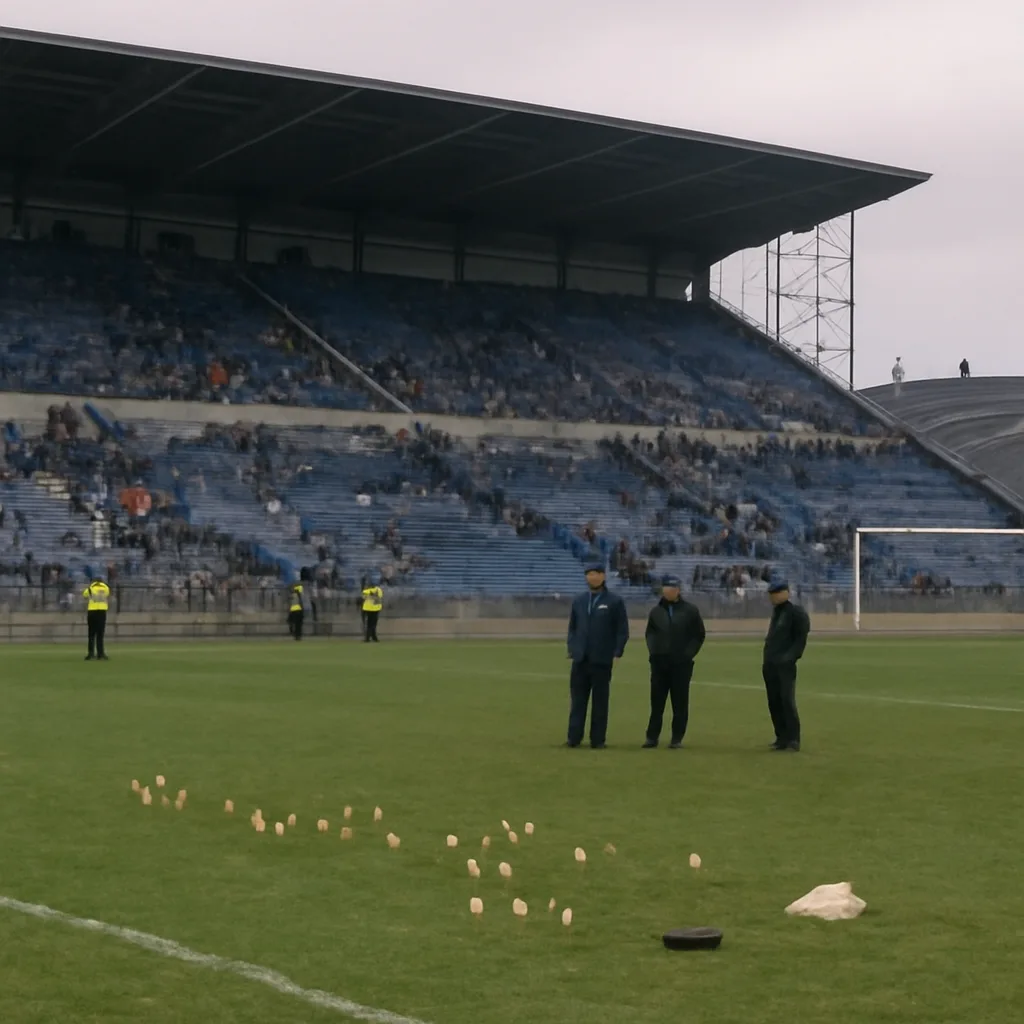
A regional soccer match on 19 January 2001 was halted and ultimately abandoned after spectators and individuals entered the field to perform a ritual described by local authorities as voodoo; police and match officials cited safety and order concerns.
Contemporary reports and later summaries indicate that the interruption began when several people ran onto the field and placed objects on the grass and around the penalty area. Stadium stewards and police moved in to remove the individuals and the items, but the situation was judged to present an ongoing risk to players, officials and spectators, prompting the decision to call off the game. Accounts from the time emphasize that the presence of ritual objects and the behavior of some onlookers raised concerns about potential violence, contamination of the pitch, and the ability to ensure a secure environment for restarting play.
Descriptions of what occurred vary in the sources available: some reports say the objects included candles and offerings; others are more cautious, noting only that unidentified items were placed on the field. Local police characterized the episode as an unusual breach of stadium protocol; they described the priority as restoring safety rather than investigating the religious or cultural motives of those involved. Match organizers similarly framed the abandonment as a safety and security decision rather than a judgment on beliefs.
The use of the term "voodoo" in contemporaneous coverage should be treated with care. "Voodoo" (or Vodou/Vodun/Vodu) refers to complex, regionally specific religious traditions with distinct histories and practices across parts of West Africa, the Caribbean and the Americas. Media descriptions at the time reflected local shorthand and eyewitness accounts; they did not always distinguish between what practitioners would identify as religious ritual, superstition, performance, or fan provocation. Where possible, official statements focused on concrete facts—objects on the pitch, spectators entering the field, and the abandonment—rather than on definitive determinations about religious intent.
No credible records indicate any injuries directly caused by the ritual actions on the pitch. The primary consequences recorded were the abandonment of the match and subsequent procedural responses by the competition authority and local law enforcement. Competition organizers typically follow established rules for matches abandoned for safety reasons; depending on the governing body, outcomes can include replaying the match, awarding a result, or other disciplinary measures. Publicly accessible archival summaries and press coverage from the period indicate that organizers opened inquiries into security lapses and stadium access controls after the incident.
The episode prompted discussion among sports administrators about crowd control and the need for clear procedures to prevent pitch incursions. It also generated commentary in local media about the intersection of belief, ritual, and sporting events—highlighting how symbolic acts by fans or outsiders can rapidly create a situation deemed unsafe in the confined context of a stadium.
Because contemporary accounts differ in detail and terminology, historians and journalists treating the case should rely on primary-source materials such as police statements, official match reports and contemporaneous local press to reconstruct what happened. Those sources provide the most reliable record of the sequence of events (unauthorised individuals entered the field, objects were placed on the pitch, police and stewards intervened, and the match was abandoned on safety grounds) while avoiding conjecture about motives beyond what eyewitnesses or participants reported.
The abandonment on 19 January 2001 remains a noted example of an event where non-sporting actions on the field led to the termination of a match, and it is cited in discussions of stadium security and incident response protocols.