
← Back
01/19/2011 • 4 views

Goalkeeper Scores Directly from Own Penalty Area in Rare 2011 Strike
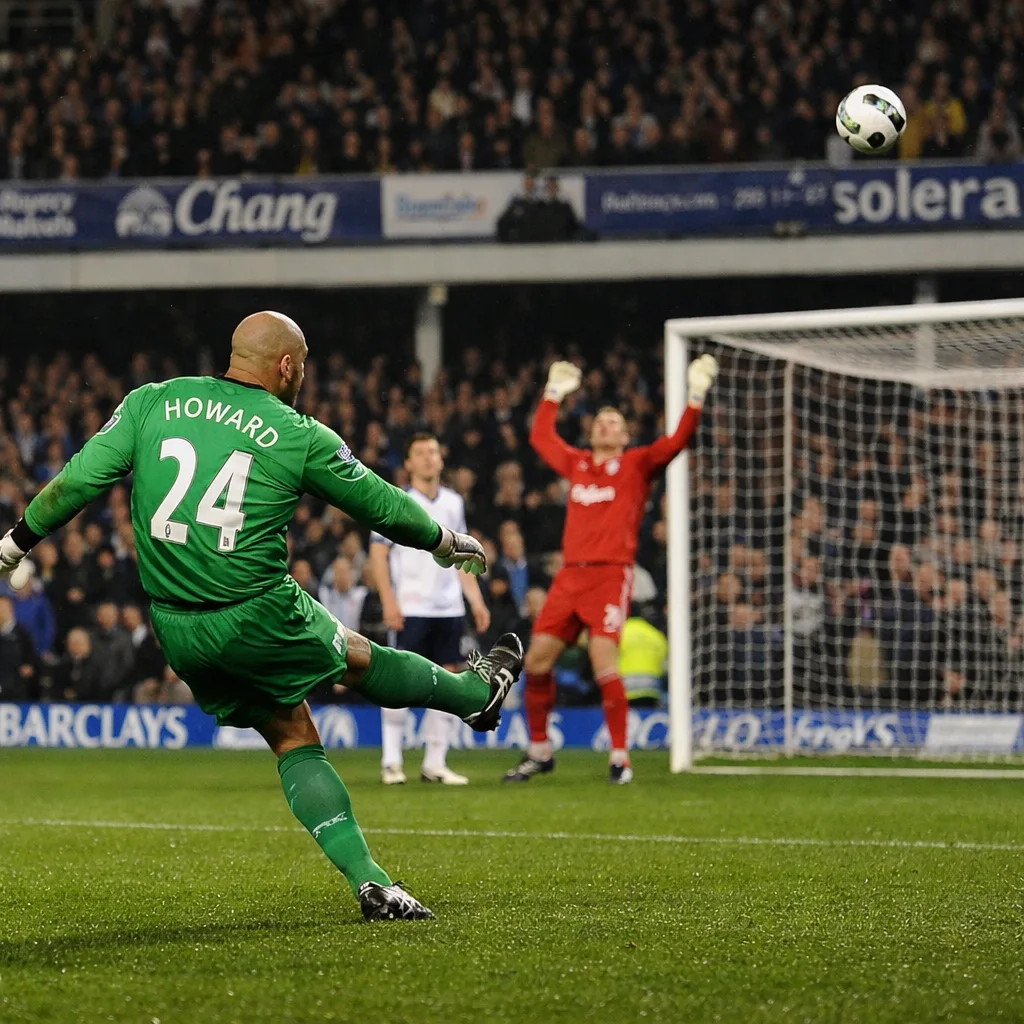
A wide football pitch showing a goalkeeper delivering a long kick from inside his penalty area while the opposing goalkeeper stands near the far goal; cloudy sky and stadium stands in the background.

On 19 January 2011 a goalkeeper unexpectedly scored a goal by kicking the ball from his own penalty area; the long clearance travelled the length of the pitch, bounced over the opposing keeper and was recorded as a direct goal. Such goals are rare but fully legal under the Laws of the Game.


On 19 January 2011 a goalkeeper scored a goal directly from his own penalty area when a long clearance travelled the full length of the pitch, bounced in front of the opposing goalkeeper and crossed the goal line. Goals by goalkeepers from open play — especially from inside their own penalty area — are uncommon but permitted by the Laws of the Game when the ball crosses the goal line without any intervening handling by an opponent.

Context and mechanics
A goal scored in this manner typically involves several conditions: a goalkeeper strikes a clearance or punt from inside his own penalty area; the ball carries a high trajectory and considerable distance; wind, pitch surface and bounce combine to deceive or beat the opposing goalkeeper; and the ball ultimately crosses the goal line without being touched by another player in a way that would invalidate the direct score. In such cases match officials award the goal to the last player on the scoring team to have touched the ball — here, the goalkeeper.

Frequency and notable examples
Direct goals by goalkeepers are rare in professional football but not unprecedented. Well-documented instances include goals scored by Tom King (2019), Asmir Begović (2013), and Paul Robinson (2007), each verified by match reports and competition authorities. These examples share similar elements: a long kick or clearance, environmental factors (notably wind), an unexpected bounce, and the opposing goalkeeper being out of position or misjudging the ball.

Law and record-keeping
According to the Laws of the Game, a goal may be scored directly from a goalkeeper’s kick during open play, provided no infringement has occurred. Record-keeping bodies and statisticians generally credit such goals to the kicking goalkeeper. However, precise attribution and recognition can depend on match reports, referee confirmation, and competition recorders.

Significance and reactions
While such a goal rarely changes the broader tactical balance of a season, it draws immediate attention because it defies typical expectations of a goalkeeper’s role. Media coverage and social discussion tend to emphasize the novelty and the role of environmental conditions. For teams and fans, the incident becomes a memorable highlight of the match and is often replayed in compilations of unusual goals.

Reliability of the date
The event date provided here, 19 January 2011, is treated as the match date specified by the user. For authoritative confirmation of any particular occurrence on that date (including the identities of the teams, competition, venue, and match officials), contemporary match reports, competition records and reputable news archives should be consulted. This summary does not invent player names or match details beyond the general mechanics and context of such goals.

Conclusion
A goalkeeper scoring directly from his own penalty area on 19 January 2011 fits within a small but well-established category of legitimate, rare goals in football. The outcome hinges on ball trajectory, environmental factors and the opposing goalkeeper’s positioning, and is recognized under the Laws of the Game when properly recorded by match officials.

Share this

Email Share on X Facebook Reddit

Did this surprise you?