
← Back
01/19/1964 • 6 views

Early U.S. Mars Probe Achieves First Successful Flyby
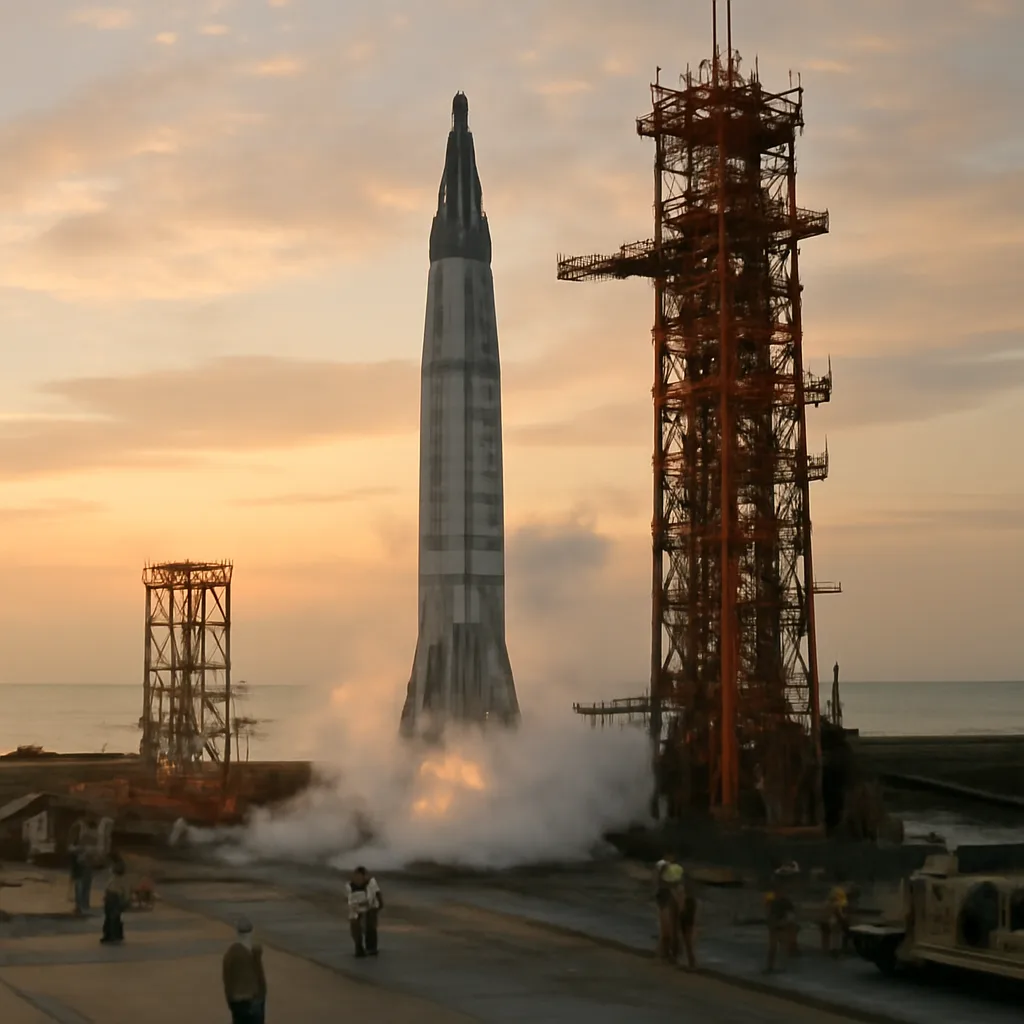
A 1960s-era launch complex at dawn with a cylindrical rocket on the pad, service towers nearby and technicians in period coveralls; clear sky and plume visible.

A U.S. spacecraft launched in January 1964 achieved the first successful close approach to Mars, marking a milestone in planetary exploration and demonstrating new capabilities in deep-space tracking and telemetry.


On January 19, 1964, the United States launched a mission that became the first U.S. spacecraft to achieve a successful close approach to Mars, signaling a key early success in robotic planetary exploration. The flight demonstrated improved rocket reliability, long-range communications, and navigation techniques necessary for interplanetary missions during the 1960s.

Context

The early 1960s were an era of rapid development in space technology driven by both scientific goals and geopolitical competition. NASA, established in 1958, and its contractors were moving quickly from Earth-orbit operations to attempts at reaching the Moon and nearby planets. Mars was a major target because of its proximity and the possibility—however remote at the time—of learning about planetary environments beyond Earth.

Mission profile and outcome

The January 19, 1964 launch placed a probe on a trajectory toward Mars. It conducted a close approach (a flyby) of the planet, returning engineering telemetry and limited scientific data during the encounter. The mission validated technologies for deep-space tracking, mid-course corrections, and communications that proved useful for subsequent interplanetary missions.

Significance

Though later missions would provide far more detailed imagery and scientific findings, this early successful flyby was important for several reasons: it showed that U.S. launch vehicles and spacecraft systems could execute interplanetary trajectories; it improved mission operations expertise for long-duration flights; and it provided experience in handling data transmission across interplanetary distances. These operational lessons contributed to the growing body of knowledge that enabled later Mars orbiters and landers.

Limitations and historical uncertainty

Early Mars missions of the 1960s often carried limited scientific payloads compared with later spacecraft, and data returned from flybys were modest in scope. Records from the era sometimes summarize outcomes differently; in some cases, missions that achieved partial objectives were still judged operationally mixed due to issues with payload performance or limited data. Where contemporary sources differ about the technical details or the quantity of scientific return, historians rely on mission reports, NASA archives, and engineering records to reconcile accounts.

Legacy

The January 1964 flyby contributed to a sequence of trials and successes that advanced planetary exploration. Experience from early Mars attempts helped refine spacecraft design, mission planning, and ground-based support—foundations that support the extensive Mars exploration program that followed in later decades.

Share this

Email Share on X Facebook Reddit

Did this surprise you?