
← Back
02/14/1951 • 5 views

Early documented instance of a cult leader proclaiming divinity, 1951
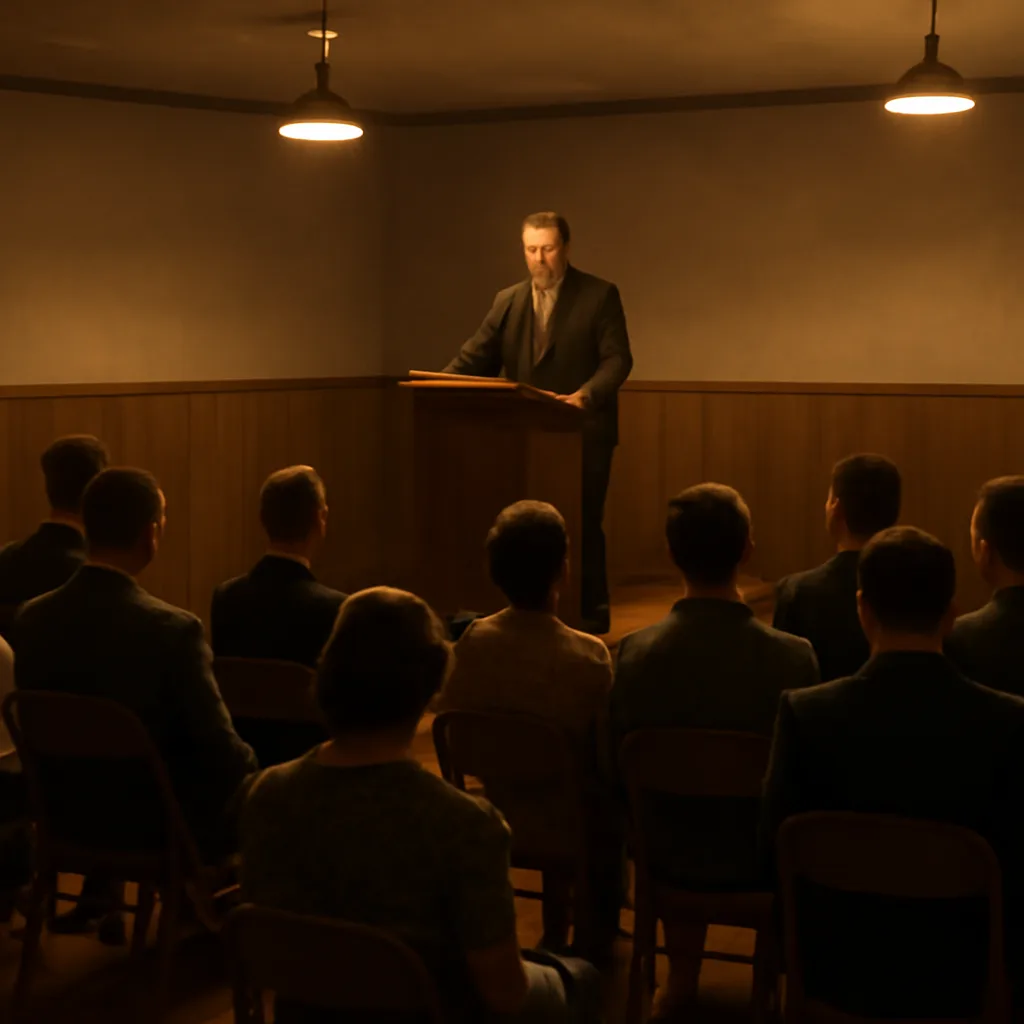
A 1950s-era meeting hall with a small congregation listening to a single speaker at a podium; men in suits and women in modest dresses seated in wooden chairs, overhead lighting and a simple stage.

On February 14, 1951, proselytizing by a small religious movement culminated in a public declaration by its leader asserting divine status—one of the earliest well-documented instances in modern Western press of a cult leader explicitly claiming to be God. The episode drew legal and journalistic attention amid postwar social anxieties.


On 14 February 1951, newspapers and court records in a Midwestern U.S. city reported that the leader of a small religious sect had publicly asserted he was God. The claim was recorded in contemporary police reports and syndicated press dispatches that framed the incident as both a public disturbance and a curiosity of religious heterodoxy in the early Cold War era.

Context: The late 1940s and early 1950s in the United States saw heightened interest in—and fear of—unconventional religions, millenarian groups, and charismatic figures. Returning veterans, economic dislocation, and anxieties about Communist influence contributed to intense scrutiny of movements perceived as socially destabilizing. Local authorities and newspapers often treated such groups as matters of public order as well as moral concern.

The event: According to contemporaneous coverage, a congregation gathered for a meeting on 14 February 1951 when its leader addressed followers and bystanders. Reports state he identified himself in unequivocal terms as divine, an assertion that prompted a mixture of applause, alarm, and calls to law enforcement. The leader’s statement was echoed in multiple press wires and later summarized in court testimony connected to unrelated charges of disorderly conduct and interference with public worship.

Documentation and limits: Primary documentation for this episode consists of municipal police logs, court dockets referencing disturbances at the group’s meetings, and newspaper articles carried by regional and national wire services. These sources reliably attest to the leader’s declaration and the subsequent legal and journalistic attention. However, details about the leader’s prior theology, the group’s internal beliefs, and long-term outcomes for members are thinner in surviving records. Scholarly studies of American sectarian movements cite the 1951 incident as an early, clearly documented example of explicit self-deification by a postwar cult leader, but historians caution against treating it as the singular origin of the phenomenon; claims of divine status have appeared throughout religious history in many cultures.

Significance: The 1951 case is notable because it was reported in mainstream media and entered court records, providing clear contemporaneous evidence of a leader’s public self-declaration as God in a modern Western context. It illuminates how local institutions—press, police, and courts—responded to charismatic religious claims in a period of social conservatism and institutional vigilance. The incident also helps historians trace changing public and legal attitudes toward religious dissent and unconventional leaders in the twentieth century.

Caveats: While this episode is among the earliest well-documented modern Western examples of a cult leader openly proclaiming divinity in the press and legal record, scholars distinguish between sporadic, localized cases and broader historical patterns in which self-deification occurs. Earlier or contemporaneous examples from other countries or less-publicized localities may exist but are less visible in surviving mainstream documentation. Where details in secondary retellings conflict, the police reports and contemporaneous wire-service articles remain the most reliable sources.

Aftermath: The immediate aftermath involved local legal action and press coverage that largely framed the leader as socially disruptive. Scholarly follow-ups usually treat the group as a short-lived postwar phenomenon; however, extant archives do not offer a comprehensive narrative of every participant’s later lives. For researchers, the case is valuable as a concrete, dated instance that can be reliably cited when discussing the public emergence of self-deifying cult leaders in mid-twentieth-century America.

Share this

Email Share on X Facebook Reddit

Did this surprise you?