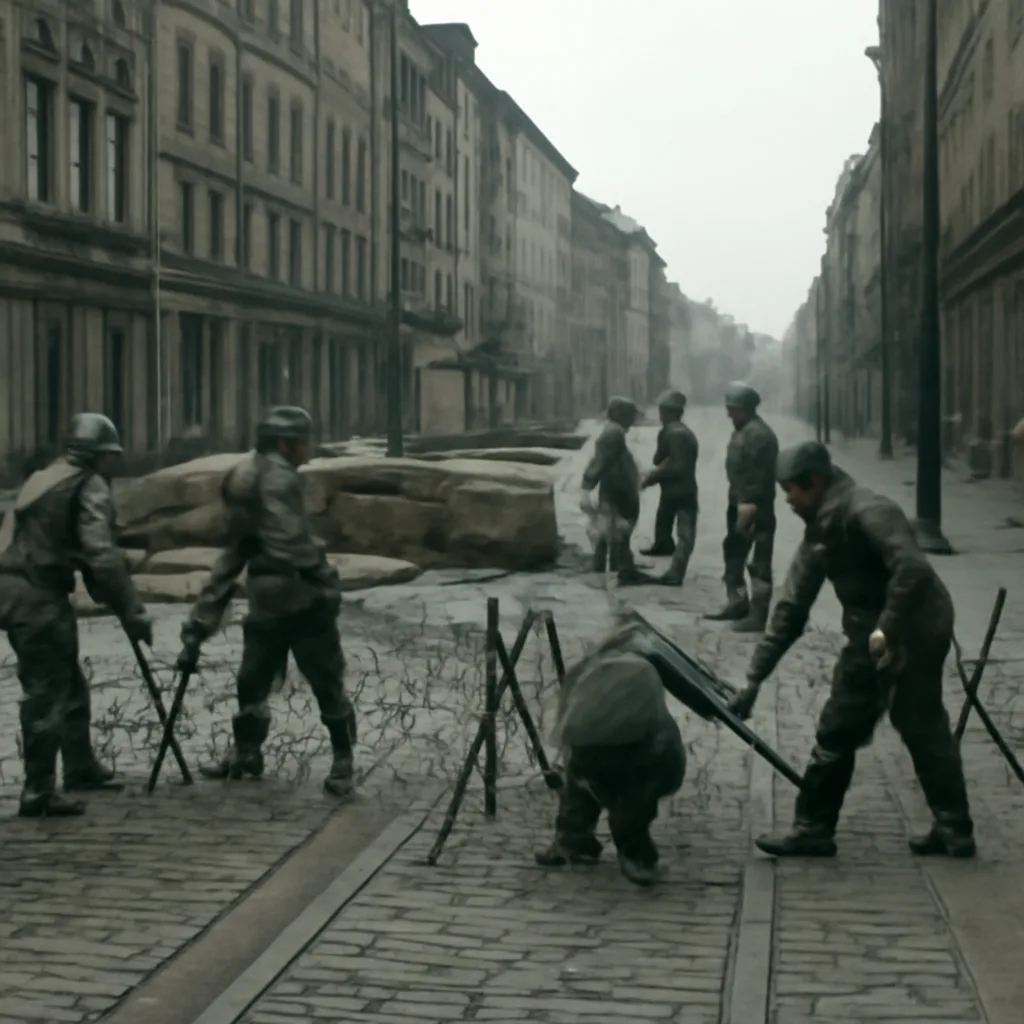
East Germany Seals Borders as Thousands Flee to West
On August 13, 1961, East German authorities began erecting barriers and closing crossings around West Berlin after a sustained wave of defections from the German Democratic Republic, transforming the city into a divided focal point of Cold War tensions.
On August 13, 1961, the German Democratic Republic (GDR) initiated rapid, large-scale measures to cut overland access between East Germany and West Berlin, beginning the construction of barriers that would become known as the Berlin Wall. The action came after months and years of population loss: since 1949 several million people had migrated from the Soviet zone and the GDR to West Germany and West Berlin, a flow that accelerated in the late 1950s and early 1960s and included skilled workers, professionals and young people. Facing economic disruption and the political embarrassment of continued emigration, the East German leadership, supported by the Soviet Union, moved to stop the outflow.
In the early hours of August 13, East German troops, border guards and police began sealing crossings, laying barbed wire, and closing major roads and rail lines linking East Berlin to the western sectors. Barricades and temporary fences were installed quickly at key transit points; in many places soldiers and police physically prevented people from crossing. The measures were presented by the GDR as necessary to prevent Western “subversion” and “fascist” agents, but for many West and East Germans the immediate effect was to freeze normal movement and separate families, workplaces and daily life.
The physical barriers that started as barbed wire and cinder-block obstacles were soon replaced by more permanent concrete walls, watchtowers, floodlights and a fortified “death strip” designed to deter and prevent escape. The border regime combined engineering features with armed border guards under orders to stop unauthorized crossings; over time escape became increasingly dangerous and, in many tragic cases, deadly. The Wall also included strict controls on transit and required special permits for many forms of travel between sectors.
Internationally, the sealing of Berlin’s intra-city borders intensified Cold War confrontation. Western governments condemned the action as a violation of Berlin’s special status and as an infringement on basic freedoms, while the Soviet bloc defended the GDR’s sovereign right to protect its borders. In practical terms, West Berlin remained supplied and politically protected by the Western Allies, and diplomatic and military posturing continued in subsequent months and years.
For East Germans, the closure altered daily life and prospects. Those who had considered leaving suddenly found routes closed; families were split and some who were outside the GDR at the time of the sudden closures were prevented from returning. The exodus that had prompted the move did not stop all at once, but the barrier dramatically reduced legal and illegal departures and became a symbol of the GDR’s determination to stop emigration.
The Wall stood as both a physical barrier and a potent political symbol for nearly three decades. It shaped the lived experience of Berliners and influenced Cold War politics until late 1989, when mass protests within East Germany and changing Soviet policies led to the Wall’s opening. Historians note that while the August 1961 actions were initially presented as temporary measures by East German officials, they marked the start of a long-term system of border control that fundamentally reconfigured Germany and Europe during the Cold War.
This account summarizes established historical facts about the August 13, 1961, sealing of borders in and around Berlin. Some details—such as precise orders given in individual units or private conversations among leaders—remain subject to archival research and scholarly interpretation.