
← Back
11/07/1991 • 6 views

European Community leaders agree framework for Maastricht Treaty
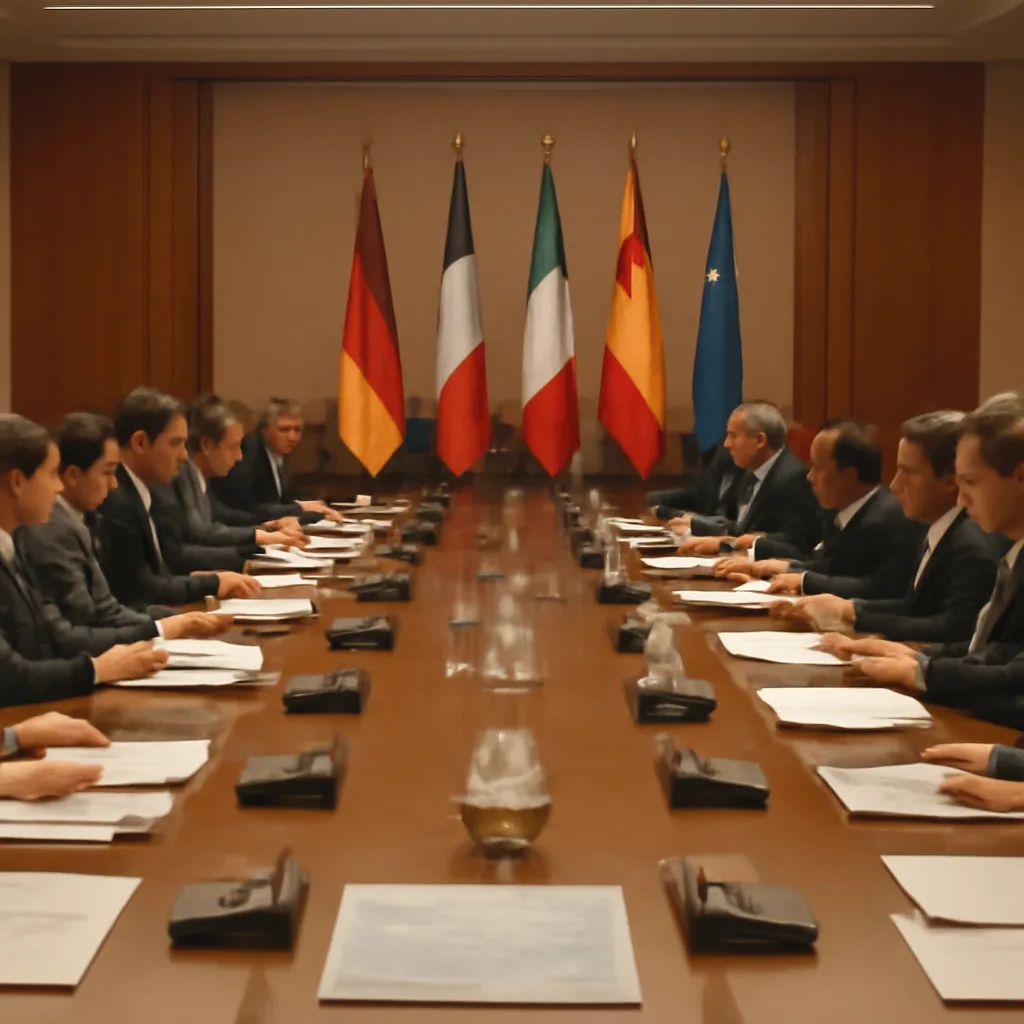
Diplomats and national leaders in formal 1990s European dress gathered around a conference table with documents and flags, negotiating treaty text in an austere summit room.

On 7 November 1991 European Community leaders endorsed the framework that would become the Maastricht Treaty, setting political and economic steps toward deeper integration including plans for a single currency and closer foreign-policy cooperation.


On 7 November 1991, leaders of the European Community reached agreement on the broad framework that would become the Maastricht Treaty, formally known as the Treaty on European Union. Negotiations throughout 1990–1991 sought to convert post-Cold War political momentum into institutional reforms; the November agreement marked the conclusion of intergovernmental negotiations on major treaty text elements and paved the way for signature in February 1992.

Context and aims
The Maastricht framework responded to shifting geopolitical realities after the fall of the Berlin Wall and the dissolution of the Soviet bloc. Member states sought a structure to deepen economic integration and to provide political cohesion for a Europe no longer divided by bipolar confrontation. Core aims included establishing the European Union as a new legal entity beyond the European Community (the existing framework for economic cooperation), creating a pathway toward Economic and Monetary Union (EMU) and a single currency, and enhancing cooperation on foreign policy and internal security.

Key provisions agreed in November 1991
- Economic and Monetary Union: The framework set out staged convergence criteria and institutional mechanisms intended to lead to EMU and ultimately a single currency. It outlined obligations for member states to coordinate fiscal and monetary policies and specified convergence targets (later known as the Maastricht criteria).
- Political union and new institutional structures: The agreement envisaged the EU as a union of states and peoples, introducing new pillars of cooperation beyond the Community’s economic remit and strengthening roles for the European Parliament and the European Commission.
- Justice and Home Affairs and Common Foreign and Security Policy: The framework expanded intergovernmental cooperation in areas of justice, policing, and foreign policy, providing for new consultation and decision-making procedures among member states.

Process and immediate aftermath
The November agreement followed intensive intergovernmental conferences and bilateral negotiations among member states, balancing differing national preferences on sovereignty, economic policy, and the pace of integration. The text agreed in November was finalized and signed by member-state governments at the Maastricht summit on 7–10 December 1991 and formally signed as the Treaty on European Union on 7 February 1992. Ratification by national parliaments and referendums followed, with some member states raising contentious debates over sovereignty and the obligations entailed by EMU.

Significance and later developments
The framework agreed in November 1991 was a pivotal step toward the creation of the European Union as it is legally and politically understood today. The Maastricht Treaty introduced binding convergence criteria for monetary union, created the three-pillar structure (the Community pillar, the Common Foreign and Security Policy, and Justice and Home Affairs), and expanded the powers of EU institutions. Many provisions were subsequently modified by later treaties (Amsterdam, Nice, Lisbon) as the Union adapted to enlargement and changing political conditions.

Notes on sources and accuracy
This summary reflects the broadly agreed chronology and principal elements of the treaty negotiations concluded in late 1991. Specific negotiation positions and the detailed drafting record involve extensive diplomatic correspondence and national deliberations; where debates or national reservations existed, they are summarized here without attributing specific, unverifiable quotes or private negotiation content.

Share this

Email Share on X Facebook Reddit

Did this surprise you?