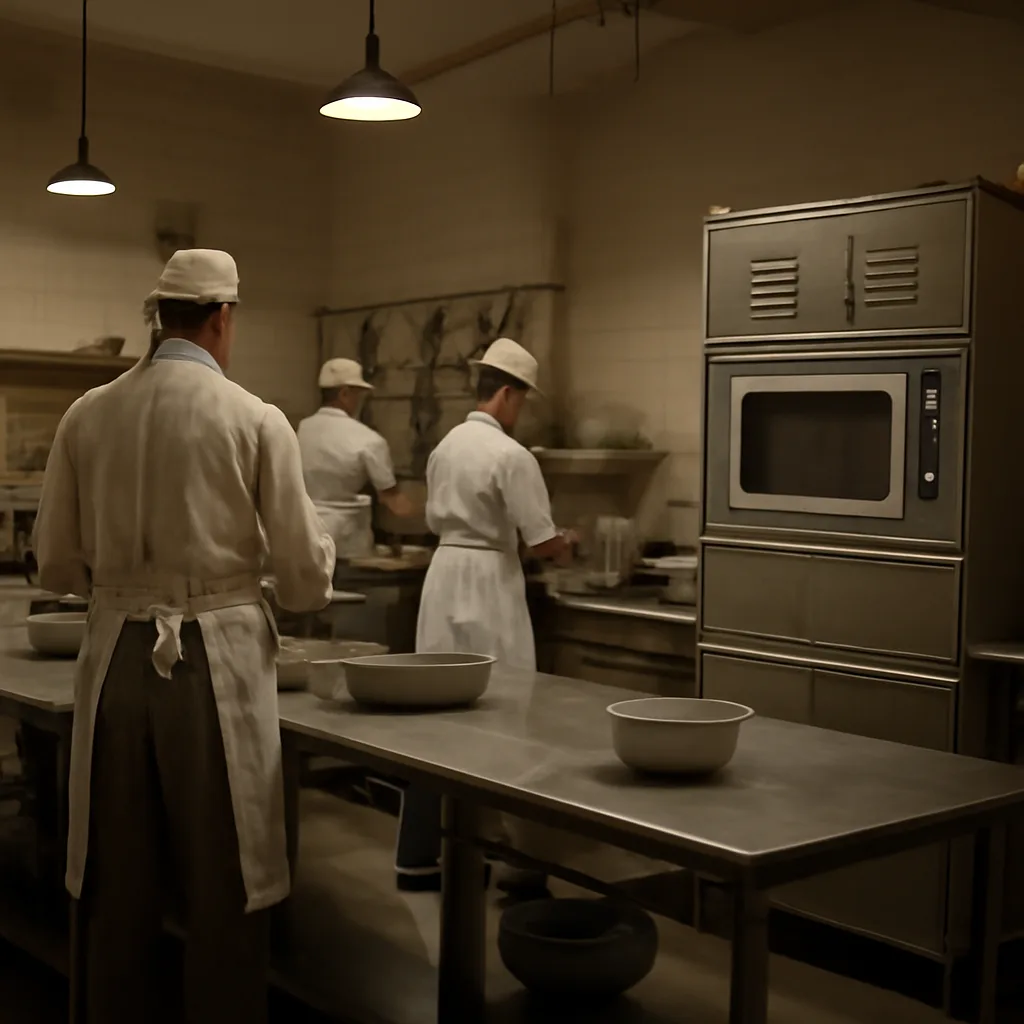
First Commercially Successful Microwave Oven Debuts
On April 2, 1947, the Raytheon-owned company Microwave Research Corporation introduced the Radarange, the first microwave oven to achieve commercial success, marking the start of a new era in food preparation for restaurants and commercial kitchens.
On April 2, 1947, the Radarange—marketed by Raytheon through its subsidiary Microwave Research Corporation—entered commercial service as the first microwave oven to gain sustained commercial success. The Radarange was a practical outgrowth of radar-technology research conducted during World War II, when engineers observed that microwaves could rapidly heat food. Raytheon’s Percy Spencer is often credited with pioneering microwave cooking in the 1940s after discovering that microwave energy could melt a chocolate bar near active radar equipment; Raytheon engineers then developed the first magnetron-powered cooking units.
The 1947 Radarange was large and costly by modern standards. Early commercial models stood roughly 5 to 6 feet tall, weighed several hundred pounds, and used water-cooled magnetrons to generate microwave energy. They were intended primarily for restaurants, ships, and institutional kitchens—not domestic households. Installation required professional servicing and significant space, and the units were priced high enough to put them out of reach for most consumers. Nevertheless, the Radarange’s ability to heat and cook food much faster than conventional ovens made it attractive to businesses that valued speed and labor savings.
Raytheon continued development in the late 1940s and 1950s, progressively reducing the size and cost of microwave ovens and addressing safety and reliability issues. Early commercial use helped refine controls, shielding, and magnetron design. Over the following decade, manufacturers introduced smaller, more affordable models aimed at restaurants and small businesses, and by the late 1950s and 1960s countertop models began to appear for home use as costs fell and consumer acceptance grew.
The debut of the Radarange in 1947 thus represents a clear technological turning point: it translated wartime microwave and magnetron expertise into a practical appliance that would eventually transform food preparation in both commercial and domestic settings. While the first units were neither compact nor cheap, their commercial success validated microwave heating as a viable method and set the stage for the rapid evolution of microwave ovens into ubiquitous kitchen appliances in subsequent decades.
Notes on sources and accuracy: accounts of the Radarange’s debut, Raytheon’s development work, and Percy Spencer’s role are well documented in corporate histories and contemporary trade publications. Specific technical details (dimensions, cooling systems, and pricing) varied across early models and over time; where exact specifications differ among sources, this summary presents the broadly agreed historical outline without asserting contested granular figures.