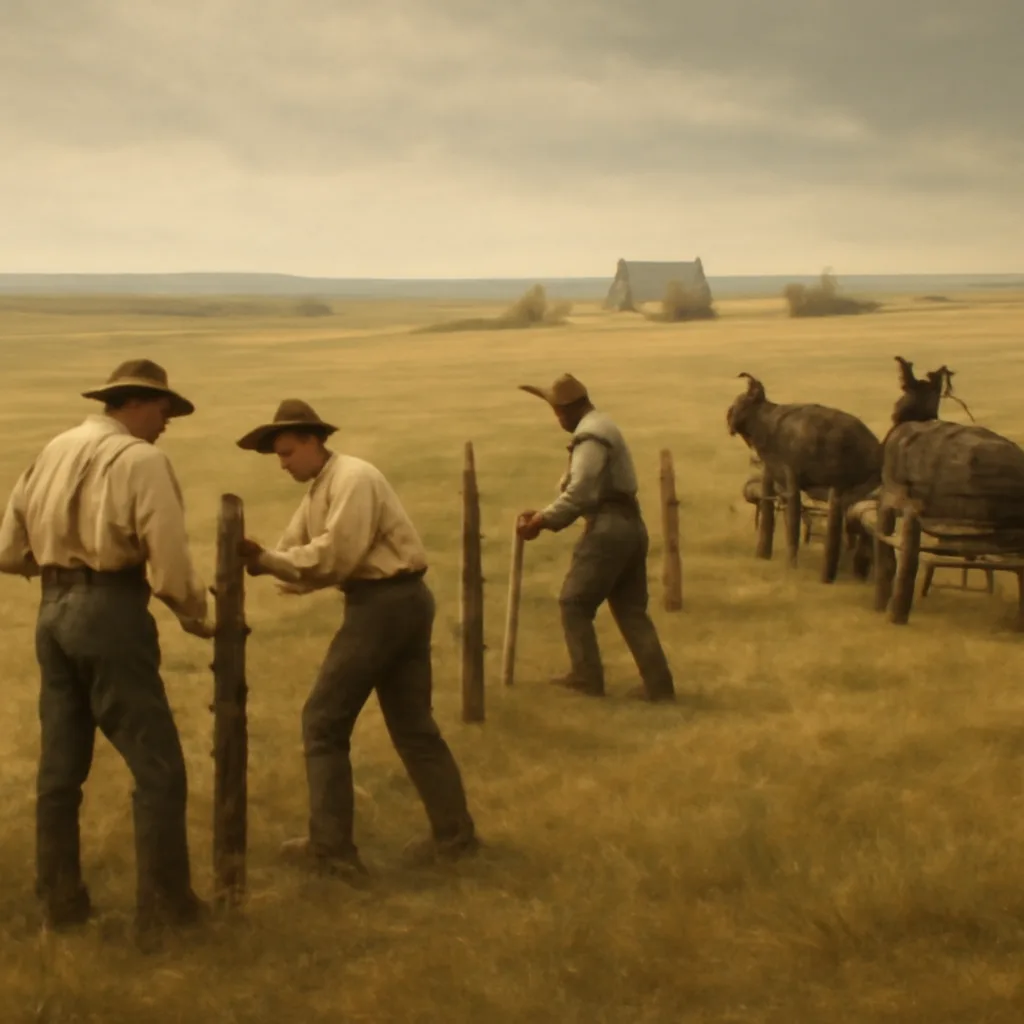
On March 24, 1874, the United States Patent Office granted the first patent for barbed wire, marking a turning point in fencing technology that would rapidly transform agriculture, land use, and settlement patterns across the American West.
On March 24, 1874, a patent was issued in the United States that is widely recognized as the first for a commercially practical form of barbed wire. The invention—designed to provide an effective, low-cost fencing solution—came at a moment when expanding settlement, livestock management, and changing land use in the American West created strong demand for new fencing methods.
Background
Before barbed wire, settlers and ranchers used post-and-rail fences, stone walls, or brush piles—methods that were labor-intensive, expensive, and often impractical on the open plains. As grazing lands were increasingly contested and as agricultural production expanded, there was a pressing need for a cheap, durable barrier that could restrain livestock and delineate property lines.
The Patent
On the date recorded here, a patent was issued that protected a specific method of producing twisted wire with barbs attached at intervals—an approach that combined readily available wire with small, sharp projections to discourage animals from pushing through. Multiple inventors and companies experimented with and patented various barb shapes and manufacturing processes in the early 1870s; the March 24, 1874, patent is notable as one of the earliest granted that led to widespread commercial adoption. (Historical accounts note several competing claims and overlapping patents in the period following 1873–1874.)
Impact and Adoption
Barbed wire’s advantages were immediate: it required less timber and labor than traditional fences, could be erected quickly on prairie land, and was affordable for many farmers and ranchers. Manufacturers rapidly industrialized production methods, and by the late 1870s and 1880s barbed wire became ubiquitous across the Plains and Great Basin regions. Its adoption accelerated enclosure of open range pasture, altered cattle ranching practices, and reduced the need for long drives to market.
Consequences and Controversy
The spread of barbed wire had significant social and environmental consequences. It facilitated private fencing of formerly open lands, fueling disputes between ranchers who supported open-range grazing and farmers or ranchers who used wire to protect crops and smaller parcels. These conflicts sometimes escalated into violent confrontations known as "range wars." Barbed wire also changed wildlife movement patterns and contributed to habitat fragmentation.
Patent disputes were common. The technology’s rapid commercialization brought competing inventors and firms into legal battles over priority and manufacturing rights. Over time, dominant designs and larger manufacturers emerged, standardizing production and distribution.
Legacy
Barbed wire is often cited by historians as a transformative technology of the American frontier era: inexpensive, utilitarian, and consequential in reshaping land tenure, agriculture, and conflict over natural resources. Although the exact sequence of early patents and competing claims is complex and sometimes disputed, the March 24, 1874, patent stands as an important milestone in the invention’s path from workshop curiosity to a fixture of rural landscapes.
Notes on sources and claims
Historical records show multiple inventors filing patents and producing barbed-wire prototypes in the early 1870s. Where claims of being "the first" are made, researchers caution that priority can hinge on the precise design, patent filing dates, or commercial manufacture. This summary reflects the widely accepted view that patents issued in 1873–1874 were pivotal in enabling the technology’s rapid spread.