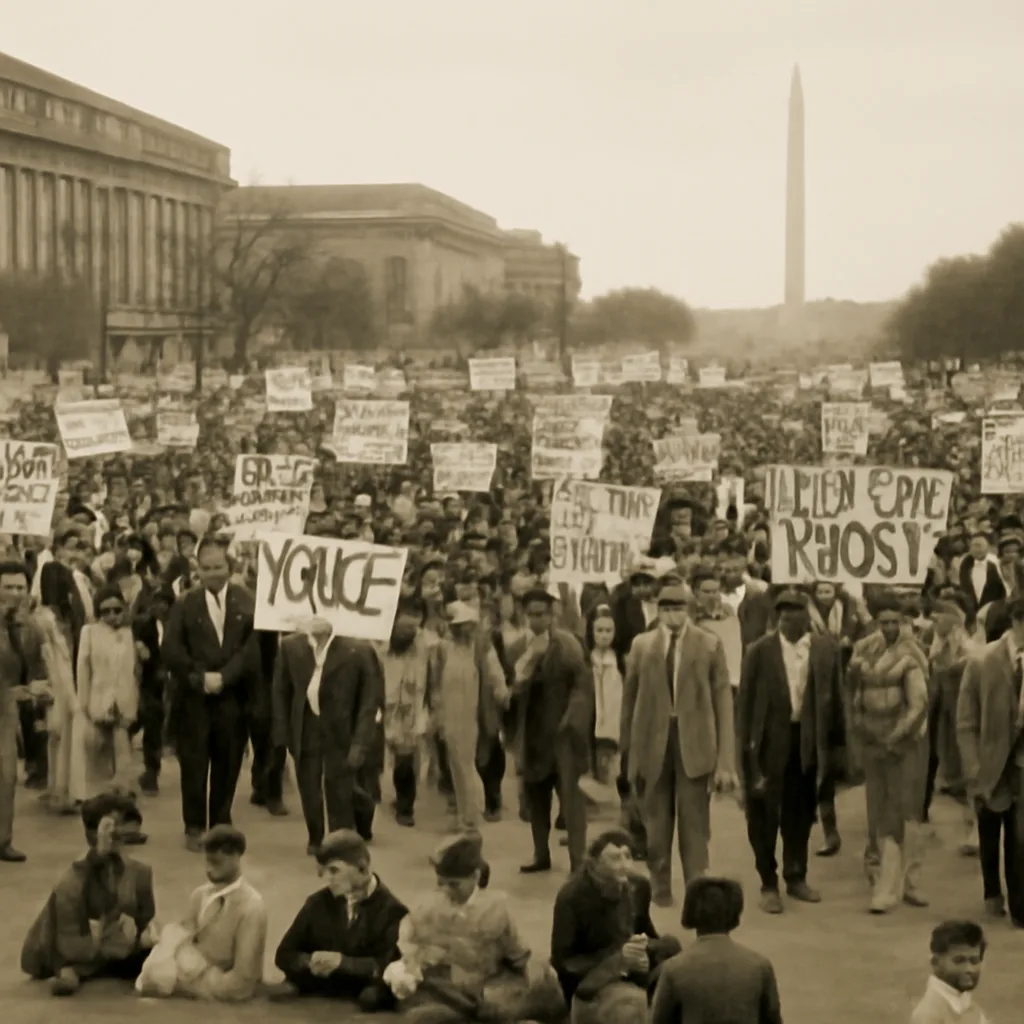
Hundreds of Thousands Rally in Washington to Protest Vietnam War
On November 15, 1969, massive anti-war demonstrations converged on Washington, D.C., as students and activists shut down parts of the capital to protest U.S. involvement in Vietnam. The day brought large marches, sit-ins, and confrontations with authorities that underscored growing national opposition to the war.
On November 15, 1969, Washington, D.C., saw one of the largest anti-war demonstrations of the Vietnam era when hundreds of thousands of protesters—students, clergy, veterans, and civil rights activists—marched on the capital to demand an end to U.S. military involvement in Vietnam. The mobilization was part of a broader wave of teach-ins, campus strikes and demonstrations that had intensified through 1968–69, following mounting American casualties and growing public unease about the war’s purpose and conduct.
Organizers included national and local groups such as Students for a Democratic Society (SDS), the National Mobilization Committee to End the War in Vietnam, and various campus antiwar coalitions; planning drew on networks built during earlier demonstrations. Participants gathered at multiple rallying points and converged on symbolic locations in the district. Marches and mass gatherings clogged major thoroughfares, disrupted traffic, and temporarily shut down government office access in parts of the city. Sit-ins, teach-ins and spontaneous encampments characterized the day for many protesters, who used nonviolent civil disobedience to press their demands.
Police and federal law enforcement established controlled perimeters and made numerous arrests for acts such as obstructing traffic, trespass, and unlawful assembly. Contemporary press accounts and later historical studies describe tense encounters in several locations; property damage was limited relative to the number of participants, though clashes between some demonstrators and law enforcement were reported. The scale of the protest, and the participation of diverse constituencies—including parents and veterans—signaled a widening base of opposition that extended beyond college campuses.
The November demonstrations came amid a contentious political backdrop: President Richard Nixon had taken office in January 1969 and pursued a policy he termed "Vietnamization"—gradually replacing U.S. troops with South Vietnamese forces—while expanding bombing campaigns in Cambodia and continuing negotiations that produced limited progress. Protesters used the Washington demonstrations to press Congress and the administration for a prompt withdrawal of U.S. forces and an end to what they called an immoral and costly conflict.
Media coverage of the day varied by outlet and political orientation, but national and international reporting emphasized both the large turnout and the political implications for U.S. policy. For lawmakers and administration officials, the demonstrations were a visible indicator of public sentiment; for activists, they were an effort to sustain pressure on decision-makers and to build a mass movement capable of forcing policy change. In the months and years that followed, antiwar demonstrations continued to be a major force in American politics, influencing public debate and contributing to shifts in policy that eventually led to negotiated U.S. withdrawal in the early 1970s.
Historians note that a single day of protest was one element within a complex mix of political, military and social pressures that produced change. While demonstrations like the November 15 event helped to shape public discourse and congressional attitudes, policy outcomes resulted from many interacting factors including battlefield developments, diplomatic negotiations, internal U.S. political dynamics, and shifts in public opinion over time.