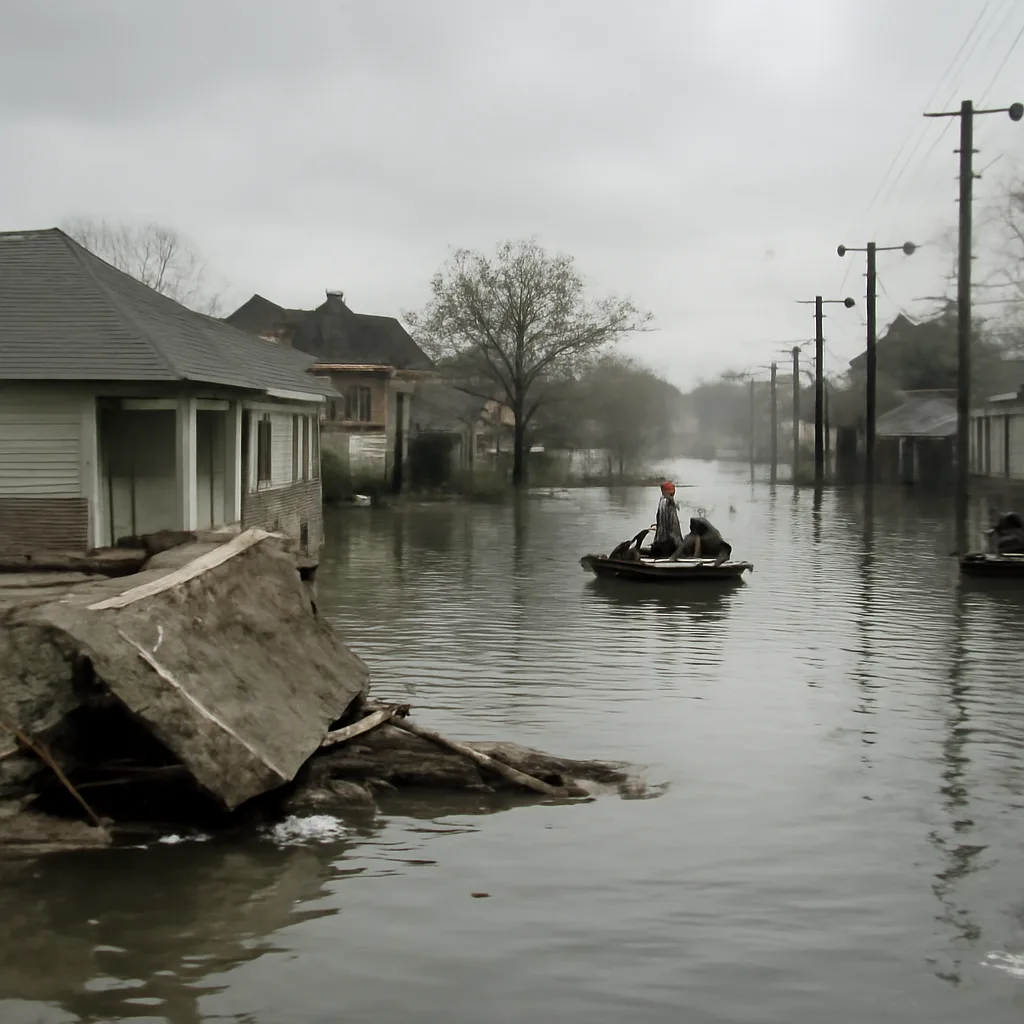
In late August 2005, Hurricane Katrina struck the Gulf Coast and, after levee breaches, flooded about 80% of New Orleans, causing widespread destruction, thousands of deaths and a prolonged humanitarian and infrastructure crisis.
On August 29, 2005, Hurricane Katrina made final landfall near the Louisiana–Mississippi border as a Category 3 storm after strengthening over the Gulf of Mexico. The storm surge and hurricane-force winds overwhelmed flood defenses around New Orleans. Multiple breaches occurred in the federal and local levee and floodwall systems along the Lake Pontchartrain and Mississippi River-Gulf Outlet, allowing floodwaters to inundate large portions of the city.
By some estimates, roughly 80 percent of New Orleans was under water at the height of the flooding; depths varied from ankle-deep in some neighborhoods to several feet in others. The flooding submerged homes, businesses and streets, destroyed critical infrastructure including hospitals and power systems, and isolated residents for days. Evacuation plans and emergency shelters were strained; many residents were unable to leave before the storm or find immediate refuge afterward. Rescue and recovery operations involved local, state and federal agencies, the U.S. military, private contractors and volunteers, but response and coordination were widely criticized as inadequate and uneven.
Human toll and displacement were severe. Exact death counts vary by source; official tallies list thousands of fatalities across the Gulf Coast region, with significant losses in New Orleans and surrounding parishes. Hundreds of thousands of residents were displaced; many who evacuated did not return for months or years, and some neighborhoods experienced long-term population decline. The storm also inflicted profound economic damage: property losses, business closures, and disruptions to oil production and shipping in the Gulf contributed to broader regional and national impacts.
The disaster prompted intense scrutiny of flood protection and urban planning. Investigations by engineering, academic and government bodies examined design, construction and maintenance of the levee and floodwall systems; subsequent reports identified multiple vulnerabilities and failures. In the years after Katrina, federal, state and local authorities undertook major investments to rebuild and strengthen flood defenses, including higher and more robust levees, surge barriers, pumping stations and revised evacuation planning.
Katrina also produced enduring political, social and cultural consequences. Debates over emergency preparedness, federal disaster response, race and poverty in America were amplified as images and accounts of the storm’s aftermath circulated nationally and internationally. Relief and rebuilding efforts involved tens of billions of dollars in federal funding, insurance payouts and private contributions; reconstruction progressed unevenly, with some neighborhoods recovering relatively quickly and others facing prolonged vacancy and slower reinvestment.
Memory of Katrina continues to shape New Orleans and national policy on disaster resilience. The storm exposed gaps in infrastructure, social safety nets and governance that have informed subsequent reforms and preparedness efforts. While investments since 2005 have reduced some vulnerabilities, experts note that climate change, sea-level rise and continuing subsidence keep flood risk and the need for adaptive planning central to the region’s future.
Note: Some specific figures—especially exact death tolls and financial totals—are reported differently across sources; this summary reflects widely documented outcomes without endorsing a single contested numerical estimate.