
← Back
09/01/1939 • 4 views

Germany Invades Poland, Triggering World War II
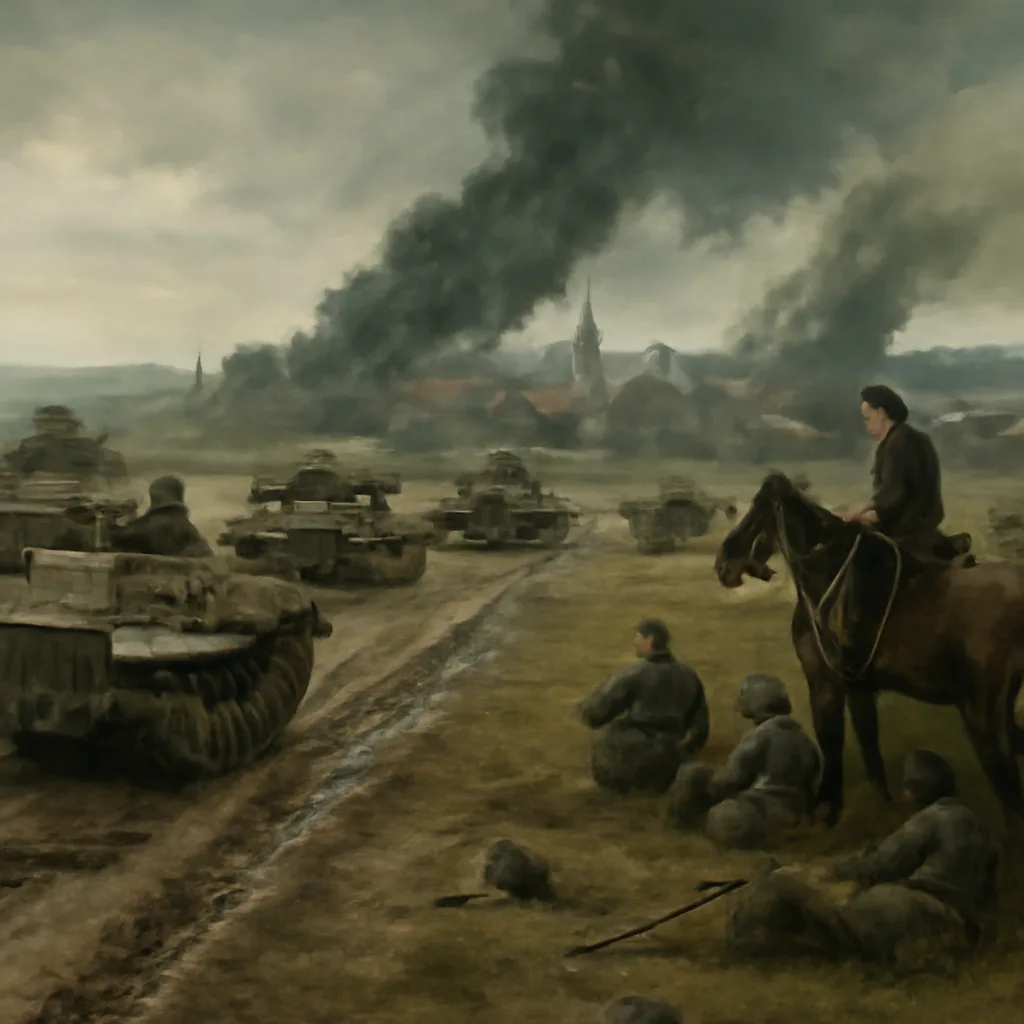
German armored columns advancing on a Polish road with smoke rising from distant bombed buildings; cavalry and infantry visible; overcast sky, 1939 Eastern European town outskirts.

On September 1, 1939, Nazi Germany launched a large-scale invasion of Poland, beginning a conflict that expanded into World War II as Britain and France declared war on Germany days later.


On September 1, 1939, Germany invaded Poland in a coordinated military offensive that marked the start of World War II in Europe. The attack combined fast-moving armored divisions (Blitzkrieg tactics), massed infantry, artillery barrages, and widespread aerial bombardment. German forces struck along a broad front from the Baltic Sea in the north to the border with Czechoslovakia in the south, employing surprise and concentrated mechanized units to overwhelm Polish positions.

The invasion followed months of escalating Nazi aggression and diplomatic maneuvering. In the weeks before the attack, Germany had concluded the Molotov–Ribbentrop Pact with the Soviet Union (signed August 23, 1939), a nonaggression treaty that included secret protocols dividing parts of Eastern Europe into German and Soviet spheres of influence. That agreement removed the prospect of immediate Soviet opposition and influenced German planning.

Poland mobilized its armed forces and sought international support, but its military was outmatched by Germany’s superior equipment, motorization, and air power. The Luftwaffe targeted Polish airfields, communication centers, and cities, while German ground forces aimed to encircle and cut off Polish units. Within days, German armies had penetrated deep into Polish territory; Warsaw was subjected to sustained bombing and siege operations.

On September 3, 1939, Britain and France—having guaranteed Poland’s borders—declared war on Germany, honoring their commitments though they offered limited direct military assistance in the immediate weeks that followed. The Western Allies’ early actions were constrained; a full-scale continental intervention did not materialize quickly, a period historians sometimes call the “Phoney War” on the Western Front.

On September 17, 1939, the Soviet Union invaded Poland from the east, citing the collapse of the Polish state and claiming to protect Ukrainians and Belarusians. The combined pressure from German and Soviet advances led to the defeat and partition of Poland. By early October 1939, organized Polish military resistance had effectively ceased; the country’s territory was divided between Germany and the Soviet Union in accordance with the secret terms laid out in the Molotov–Ribbentrop Pact. Many Polish military personnel and civilians were captured, displaced, or killed; the subsequent occupation brought repression, mass arrests, and, over time, increasingly brutal policies by both occupiers.

The invasion of Poland had immediate and long-term consequences. It transformed a regional conflict into a global war as alliances expanded and other nations were drawn in. The conduct of the campaign—use of combined arms, rapid maneuver, and total war targeting civilian infrastructure— foreshadowed the wider devastation of the coming years. The defeat and occupation of Poland also set the stage for systematic repression and, later, genocidal policies implemented by the Nazi regime.

Historians continue to study the invasion’s military, diplomatic, and social dimensions, including the roles of German and Soviet decision-making, the responses of the Western Allies, and the experiences of Polish military personnel and civilians. Some specific details—such as precise casualty figures and the full extent of clandestine agreements made before the invasion—remain subjects of research and revision as archival material and scholarship develop.

Share this

Email Share on X Facebook Reddit

Did this surprise you?