
08/02/2018 • 6 views
NASA Presents Strong Evidence of Liquid Water on Mars
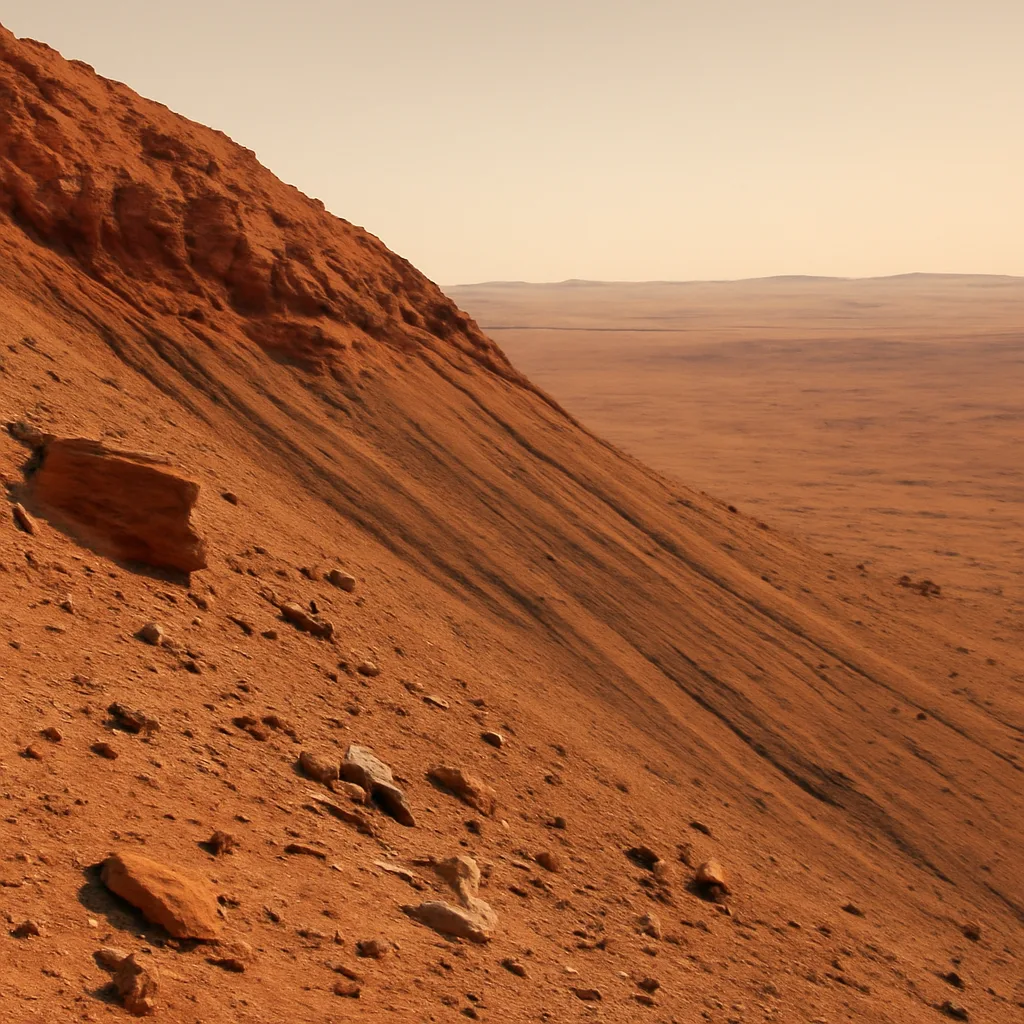
NASA announced on August 2, 2018, that data indicate the intermittent presence of liquid water on modern Mars in the form of recurring slope lineae—seasonal dark streaks—supporting the idea that briny flows occur on slopes during warm months.
Background and evidence
RSL were first described in 2011 as seasonal dark streaks that advance downslope on warm slopes over weeks and then fade in colder seasons. Their appearance and timing suggested a link to transient liquid rather than dry granular flows. The key 2018 evidence cited hydrated salts detected in spectra at multiple RSL locations. Certain salts, especially perchlorates, lower the freezing point of water and can form transient brines under Martian surface conditions. The presence of these hydrated salts at RSL sites strengthens the interpretation that liquid brines, present briefly during warm periods, are involved in producing the observed streaks.
What the data do—and do not—show
The spectral detections indicate hydrated minerals co-located with RSL, but the instruments did not directly image liquid water or capture flowing water. The inferred brines would be extremely saline and ephemeral, forming under narrow temperature and humidity conditions. Scientists emphasize that the results point to transient, localized wetting rather than stable, widespread bodies of liquid water. The scale of the flows, where they occur, and the exact physical mechanism (e.g., thin films, seepage, or wetting of grains) remain subjects of ongoing study.
Scientific and exploration implications
If RSL are indeed caused by transient brines, this has implications for our understanding of modern Martian hydrology and present-day habitability. Liquid water—even in very salty form—is a key factor in assessing whether environments could support microbial life as we know it. The presence of brines also affects planetary protection policies: sites with potential transient liquid water are subject to strict restrictions to avoid forward contamination by Earth microbes. For human exploration, briny seeps could inform in-situ resource considerations, but their small scale and chemical toxicity (perchlorates are hazardous to humans) limit immediate practical use.
Caveats and ongoing research
The interpretation of hydrated salts at RSL sites is supported by multiple lines of orbital evidence but remains debated in some respects. Alternative explanations—such as dry granular flows modified by seasonal CO2 frost or changes in surface texture and albedo—have been proposed and studied. Further observations, laboratory experiments, and higher-resolution spectroscopy are needed to refine models of RSL formation and to determine how often and under what conditions liquid brines form. Future missions with ground-based instruments, possibly including rover investigations that could access appropriate slopes, would provide stronger constraints but face engineering and planetary protection challenges.
Context in the timeline of Mars exploration
The 2018 announcement built on decades of Mars research that established a wetter ancient Mars, with abundant evidence for liquid water billions of years ago. The new findings shifted attention to where and how water might still appear today on much smaller, transient scales. They spurred renewed planning for targeted observations and careful site-selection considerations for both robotic and, eventually, human missions.
In sum, NASA’s August 2, 2018 announcement provided compelling orbital evidence that hydrated salts associated with recurring slope lineae are consistent with transient briny liquid water on modern Mars. The results advance understanding of present-day Martian processes while leaving open questions about the precise mechanisms, frequency, and habitability implications of these ephemeral wet environments.