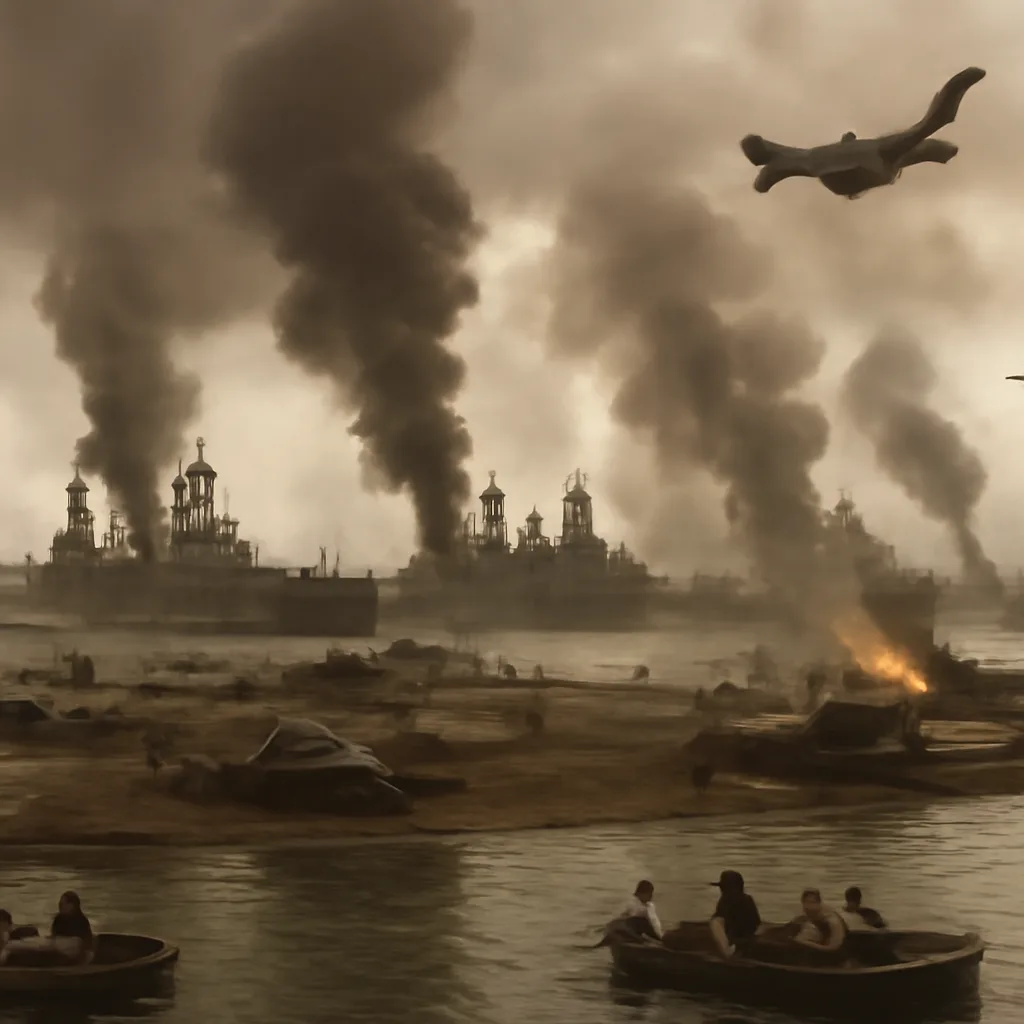
Japanese attack on Pearl Harbor brings the U.S. into World War II
On December 7, 1941, Imperial Japanese forces launched a surprise air and naval attack on the U.S. Pacific Fleet at Pearl Harbor, Hawaii, prompting the United States to declare war on Japan and enter World War II.
On the morning of December 7, 1941, Japanese carrier-based aircraft and midget submarines attacked the U.S. naval base at Pearl Harbor on the island of Oahu, Hawaii. The assault began before dawn local time and targeted battleships, cruisers, destroyers, and airfields, as well as support facilities. In approximately two hours of strike operations, U.S. losses included four battleships sunk (two later raised), several other ships damaged, about 188 U.S. aircraft destroyed or damaged, and 2,403 Americans killed with roughly 1,178 wounded. Japanese losses were light by comparison.
The attack followed months of deteriorating relations between the United States and Japan. Tokyo had been expanding its control across East and Southeast Asia, and the U.S. had responded with economic sanctions and oil embargoes aimed at curbing further Japanese aggression. Japanese leaders decided that a preemptive strike could neutralize the U.S. Pacific Fleet long enough to secure Japan’s strategic objectives in Southeast Asia and the western Pacific.
In Washington and across the United States, the attack produced immediate shock and outrage. On December 8, 1941, President Franklin D. Roosevelt addressed a joint session of Congress, calling December 7 “a date which will live in infamy” (this is a recorded historical quotation) and requesting a declaration of war. Congress obliged, and the United States formally declared war on Japan. Days later, Germany and Italy, allied with Japan as the Axis powers, declared war on the United States, bringing America fully into the global conflict.
Strategically, the attack achieved some of Japan’s short-term aims by damaging battleships and temporarily reducing U.S. naval presence in the Pacific. However, several key U.S. assets were not present at Pearl Harbor—most notably, American aircraft carriers were at sea—and important repairable ships and facilities were later returned to service. The loss of life, material damage, and the galvanizing effect on American public opinion outweighed any long-term strategic advantage for Japan. The U.S. mobilization that followed led to rapid industrial and military expansion and a sustained Allied campaign across the Pacific theater.
Historians continue to study the attack’s intelligence, diplomatic, and operational contexts. Debates have examined U.S. and Japanese decision-making, warning signs that were missed or misinterpreted, and whether the scale of the attack was foreseeable. Primary documentary evidence—military records, diplomatic communications, and survivor testimony—forms the basis for most scholarly accounts.
The attack on Pearl Harbor remains a defining moment in 20th-century history: it ended U.S. official neutrality, transformed American foreign policy and military posture, and set the stage for the Pacific War that would continue until 1945.